


















Lesson 17 of 47 · Assessment and CPR
Chapter 3 Review: Assessment and CPR
Review chapter 3: DRABC, recovery position, adult and child CPR, AED use and choking, with a cheat-sheet picture, a comparison table, drill and ten-question quiz.
This chapter held the skills with the highest stakes in all of first aid. Because they are used rarely and under pressure, they need to be rehearsed far more often than they are read. Use this page as a pocket recap, then practice aloud and, if you can, on a manikin or a cushion.
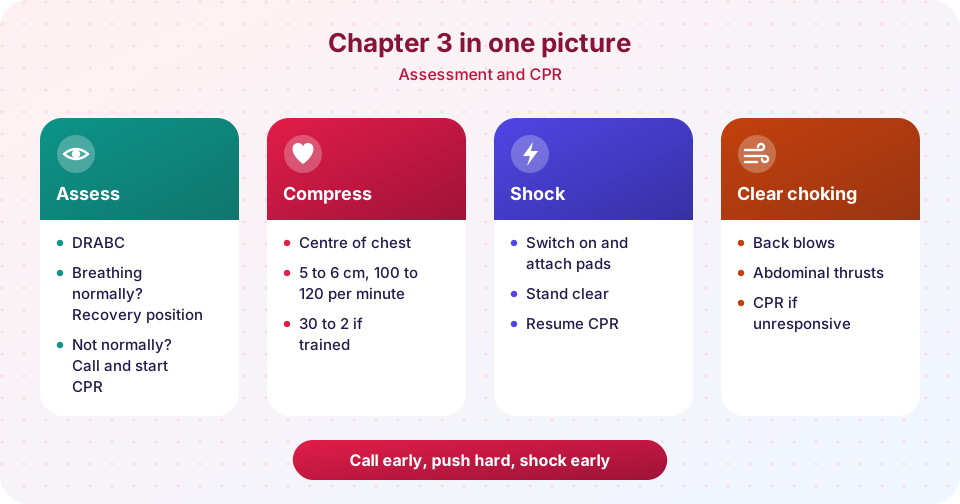
Educational information only. This course is not a substitute for a certified, hands-on first-aid or CPR course, nor for emergency services. Guidelines differ between countries; follow your local training and the dispatcher.
What you will learn
- A single-page comparison of adult, child and infant CPR.
- The decision points in the primary survey and the choking response.
- A mixed quiz that checks the whole chapter.
The sequences at a glance
| Step | What to do |
|---|---|
| Danger | Check the scene is safe for you and the person |
| Response | Shout, tap shoulders; no response: shout for help |
| Airway | Head tilt, chin lift (neutral head for infants) |
| Breathing | Look, listen, feel up to 10 seconds; gasps are not normal |
| Breathing normally | Call, recovery position, keep checking |
| Not breathing normally | Call on speaker, start CPR, send for an AED |
| AED | On, bare and dry the chest, pads, stand clear, shock if advised, resume CPR |
| Severe choking | Back blows, then thrusts; unresponsive: CPR |
CPR comparison
| Adult | Child (1 year to puberty) | Infant (under 1 year) | |
|---|---|---|---|
| Hands | Two hands, heel on lower breastbone | One or two hands | Two fingers or encircling thumbs |
| Depth | 5 to 6 cm | About one third, near 5 cm | About one third, near 4 cm |
| Rate | 100 to 120 per minute | 100 to 120 per minute | 100 to 120 per minute |
| Ratio with breaths | 30:2 | 15:2 (ERC) or 30:2 for one rescuer (AHA) | 15:2 (ERC) or 30:2 for one rescuer (AHA) |
| Initial breaths | Not required | 5 (ERC); start with compressions (AHA) | 5 (ERC); start with compressions (AHA) |
| Breath style | Mouth over mouth, nose pinched | Mouth over mouth, gentle | Mouth over mouth and nose, gentle puffs |
| AED | Adult pads | Child pads if available | Child pads if available |
Five mistakes to avoid
- Waiting too long to start. Start within seconds of recognizing the problem.
- Pushing too lightly or too slowly. Push hard to 5 to 6 cm in adults, fast at 100 to 120 per minute.
- Leaning on the chest. Allow full recoil.
- Long pauses. Keep interruptions under 10 seconds.
- Hesitating with the AED. It will only shock when it should.
Keeping the skills fresh
Studies of trained lay rescuers show that CPR skills, especially compression depth and rate, begin to fade within three to six months after a course, and knowledge fades too. A few habits slow the decay:
- Short, frequent practice. Five minutes of compressions on a cushion or a manikin every few months does more than a long course every three years.
- Feedback devices. Many modern manikins and phone apps give feedback on depth and rate; use them when you can.
- Mental rehearsal. Walk through the sequence in your head when you pass an AED or see a first-aid sign.
- Teach someone else. Explaining DRABC to a friend or a family member is one of the best ways to learn it.
Try it
A memory drill: say each answer aloud before you read it.
Press Run (or Ctrl + Enter) to see the console output here.
No output.
Check your understanding
Quick check · 10 questions
of 10 answered You scored / 10 · perfect!
-
1. What are the first two checks in DRABC?
Check for danger first, then for a response. -
2. How long do you check for breathing?
Up to 10 seconds; longer delays treatment. -
3. A person is unresponsive, breathing normally and not injured. What next?
Normal breathing plus unresponsive: recovery position and keep checking. -
4. What are the adult compression depth and rate?
Target depth 5 to 6 cm; target rate 100 to 120 per minute. -
5. What does an AED do if a person's heart is not in a shockable rhythm?
It analyses and shocks only when the rhythm is shockable. -
6. Which is correct for pad placement on an adult?
Place pads as shown on the pads and diagrams. -
7. Why does a child need breaths in CPR when possible?
Asphyxial causes are common in children. -
8. What technique is used for infant choking after back blows?
Five back blows then five chest thrusts. -
9. What should you do if the person who is choking becomes unresponsive?
Lay them down and start compressions. -
10. Why swap rescuers about every two minutes?
Fatigue reduces depth and rate; swapping keeps quality high.
Summary
- DRABC: danger, response, airway, breathing; call and act.
- Not breathing normally: call, CPR at 5 to 6 cm and 100 to 120 per minute, AED early.
- Children and infants: one-third depth, breaths matter, check your guideline's ratio.
- Choking: coughing for mild; back blows and thrusts for severe; CPR if unresponsive.
Track your progress
Create a free account to tick off lessons and pick up where you left off on any device.
of First Aid and Emergency Care lessons completed