


















Lesson 24 of 47 · Fractures and Injuries
Fractures, bones and splinting
Learn how bones break, how to recognize open and closed fractures, and how to support a broken limb with a splint or sling until medical help takes over.
A fracture is a break in a bone. Some fractures are tiny cracks that only show on an X-ray; others snap a bone clean through and push it out of line. They are common: nearly everyone breaks a bone at some point, whether as a child falling from a climbing frame or as an older adult slipping on ice. In first aid your job is not to fix the break. Your job is to recognize it, stop the injury from getting worse, keep the person comfortable and get them to proper care.
The single most useful idea in this lesson is simple: keep it still. Movement of a broken bone causes pain, can tear blood vessels and nerves, and can turn a closed fracture into an open one. A splint, a sling or even the helper's hands all do the same job of removing movement.
What you will learn
- How bones break and what an open fracture is.
- The signs that suggest a fracture, and why you do not test for them.
- How to check circulation beyond an injury before and after you support it.
- How to splint a forearm, a lower leg and a finger, and how to make a sling.
- When a broken bone is an emergency that needs a call right away.
Key terms
- Closed fracture: the bone is broken but the skin is not broken through.
- Open fracture: the bone has broken the skin, or a wound leads down to the break. Infection and bleeding are the big risks.
- Splint: anything rigid or firm that is secured along an injured part to stop it moving.
- Sling: a bandage, usually a triangle of cloth, that supports the weight of an injured arm.
- Circulation, sensation, movement (CSM): the three things you check beyond an injury: blood flow, feeling and the ability to move.
How bones break
A bone is a living tissue with a hard outer shell, a blood supply and soft marrow inside. It can bend a little, but when a force is bigger than the bone can take, it breaks. The break is described by its pattern. A transverse fracture goes straight across, a spiral fracture twists around the bone, a comminuted fracture breaks into several pieces and a stress fracture is a thin crack caused by repeated loading, as in distance runners. Children's bones are more flexible, so a greenstick fracture can happen, where the bone bends and cracks on one side like a young branch.
A first-aider does not need to name the pattern. What matters is whether the skin is broken and whether blood vessels or nerves might be hurt. Bone ends can cut vessels, and a broken thigh bone in particular can bleed a large amount inside the thigh without much outward sign. This is one reason a suspected thigh or pelvis fracture is always treated as an emergency.
Recognize a fracture
Look for these signs, and ask what happened:
- Pain at one spot that gets worse with movement or pressure.
- Swelling and bruising developing over minutes to hours.
- Deformity: an odd angle, a bump, a shortened limb, or a joint where there should not be one.
- Loss of function: the person cannot use or bear weight on the limb.
- A snap or crack heard or felt at the time of injury.
You cannot be sure from the outside. People sometimes walk on a broken bone, and a badly bruised bone can look worse than a small crack. The safe rule is that if you suspect a fracture, treat it as one. Do not press along the bone, move the limb to see if it hurts, or try to feel for grating bone ends. That only causes pain and damage.
Check beyond the injury
Before you touch the limb, and again after you have supported it, check the part beyond the injury (toward the fingers or toes):
- Color and warmth: pink and warm is good; pale, blue or cold suggests blood flow is poor.
- Feeling: ask if they can feel your touch on a fingertip or toe, and if there is numbness or pins and needles.
- Movement: ask them to wiggle the fingers or toes if this does not hurt.
- Pulse: feel the wrist pulse for an arm or the foot pulse for a leg, if you know how.
If these get worse after you apply a splint, the splint may be too tight. Loosen it. If the limb is pale, cold or blue and stays that way, call emergency services, because the blood supply may be cut off.
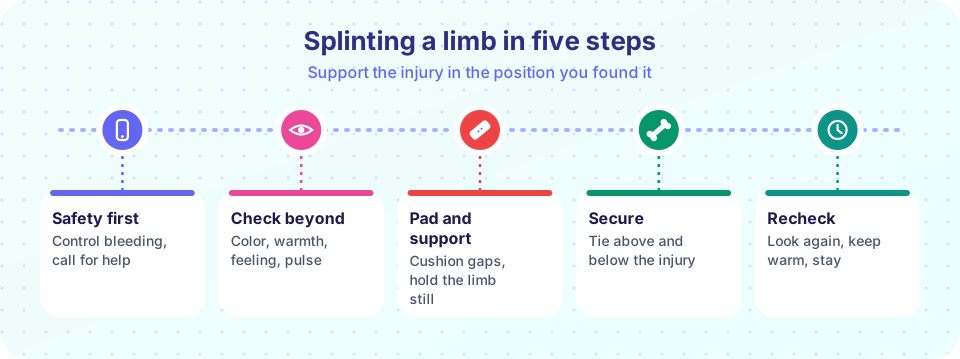
How to splint
The goals of a splint are to keep the bone ends and the joints on either side from moving, to pad bony points, and to avoid cutting off circulation.
- Keep the limb in the position found. Do not try to straighten it. If it is bent, support it bent. The only time a trained responder moves a limb is to restore circulation, and that is a decision for them.
- Support it with your hands while someone else fetches padding and splint material, or while you wait for help.
- Pad the gaps. Use soft cloth, a folded towel or clothing between the splint and the body, especially at the wrist, ankle and knee.
- Place the splint so that it extends beyond the joint above and the joint below the break. For a forearm, that means from beyond the elbow to beyond the fingers' base.
- Secure it with bandages, scarves or strips of cloth. Tie them above and below the break, never directly over it. Knots go on the splint side, not on the injury.
- Recheck circulation, sensation and movement, keep the person warm and stay with them.
Improvised splints include a rolled magazine or newspaper, a piece of cardboard, a folded jacket, a pillow or a straight piece of wood padded with cloth. A leg can be tied to the other leg with padding between them, which acts as a splint. Fingers can be taped to the neighboring finger (buddy taping).
A sling for an arm
For a forearm, wrist or collarbone injury, the person is often most comfortable holding the arm across the chest. A triangular bandage makes a sling. Slide it under the arm, bring the ends up around the neck and tie them at the side of the neck on the uninjured side, with a pad under the knot. The hand should sit slightly higher than the elbow, and the fingertips should stay visible so you can check them.
Open fractures
If bone or a wound shows, cover the area with a sterile dressing or the cleanest cloth you have. Do not push the bone back or wash deep into the wound. If there is bleeding, press gently around the wound (not on a protruding bone) and pad around it with bulky dressings. Call emergency services.
Thigh, hip, pelvis and spine
A suspected broken thigh bone, hip or pelvis calls for an emergency call. Keep the person lying still, support the injured leg in the position found, and do not make them move. Do not attempt a splint that requires lifting or rolling them unless you are trained. A suspected spine injury is handled as in the lesson on head, neck and spine injuries.
Cold, elevation and care while waiting
Wrap a cold pack or a bag of ice in a cloth and place it near the injury for up to 10 to 20 minutes to reduce pain and swelling, with a break before repeating. Do not put ice directly on the skin. Raise the limb gently if that is comfortable and does not move the fracture. Give nothing to eat or drink, because a person with a fracture may need an anesthetic. Keep them warm, because shock can follow serious injuries.
When to call emergency services
Call at once if there is an open fracture, heavy bleeding, a suspected broken thigh, hip, pelvis, neck or back, a pale or blue limb beyond the injury, signs of shock (pale, clammy, fast pulse, confusion), or several injuries. If a person has a probable arm or lower-leg fracture and is otherwise well, urgent medical care (a doctor or emergency department) is still needed, but you may arrange transport in line with local advice.
Common misconceptions
- "If they can move it, it is not broken." People can move, and even walk on, broken bones. Pain, swelling and deformity matter more than movement.
- "Straighten it so it looks normal." Forcing a bone straight can damage vessels and nerves. Support it as found.
- "Wrap the bandage as tight as possible." Swelling continues after you tie it. A tight splint cuts off blood flow, so check the fingers or toes.
Try it
First, practice the order of the splinting steps. The cards are shuffled; click them in the right order. This is a study game, not a substitute for hands-on practice.
Next, a small function that turns a circulation check into a plain-language message. It shows how the three observations combine, and it is a demonstration, not a diagnostic tool.
Press Run (or Ctrl + Enter) to see the console output here.
No output.
Check your understanding
Quick check · 5 questions
of 5 answered You scored / 5 · perfect!
-
1. What is the most important principle when you suspect a fracture?
Movement causes pain and can damage vessels and nerves. Support the limb as found and keep it still. -
2. A splint should extend:
Holding the joints on both sides stops the bone ends from moving. -
3. After you apply a splint, the fingertips turn pale and cold. What do you do?
Pale, cold fingertips suggest reduced blood flow. Loosen the splint and call emergency services. -
4. Which of these is an open fracture?
In an open fracture the skin is broken over or near the bone, which brings bleeding and infection risks. -
5. Why give nothing to eat or drink to a person with a probable fracture?
Treatment of a serious fracture may need surgery or anesthesia, and an empty stomach is safer.
Summary
- A fracture is a break in a bone; it is open if the skin is broken and closed if it is not.
- Signs: pain, swelling, bruising, deformity and loss of function. If in doubt, treat as a fracture.
- Immobilize the limb as found, with the joints above and below held still, padding the gaps.
- Check circulation, sensation and movement beyond the injury before and after.
- Call emergency services for open fractures, thigh, hip, pelvis, neck or back injuries, a pale limb or signs of shock.
Track your progress
Create a free account to tick off lessons and pick up where you left off on any device.
of First Aid and Emergency Care lessons completed