


















Lesson 36 of 47 · Environmental Emergencies
Bites, stings and poisons
Learn first aid for animal bites, snake bites, insect stings, ticks, poisoning and carbon monoxide, including what to say to a poison center and what never to do.
Most animals avoid people, and most substances in a home are safe when used correctly. But the few times they are not, the cause matters less than your first response. A dog bite needs thorough washing. A wasp sting may be nothing or may be the start of anaphylaxis. A toddler who has swallowed something from under the sink needs expert advice in minutes, not a home remedy. And an odorless gas from a faulty heater can harm everyone in a room without anyone noticing.
This lesson covers bites, stings, ticks and poisons. Many details depend on where you live: which snakes and spiders exist, which poison center to call, which medicines are carried. The principles stay the same: keep yourself safe, keep the person calm and still, deal with the immediate threat, get expert advice early, and do not use myths such as cutting a bite or making someone vomit.
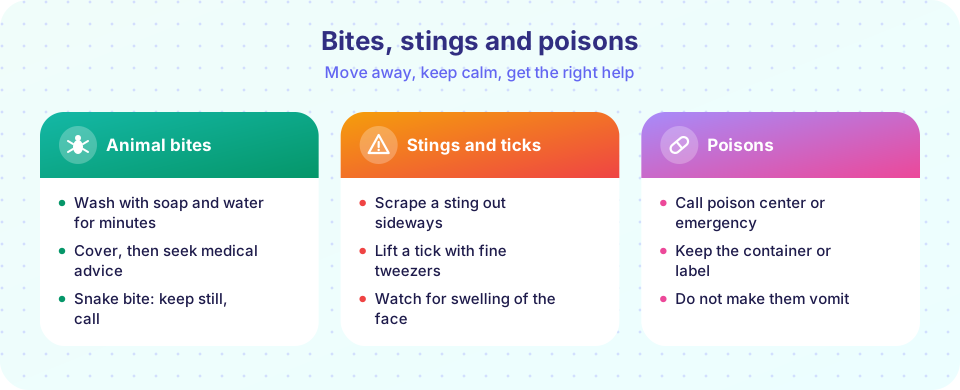
What you will learn
- How to care for an animal bite and why rabies matters in some countries.
- What to do, and not do, for a snake bite.
- How to remove a sting and a tick, and what to watch for afterward.
- How to deal with poisoning, including what to tell a poison center.
- How to recognize and respond to carbon monoxide.
Key terms
- Venom: a toxin injected by an animal through a bite or sting. A poison is a substance that harms when swallowed, breathed or touched.
- Rabies: a deadly viral disease spread by the saliva of infected mammals. It is preventable with prompt treatment after exposure.
- Antivenom: a medicine that neutralizes certain venoms, given in hospital.
- Poison center: a phone service with experts who advise on poisoning. Numbers differ by country.
- Carbon monoxide (CO): a colorless, odorless gas made when fuels burn without enough air.
Animal bites
Animal and human mouths carry bacteria, so bites can become infected, and some also carry viruses.
- Stop the bleeding with direct pressure and a clean pad. See the bleeding lessons for details.
- Wash the wound gently but thoroughly with soap and running water. Do this for several minutes. If a rabies-carrying animal could have been involved, wash for at least 15 minutes.
- Cover with a clean dressing and seek medical advice. Doctors decide about antibiotics, tetanus protection and, where needed, rabies treatment.
- Get care quickly for bites that are deep, on the face, hands or joints, from cats (their teeth make deep punctures), from humans, from wild animals or bats, in a person with a weak immune system or diabetes, or when the wound looks infected (increasing redness, swelling, pus, fever).
In countries where rabies occurs, any bite, scratch or lick on broken skin from a wild or unknown mammal, such as dogs, bats, monkeys or foxes, is an emergency. Wash well and go to a medical facility at once; rabies is almost always fatal once symptoms appear but is preventable if treatment is given in time. Do not try to catch the animal yourself.
Snake bites
Most snakes are harmless, and many bites from venomous ones are "dry" with no venom injected. But the dangerous species can cause serious harm, and you often cannot be sure which snake it was. The goal is to keep the venom from spreading and get to hospital quickly.
Do:
- Move away from the snake. Keep the person calm and still; movement and panic speed the spread of venom.
- Call emergency services.
- Remove rings and watches from the bitten limb before it swells.
- Immobilize the limb with a splint or by lying still, keeping it at about heart level.
- Note the time and, if you can see the snake safely, its color and size, or take a photo from a distance.
- In some regions, such as Australia, trained first aiders apply a firm pressure immobilization bandage along the whole limb for bites from certain venomous snakes and spiders. Other regions do not recommend it. Learn the advice for where you live.
Do not: cut the wound, suck out the venom, apply a tourniquet, apply ice, give alcohol, or try to catch or kill the snake. These make things worse.
Stings and ticks
Insect stings
For bee, wasp and hornet stings:
- Remove a visible stinger by scraping it sideways with a card or fingernail. Speed matters more than the technique; do not worry about squeezing the venom sac.
- Wash the area and apply a cold pack wrapped in cloth to reduce pain and swelling.
- Watch for allergic reaction for at least half an hour. Call emergency services and use an adrenaline auto-injector if there is a swollen tongue or face, trouble breathing, widespread hives or faintness (see the lesson on anaphylaxis).
- Call emergency services for stings inside the mouth or throat (swelling can block the airway), multiple stings in a child or person with a known allergy.
Other stings, such as jellyfish, spiders and scorpions, depend on the region and the species. Follow local first-aid advice and seek medical help for severe pain, spreading symptoms or children.
Ticks
Ticks are small arachnids that attach to the skin and feed on blood. They can pass on bacteria such as those that cause Lyme disease, and other infections, depending on the region.
- Remove it promptly using fine-tipped tweezers or a tick-removal tool. Grasp the tick as close to the skin as you can and pull straight up with steady pressure. Do not twist, crush or squeeze the body, and do not use petroleum jelly, a lit match or alcohol.
- Clean the bite and your hands with soap and water.
- Note the date and place. Watch the area for several weeks. See a doctor if a spreading red rash appears (a ring-like rash is typical of Lyme disease), or if you get fever, tiredness, muscle or joint pain or headache.
Poisoning
A poison is any substance that can harm the body in the dose or form encountered. Poisoning happens by swallowing (medicines, cleaning products, plants, berries, mushrooms, button batteries), breathing (fumes, carbon monoxide), contact with the skin or eyes, and injection. Young children, who explore with their mouths, and older adults who can mix up medicines are the most common victims.
First aid for poisoning
- Make the scene safe. If the cause is gas or fumes, do not enter unless you can do so safely. Get the person to fresh air if you can and open windows.
- Check responsiveness and breathing. If the person is unresponsive and not breathing normally, start CPR. If they are unresponsive but breathing, use the recovery position.
- Call the poison center or emergency services right away, even if the person seems well. Many poisons act late. Have the container, packaging, plant or tablets at hand.
- Tell them: the person's age and approximate weight, what the substance was (the name on the label), how much and when, how it entered the body and what symptoms there are.
- Follow their instructions exactly. Keep the person calm, awake if possible and watched.
- Take the container or a sample with you to the hospital.
Do not make the person vomit. Methods such as finger down the throat, salt water or syrup of ipecac do not help and can cause harm, particularly with corrosive or petroleum products. Do not give milk, charcoal or antidotes unless the poison center tells you to.
Poison center numbers differ by country, for example 1-800-222-1222 in the United States and 13 11 26 in Australia. In the United Kingdom, NHS 111 gives advice and 999 is for emergencies. Find the number for where you live and save it in your phone.
Special cases
- Button batteries and magnets: if a child may have swallowed a button battery or more than one magnet, go to an emergency department at once, even if the child seems fine. A lodged battery can burn the food pipe within hours.
- Medicine overdose, including alcohol and drugs: call emergency services, use the recovery position if unresponsive and tell them what the person took. If the person has an opioid overdose and naloxone is available and you are trained, use it as taught.
- Plants and mushrooms: do not wait for symptoms. Call the poison center with a sample or a photo.
Carbon monoxide
Carbon monoxide (CO) is produced by fuel-burning appliances such as gas heaters, boilers, stoves, generators and car engines in enclosed spaces. You cannot see or smell it. It attaches to hemoglobin in the blood in place of oxygen, so the brain and heart are starved.
Signs: headache, dizziness, nausea, weakness, confusion, shortness of breath, chest pain and collapse. Several people in the same place falling ill at the same time, or symptoms that ease when leaving the building, are important clues. Pets can be affected first.
First aid:
- Get everyone out into fresh air if it is safe for you to do so, and do not go back in. Open doors and windows only if you can do so without delay.
- Call emergency services. Do not drive affected people yourself if they are drowsy.
- Check breathing and start CPR if needed.
- Do not re-enter until the fire service or the gas company has checked the building.
Prevention: install CO alarms near sleeping areas and on every floor, have fuel-burning appliances serviced, never use a barbecue or generator indoors and never run a car in a closed garage.
Common misconceptions
- "Cut the bite and suck out the venom." This is dangerous and does not work.
- "Make them vomit to get the poison out." Vomiting can cause more harm, and it is not advised.
- "If the child seems fine, it was nothing." Some poisons and button batteries cause harm hours later.
- "Burn a tick off or cover it in oil." Remove it with fine tweezers.
- "All spiders and snakes are deadly." Few are, but treat the bite as potentially serious until you know.
Try it
First, a decision helper for common bites and stings. Pick what happened and read the first-aid steps. It is a study demonstration with general advice; local species and rules differ.
Now a small tool that writes the message you would give to a poison center or dispatcher. Preparing the facts in advance is the helpful part: age, weight, substance, amount, time and symptoms.
Press Run (or Ctrl + Enter) to see the console output here.
No output.
Check your understanding
Quick check · 6 questions
of 6 answered You scored / 6 · perfect!
-
1. How should you remove a tick?
Fine tweezers, as close to the skin as possible, steady pull. No twisting, squeezing or home remedies. -
2. Which of these should you never do for a snake bite?
Cutting and sucking cause damage and do not remove venom. -
3. A toddler swallowed part of a cleaning product. What is the best next step?
Do not induce vomiting. Get expert advice and keep the label. -
4. A person has a headache and dizziness, and several others in the room feel the same. A gas heater is running. What is the likely cause?
Several people ill together near a fuel-burning appliance suggests carbon monoxide. Get everyone to fresh air and call. -
5. A bee stings a person on the tongue. What is the priority?
Stings in the mouth or throat can swell and block breathing. -
6. Why should a child who might have swallowed a button battery go to the emergency department even if well?
A lodged battery can cause serious burns quickly, even without symptoms.
Summary
- Animal bites: pressure, wash thoroughly, cover and get advice; urgent for deep, facial, hand, cat, wild-animal and possible rabies exposures.
- Snake bite: calm, still, call, remove rings, immobilize; no cutting, sucking, ice or tourniquets; follow local pressure-bandage advice.
- Stings: scrape out a stinger and watch for allergy; ticks: fine tweezers, straight up, watch for rash and fever.
- Poisoning: safety, breathing, call the poison center, keep the container, no forced vomiting.
- Carbon monoxide is silent: fresh air, call and install alarms.
Next: Chapter 7 review
Track your progress
Create a free account to tick off lessons and pick up where you left off on any device.
of First Aid and Emergency Care lessons completed