


















Lesson 25 of 47 · Fractures and Injuries
Sprains, strains and dislocations
Tell sprains, strains and dislocations apart, learn the modern PEACE and LOVE approach for the first days, and know why you never force a joint back.
Not every painful limb is a broken one. Soft-tissue injuries such as sprains and strains are the most common sports and everyday injuries in the world: a twisted ankle on an uneven pavement, a pulled hamstring during a sprint, a wrist hurt in a fall. They hurt, they swell, and most heal well with sensible care. A dislocation looks more dramatic and is more urgent, because a joint that has been forced out of place can damage nerves and blood vessels next to it.
First aiders are not expected to diagnose. A sprain, a strain, a fracture and a dislocation can look alike in the first minutes, and the same injury can involve more than one of them. This lesson gives you a way to think about the structures, to recognize the common patterns, to give sensible first aid and to know when someone needs to be seen by a clinician.
What you will learn
- The difference between ligaments, tendons, muscles and joints, and which are hurt in a sprain, a strain and a dislocation.
- The signs of each injury and when to suspect a fracture instead.
- The current approach to the first days after a soft-tissue injury (PEACE and LOVE) and what the evidence says about ice.
- Why you never try to put a dislocated joint back, and how to support it instead.
- When to get medical care.
Key terms
- Ligament: a tough band that connects one bone to another and keeps a joint stable.
- Tendon: a cord that connects muscle to bone.
- Joint: the place where two bones meet, held by ligaments and a capsule and moved by muscles.
- Reduction: the medical procedure of putting a dislocated joint back in place. It is done by trained clinicians, often with pain relief.
- Instability: a joint that gives way or feels loose after an injury.
The structures
Your skeleton works because the pieces are held together and moved by soft tissue. Ligaments hold bone to bone and stop joints bending the wrong way. Muscles contract to produce movement, and tendons pass the pull on to the bone. The ends of the bones in a joint are covered with smooth cartilage, and the whole joint is wrapped in a capsule. An injury can affect any of these structures.
Sprains
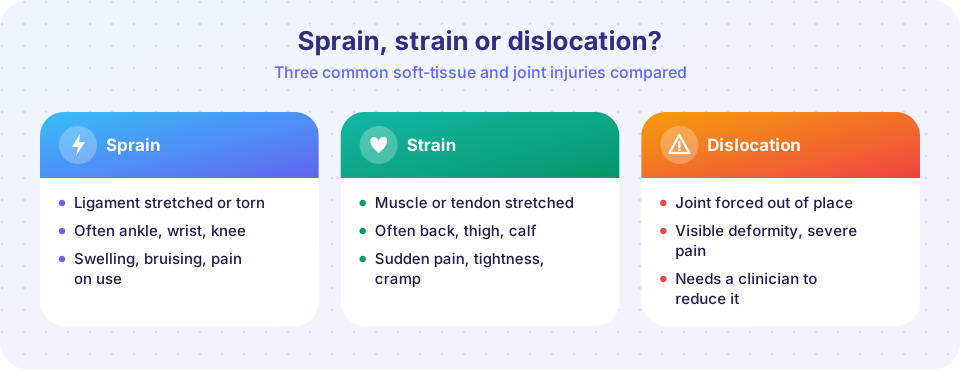
A sprain is an injury to a ligament. It happens when a joint is pushed beyond its normal range, for example when the ankle rolls inward as you step off a curb. Doctors often grade sprains. In a mild (grade 1) sprain the ligament is stretched, with some pain and swelling. In a moderate (grade 2) sprain it is partly torn, with more swelling, bruising and some looseness. In a severe (grade 3) sprain it is completely torn, the joint may be unstable and the pain can be intense, though sometimes less than in a grade 2 injury. The ankle, knee, wrist and thumb are the common sites.
Strains
A strain is a stretch or tear of a muscle or of its tendon, often called a pulled muscle. It often happens during a sudden burst such as sprinting or lifting, when the muscle is loaded while lengthening. The person feels a sudden pain, may hear or feel a pop, and often has tightness, cramp-like spasm, swelling and sometimes a bruise that appears a day later. The thigh muscles, calf and lower back are the common sites.
Dislocations
A dislocation is a joint whose bones have been forced out of their normal position. The shoulder is the most commonly dislocated large joint. Fingers, the kneecap, the elbow and the jaw are also common. Signs include severe pain, an obvious deformity (a squared-off shoulder, a finger bent sideways), swelling, inability to move the joint and sometimes numbness or tingling beyond it. A dislocation often tears ligaments and the capsule, and it may come with a fracture.
Is it broken? How a clinician thinks
A first aider cannot tell a bad sprain from a fracture by looking. Clinicians use structured rules to decide who needs an X-ray. For the ankle, for example, the widely used Ottawa ankle rules ask whether the person can take four steps and whether there is tenderness over particular bony points. You do not need to apply such rules, but their logic is useful: inability to bear weight, tenderness right over a bone, obvious deformity or numbness all raise the chance of a fracture. If you see any of these, immobilize the injury as a fracture and arrange care.
First aid for sprains and strains
For decades the standard advice was RICE: rest, ice, compression, elevation. The idea was to limit swelling. More recent thinking is more cautious. In 2019 two sports-medicine researchers, Blaise Dubois and Jean-Francois Esculier, proposed a two-part approach called PEACE and LOVE in the British Journal of Sports Medicine. It is helpful to know because it reflects current practice among many clinicians.
- Immediately (PEACE): Protect the injured part by limiting movement for a day or two; Elevate it above the heart if you can; Avoid anti-inflammatory medicines, because inflammation is part of normal healing and the evidence on these drugs in this setting is not clear; Compress with a bandage or tape to limit swelling; Educate the person so that they do not over-treat with scans or rest that is too long.
- Later (LOVE): Load the tissue gradually, Optimism (a positive attitude helps recovery), Vascularization (pain-free cardio exercise to raise blood flow) and Exercise to rebuild mobility and strength.
What about ice? A cold pack numbs pain, and many people find it comforting. The evidence that ice speeds healing or reduces long-term problems is limited, and the PEACE and LOVE authors do not recommend it as a healing treatment. If you use it for comfort, wrap it in a cloth, keep it on for 10 to 20 minutes at a time and never put it directly on the skin.
A compression bandage should be snug, not tight. Check the toes or fingers: they should stay pink and warm. Remove it if there is throbbing, numbness or color change.
First aid for dislocations
- Do not try to put it back. Pulling or pushing can damage nerves, arteries and the joint surface, and there may also be a fracture. Reduction needs trained hands, and often X-rays first.
- Support the joint in the position found. For a shoulder, let the person hold the arm in the most comfortable position, perhaps with a sling and a pad between the arm and the body.
- Check beyond the joint: color, warmth, feeling and movement of the fingers or toes.
- Cold pack for comfort, then get urgent care. Call emergency services if the limb is pale, cold, numb or if there is severe pain that does not settle. A dislocated finger can be buddy-taped for the trip to the clinic.
- The person should not eat or drink in case an anesthetic is needed.
Films in which a hero pops a shoulder back in place against a wall are dramatic and unwise. Repeated forceful attempts can make later dislocations more likely.
When to see a clinician
See a doctor or an urgent care center if any of the following apply: deformity, inability to bear weight or use the limb, numbness, a joint that feels unstable, severe pain, or no improvement after a few days. For a back strain, seek care urgently for numbness in the groin or legs, new weakness, loss of bladder or bowel control, or pain after a high-force injury.
Common misconceptions
- "A sprain is less serious than a break." A severe sprain can be a bigger problem than a small fracture, and the two can occur together.
- "Walking on it proves it is not broken." People walk on fractures. Look at tenderness, swelling and how the injury happened.
- "Pop it back in right away." A first aider should not try to reduce a dislocation. The risk of harm is real.
- "Total rest is always best." After the first day or two, gradual movement and loading help recovery.
Try it
Sort the descriptions into the right injury. This is a study tool with typical patterns; real injuries are messier.
Now explore PEACE and LOVE. Click a letter to see what it stands for and the idea behind it.
Check your understanding
Quick check · 5 questions
of 5 answered You scored / 5 · perfect!
-
1. Which tissue is injured in a sprain?
A sprain is an injury to a ligament. A strain involves a muscle or a tendon. -
2. A person has a squared-off shoulder, cannot move the arm and is in severe pain. What is the best first-aid action?
Do not try to reduce a dislocation. Support the joint, check beyond it and get urgent care. -
3. What does the evidence say about ice for sprains?
Ice numbs pain, but evidence that it speeds healing is limited. If used, wrap it in cloth for 10 to 20 minutes. -
4. Which finding makes a fracture more likely than a simple sprain?
Bone tenderness and inability to bear weight are classic reasons for an X-ray. -
5. What does the A in PEACE stand for?
In PEACE, A stands for avoid anti-inflammatories, because inflammation is part of normal healing.
Summary
- A sprain hurts a ligament, a strain hurts a muscle or tendon, and a dislocation forces a joint out of place.
- A first aider cannot rule out a fracture: tenderness over bone, deformity and inability to bear weight mean treat as a fracture.
- For soft-tissue injuries, protect, elevate and compress at first, then reload gradually (PEACE and LOVE). Ice is for comfort only.
- Never try to put a dislocated joint back. Support it, check beyond it and get urgent care.
- Get a clinician to see deformity, numbness, instability, severe pain or no improvement after a few days.
Track your progress
Create a free account to tick off lessons and pick up where you left off on any device.
of First Aid and Emergency Care lessons completed