


















Lesson 15 of 47 · Assessment and CPR
CPR for Children and Infants
Learn how CPR changes for children and infants: why breaths matter more, hand technique, one-third chest depth, 15:2 and 30:2 ratios, and when to call.
Cardiac arrest in children is much rarer than in adults, and it is usually different in cause. Adults most often collapse because of a heart rhythm problem; infants and children more often stop breathing first, because of choking, drowning, serious infections, severe injury or other breathing problems, and the heart stops later because it lacks oxygen. This difference is the reason the child sequence puts rescue breaths at the start, and why the techniques are scaled to a smaller body. The principle is still the same: get oxygenated blood moving with compressions and breaths, and call for help.
Educational information only. This lesson is not a substitute for a certified paediatric first-aid course with a manikin, and it is not medical advice. Guidelines differ between organizations and are updated regularly; follow your local training and the dispatcher. If a child or infant is not breathing normally, call your local emergency number.
What you will learn
- How to define "infant" and "child" for CPR, and why the sequence is different.
- Hand and finger techniques for children and infants, and the one-third chest depth rule.
- How to give rescue breaths to a small person.
- Where major guidelines differ, and what to do in that situation.
- The order of actions for a lone rescuer.
Key terms
Infant: a baby under one year old (not counting newborns in the first hours, who have a separate resuscitation process in hospital).
Child: from age one to puberty (signs of puberty, such as chest hair or breast development, are a practical cue).
Asphyxial arrest: cardiac arrest that follows a lack of oxygen, as in drowning or choking.
Encircling technique: placing both thumbs side by side on the infant's breastbone while the fingers wrap around the chest.
One-third depth: pushing down about one third of the front-to-back depth of the chest.
Why breaths matter more
In a child whose breathing has failed, the blood still carries some oxygen for a short time, but it falls quickly. Compressions alone circulate that oxygen but cannot replace it. Research on children's cardiac arrest, especially from large registries, shows that compression-only CPR works less well than CPR with breaths in children, and that the difference is bigger than in adults. For this reason all major guidelines recommend breaths for children and infants if you are trained and able. If you cannot or will not give breaths, do compressions: some CPR is far better than none.
The sequence for children and infants
Use the DRABC approach. After checking danger and response, and opening the airway, look, listen and feel for breathing for up to 10 seconds. Open the airway gently: the head is tilted slightly for a child, and kept neutral for an infant. If the child or infant is not breathing normally:
- Shout for help. If someone else is there, ask them to call emergency services and fetch an AED. If you are alone, follow your local rule on whether to call first or give about one to two minutes of CPR first. Several guidelines suggest that, if you are alone with a child and have no way of calling hands-free, you should do about one minute of CPR first and then call. If you have a phone with a speaker, call at once and put it down beside you.
- Give rescue breaths. The European Resuscitation Council teaches five initial rescue breaths, each about one second, because of the likely breathing cause. The American Heart Association starts with compressions, in a 30:2 sequence for a single rescuer.
- Compress the chest. Push down about one third of the depth of the chest, at 100 to 120 compressions per minute, allowing full recoil.
- Continue with the ratio you were taught: the ERC uses 15 compressions to 2 breaths for children and infants (for all lay rescuers), while the AHA uses 30:2 for one rescuer and 15:2 for two health-care rescuers.
- Use an AED when it arrives. Switch it on and follow the prompts, with child pads if available.
The differences between the major guidelines are modest, and the evidence does not show that one clearly beats the other. What matters most is that you start, push hard and fast, give breaths if you can, and follow the dispatcher.
Techniques by age
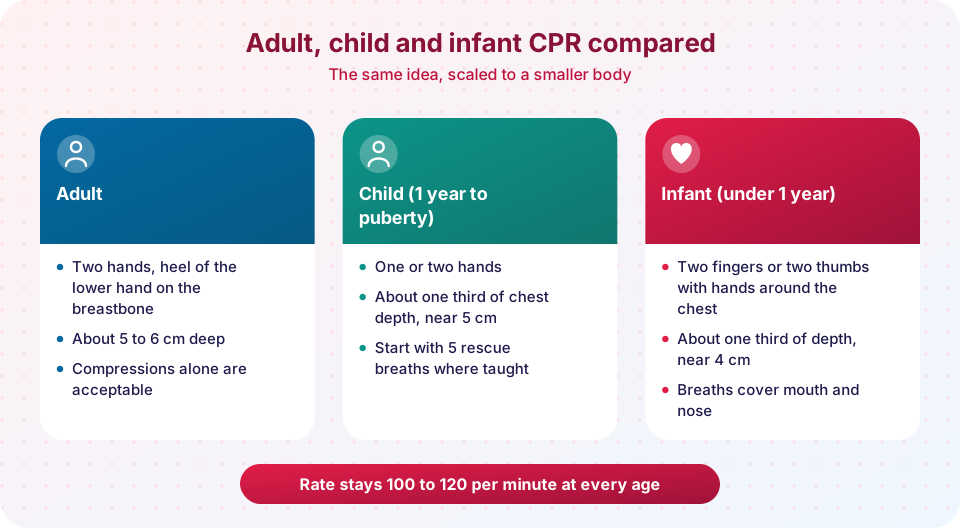
Child (1 year to puberty). Place the heel of one hand, or two hands for a larger child, on the lower half of the breastbone. Compress about 5 cm, or one third of the chest depth. Keep your arm straight if you are using one hand, and lift the fingers off the ribs.
Infant (under 1 year). Lay the baby on a firm flat surface, or hold them along your forearm with the head lower. The most common methods are:
- Two fingers (index and middle) placed on the lower half of the breastbone, just below an imaginary line between the nipples. This is usually taught for a lone rescuer.
- Encircling thumbs with your hands wrapped around the chest, thumbs side by side on the breastbone. This often gives better depth and is used by two rescuers. If the baby is small, overlap the thumbs.
Compress about 4 cm (one third of depth) and allow full recoil.
Rescue breaths for small people
For a child, use the same method as for an adult, tilt the head slightly, pinch the nose, seal your mouth over theirs and blow for about one second. Each breath should be enough to make the chest rise visibly: for a small person this is less than an adult's full breath. Blowing too hard or too fast can fill the stomach or cause harm to the lungs.
For an infant, cover both the mouth and nose with your mouth, and give gentle puffs, about one second each, using only the air in your cheeks if that is enough to see the chest rise. Keep the head in neutral position so the airway stays open.
If the chest does not rise, re-open the airway, check the mouth and try again; after two attempts go back to compressions.
Press Run (or Ctrl + Enter) to see the console output here.
No output.
Special situations
- Choking or drowning. Breaths are especially important. Give the five initial rescue breaths and start CPR; for choking, see the next lesson.
- Newly born baby. Delivery-room resuscitation is a specialized process; if you are with a newly born baby who is not breathing, call for help and follow the dispatcher.
- Suspected injury. Open the airway using the least movement necessary. If a child has been in a road collision and is not breathing, breathing and circulation come first.
- Do not shake a baby, even to check response. Instead, flick the soles of the feet, speak and gently tap the shoulders.
Practice and training
Paediatric CPR is a skill that fades quickly. Many courses use infant manikins that give feedback on depth and rate, and the muscle memory is far easier to build with real practice. If you care for children, take a paediatric first-aid course and renew it regularly.
Try it
The next plot compares typical target depths. It shows the recommended ranges as simple bars and is not medical data.
Press Run (or Ctrl + Enter) to see the result here.
Program input · what you'd type while the program runs
Type the answers before you press Run, one per line. Each time the program reads a line (with input()), it gets the next line from this box.
Next, a small helper shows how the two main guideline families compare. It prints the sequence for each, so you can see where they differ. It is a learning aid; always follow your own course.
Press Run (or Ctrl + Enter) to see the console output here.
No output.
Common misconceptions
"A child's chest is too delicate for compressions." Cardiac arrest in a child is fatal without circulation. Compress one third of the chest depth and trust the technique.
"Do the same as for an adult." Mostly the same idea, but breaths, hand technique and depth are different.
"If I am alone, I must leave the baby to call." Use a speaker phone if you can; otherwise follow your course's rule about doing a minute or two of CPR before calling.
Check your understanding
Quick check · 5 questions
of 5 answered You scored / 5 · perfect!
-
1. Why are rescue breaths especially important for children?
Asphyxial causes are more common in children, so oxygen must be supplied. -
2. What is the target compression depth for a child and an infant?
About 5 cm for a child and 4 cm for an infant, that is, one third of chest depth. -
3. Which technique is typically used for an infant?
Two fingers for a lone rescuer or encircling thumbs, depending on training. -
4. How do you give a rescue breath to an infant?
The infant's face is small, so you cover mouth and nose, and each puff is gentle. -
5. What do guidelines generally say if you cannot or will not give breaths to a child?
Compression-only CPR is better than no CPR.
Summary
- Children and infants usually stop breathing first, so rescue breaths matter; if you cannot give them, compress.
- Compress one third of chest depth at 100 to 120 per minute: one or two hands for a child, two fingers or encircling thumbs for an infant.
- Guidelines differ on initial breaths and ratios (15:2 versus 30:2); follow your training and the dispatcher.
- Use an AED with child pads if available; adult pads are better than no shock.
Next: Choking
Track your progress
Create a free account to tick off lessons and pick up where you left off on any device.
of First Aid and Emergency Care lessons completed