


















Lesson 41 of 47 · Preparedness and Special Situations
Disasters, triage and psychological first aid
Learn how first aid works when many people are hurt: staying safe, simple triage, earthquakes and floods, and psychological first aid and mental health support: look, listen, link.
Ordinary first aid assumes one casualty, a clear head and an ambulance on the way. A disaster breaks all three assumptions. An earthquake, a flood, a building collapse or a transport crash can injure many people at once, cut roads and phone lines, and leave ordinary people as the only help for hours. In these situations the right question is not "how do I give the best possible care to this person?" but "how do I do the most good for the most people with what I have?"
Disasters also hurt minds. Fear, shock and grief are normal reactions to abnormal events, and the way people are treated in the first hours can shape how they cope later. This lesson covers staying safe, how to sort casualties (triage), what to do in two common disasters, and psychological first aid: the practical, humane support that anyone can give. It ends with how to help a person in a mental health crisis in everyday life.
What you will learn
- The priorities for a first aider in a disaster, and why you must stay safe.
- How simple triage (START) sorts casualties into four groups.
- What to do in an earthquake and a flood.
- How to give psychological first aid using look, listen and link.
- How to respond to a panic attack or a person who may be thinking of suicide.
Key terms
- Mass-casualty incident: an event in which the number of casualties overwhelms the local resources.
- START triage: "Simple Triage and Rapid Treatment", a quick system for sorting casualties by checking walking, breathing, circulation and mental status.
- Tourniquet: a band placed high on a limb to stop life-threatening bleeding when direct pressure fails.
- Psychological first aid: humane, supportive help for people in distress after a crisis.
- Crisis line: a phone or text service staffed by trained people who support someone in distress.
First aid in a disaster
Priorities
- Your safety first. Look for fire, unstable structures, flood, gas and live wires. If it is unsafe, do not enter.
- Call for help if you can. Emergency lines may be overloaded; try texts, or ask someone to go to the nearest emergency post.
- Stop life-threatening problems quickly: breathing, severe bleeding. In severe bleeding from a limb, press hard on the wound with a thick pad. If that does not control it and you are trained, apply a tourniquet high on the limb, tight enough to stop the bleeding, and note the time.
- Sort and share the work. Ask uninjured people to help: to call, to bring supplies, to comfort others.
- Keep people warm and sheltered and keep records of who was helped and what was done, to hand over.
Triage with START
Triage means "sorting". It is used when you cannot treat everyone at once. START was developed in California in the early 1980s and is widely used in emergency services. A first aider may meet it in training or when working alongside rescuers. In a few seconds per person, you look at:
- Can they walk? If yes, they are green (minor): ask them to move to a safe area.
- Are they breathing? If not, open the airway. If still not breathing, they are black (deceased or expectant) in this system. If breathing after opening the airway, red (immediate).
- Breathing rate over 30 per minute? If yes, red.
- Circulation: is the radial pulse at the wrist absent, or is the skin slow to return to pink after pressing a nail bed (more than 2 seconds)? If yes, red (and control bleeding).
- Mental status: can they follow a simple command, such as "squeeze my hand"? If not, red. If yes, yellow (delayed).
Triage is repeated, because people change. The aim is not to give up on anyone but to treat first the people who will benefit most and soonest from help. Professional responders usually take over triage on arrival.
Earthquakes
- Drop, cover and hold on: drop to your hands and knees, cover your head and neck under a sturdy table or beside an inside wall, hold on until the shaking stops. Do not run outside during shaking.
- Afterward, expect aftershocks. Check yourself and others for injury, treat bleeding and breathing problems, and check for gas leaks, fire and damaged buildings. Do not use elevators.
- Trapped people: call for help, avoid moving heavy debris unless you are trained, and keep them calm. A person who has been under a heavy load for hours can become seriously ill when the load is released, so call professional rescuers.
Floods
- Do not walk or drive through floodwater. Even about 15 cm (6 inches) of moving water can knock an adult off their feet and about 30 cm (12 inches) can float many cars.
- Move to higher ground and stay away from rivers and drains.
- Floodwater carries sewage and chemicals. Wash well after contact, and cover wounds.
- Keep away from fallen power lines and electrical equipment.
A basic emergency supply kit
Plan for at least three days without help: about three to four liters of water per person per day, non-perishable food, a first-aid kit, a flashlight, a battery or crank radio, spare batteries, chargers or power banks, copies of important documents, cash, medicines and items for babies and pets.
Psychological first aid
After a disaster, most people feel shock, fear, helplessness, numbness, guilt, anger or sadness. They may shake, cry, feel sick, not sleep or find it hard to think. These are normal reactions to abnormal events. Most people recover over days and weeks with practical support and the company of others. Some develop longer-lasting problems and need professional care.
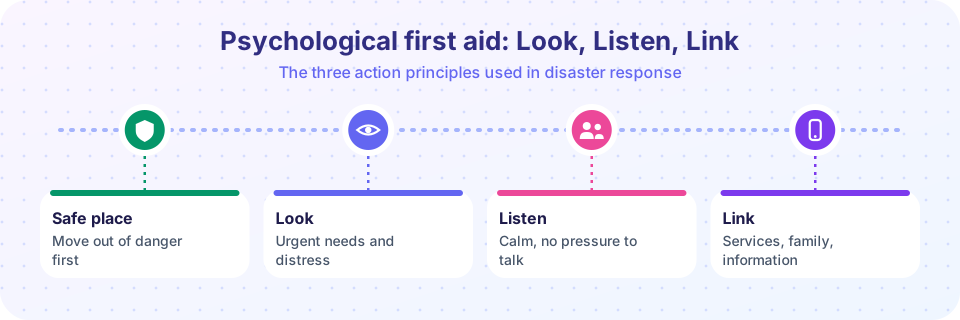
Psychological first aid (PFA) is a set of practical, supportive actions, not therapy. The World Health Organization's guide organizes it into three action principles: look, listen and link.
- Look. Check for safety. Check for people with urgent basic needs (water, food, medical care). Look for people with serious distress.
- Listen. Approach calmly. Introduce yourself. Ask what the person needs. Listen without pushing them to tell the story. Stay with them, in silence if need be. Help them feel calm.
- Link. Help people with their immediate needs: water, shelter, information about services and where family members are. Help them contact loved ones, and connect them to the help they need.
What helps:
- A calm, quiet, respectful manner. Offer water and a blanket.
- Honest information about what you know, and an honest "I don't know" when you do not.
- Keeping families together, and children with their carers.
- Respecting culture, faith and privacy.
What to avoid:
- Forcing people to talk about what happened.
- Saying "I know how you feel" or "it could have been worse" or "you should be strong".
- Making false promises.
- Judging how they react.
- Pressing for details or passing on their story.
There is a related point from research. Compulsory, single-session "psychological debriefing" delivered to all survivors shortly after an event has not been shown to prevent later problems, and some reviews suggest it may not help. Supportive, voluntary, practical help is what the evidence favors. If distress remains strong or disabling for weeks, or the person cannot function, encourage them to see a health professional.
Look after yourself. Helpers are affected too. Take breaks, eat and sleep when you can, talk to a colleague or friend and seek help if the experience stays with you.
Helping in a mental health crisis
This is educational information, not mental health treatment. If someone is in immediate danger, call your emergency number. Crisis line numbers differ by country, for example 988 in the United States, 116 123 (Samaritans) in the United Kingdom and 13 11 14 (Lifeline) in Australia. International directories such as findahelpline.com list services in many countries.
A panic attack
A panic attack is a sudden surge of intense fear with a racing heart, chest tightness, breathlessness, trembling, dizziness and a feeling of losing control. It feels dangerous but passes, usually within minutes. Chest pain and breathlessness can also be signs of a medical emergency, so call for help if the person has chest pain and you are not sure, or if it is the first time. Otherwise: stay calm, speak slowly and simply, encourage slow breathing (in for four, out for six), remove the person from a noisy place, and stay with them until it passes. Do not tell them to "calm down".
Someone who may be suicidal
People rarely hide thoughts of suicide completely, and talking about it helps. The recognized Mental Health First Aid action plan can be summarized as ALGEE: Assess for risk of suicide or harm, Listen non-judgmentally, Give reassurance and information, Encourage appropriate professional help, and Encourage other supports and self-help.
- Ask directly: "Are you thinking about suicide?" A systematic review of studies (Dazzi and colleagues, 2014) found no evidence that asking about suicide increases suicidal thoughts. It can bring relief.
- Listen without arguing, lecturing or promising to keep it secret.
- If there is an immediate risk, such as a plan, a method at hand or an attempt that has started, do not leave them alone, remove or keep away from means if it is safe, and call emergency services or a crisis line.
- Connect them to a crisis line, a doctor or a trusted person, and follow up.
Common misconceptions
- "Asking about suicide plants the idea." The best available evidence says it does not.
- "Everyone needs counseling after a disaster." Most people recover with practical and social support. Forced debriefing is not recommended.
- "Triage means giving up on some people." It means doing the most good with limited resources and re-checking.
- "Run outside in an earthquake." Most injuries occur from falling objects when people move; drop, cover and hold on.
Try it
First, a START triage trainer. Set the five checks for a casualty and read the category. It is a study demonstration with a simplified algorithm; real triage is done by trained responders.
Now practice the three actions of psychological first aid. Choose the response that fits look, listen or link.
Check your understanding
Quick check · 6 questions
of 6 answered You scored / 6 · perfect!
-
1. What is your first priority in a disaster as a first aider?
If you become a casualty you cannot help anyone. -
2. In START triage, a person who can walk is:
Walking casualties are sorted as minor and moved to a safe area. -
3. What should you do in an earthquake when the shaking begins?
Drop, cover and hold on is the standard advice. -
4. What do the three Ls in psychological first aid stand for?
Look, Listen and Link: the WHO action principles. -
5. What does research say about asking someone directly about suicide?
A systematic review found no evidence that asking increases suicidal ideation. -
6. Why is it unwise to drive through floodwater?
About 30 cm of moving water can float many cars.
Summary
- In a disaster: safety first, call for help, control life-threatening bleeding and breathing problems, share the work.
- START triage sorts casualties by walking, breathing, rate, circulation and commands into green, yellow, red and black; responders repeat it.
- Earthquake: drop, cover, hold on. Flood: do not wade or drive through floodwater.
- Psychological first aid is look, listen, link: calm, practical, non-pressuring.
- Ask directly about suicide, listen, stay with the person if risk is immediate and connect them to a crisis line or emergency services.
Next: Chapter 8 review
Track your progress
Create a free account to tick off lessons and pick up where you left off on any device.
of First Aid and Emergency Care lessons completed