


















Lesson 13 of 47 · Assessment and CPR
CPR for Adults: Chest Compressions and Breaths
Learn adult CPR step by step: hand position, 5 to 6 cm depth, 100 to 120 per minute, 30:2 with breaths, hands-only CPR, fatigue and when to stop.
Cardiopulmonary resuscitation, or CPR, is an emergency procedure that does the heart's job by hand. Each compression squeezes the heart between the breastbone and the spine and pushes blood out to the brain and body. It cannot restart a heart by itself, but it buys time and keeps the brain and heart muscle alive until a defibrillator or an ambulance crew arrives. When someone is unresponsive and not breathing normally, CPR is the right thing to do, even if you are scared of doing it wrong: the person has nothing to lose.
Educational information only. This lesson is not a substitute for a certified, hands-on CPR course with a manikin, and it is not medical advice. Guidelines differ between countries. In a real emergency, call your local emergency number and follow the dispatcher.
What you will learn
- How CPR works and why compressions are the most important part.
- Correct hand position, depth, rate and recoil for an adult.
- How to combine compressions with breaths (30:2) and when hands-only CPR is enough.
- How to avoid fatigue, minimize pauses and when to stop.
- Common problems: ribs cracking, vomiting, and doubts about harming the person.
Key terms
Chest compression: pressing down on the lower half of the breastbone to pump blood.
Compression depth: how far the breastbone moves toward the spine; about 5 to 6 cm in adults.
Recoil: letting the chest return fully to its normal position between compressions so the heart can refill.
Rescue breath: a breath given into the person's mouth, 1 second long, that makes the chest rise.
Compression fraction: the share of time during which compressions are actually being delivered.
Why compressions come first
When the heart stops, the blood in the body still carries oxygen for a few minutes, so early compressions circulate that oxygen to the brain and heart. In 1960, William Kouwenhoven, James Jude and Guy Knickerbocker published their account of external, closed-chest cardiac massage, and the compression-plus-ventilation combination became standard. Today, most adult cardiac arrests outside hospitals happen because of a heart rhythm problem, and for these the most valuable first minutes are filled by compressions and a shock, not breaths. That is why guidelines say: if you are unsure about breaths, do compressions.
The steps
Follow DRABC first (see the previous lesson). When the person is unresponsive and not breathing normally:
- Call emergency services (on speaker) and ask for an AED. If someone else is present, they call while you start.
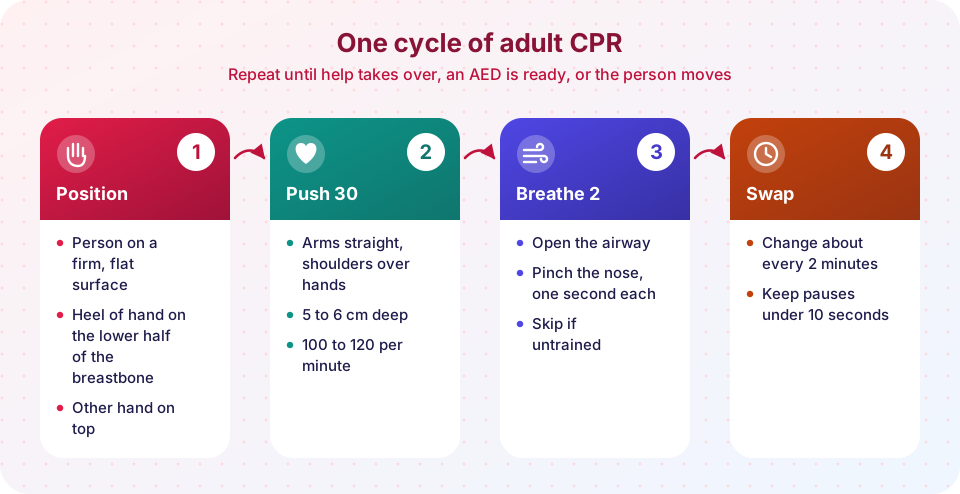
- Position the person on their back on a firm, flat surface. Kneel beside the chest. Do not move them far; the floor is fine.
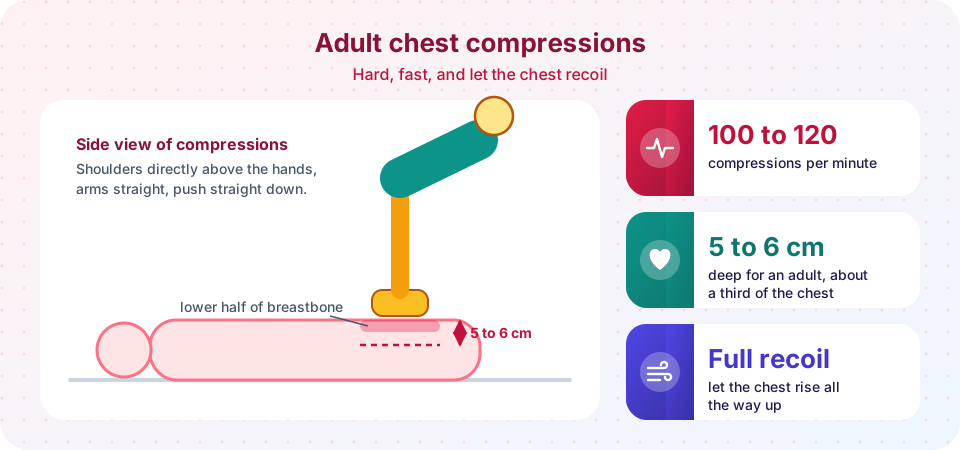
- Find the position. Place the heel of one hand on the centre of the chest, on the lower half of the breastbone, in line with the nipples in most adults. Put your other hand on top and interlock your fingers, keeping the fingers off the ribs.
- Lock your arms. Elbows straight, shoulders directly above your hands, so your body weight does the work.
- Push down hard about 5 to 6 cm (roughly 2 inches), then let the chest recoil fully. Do not lean on the chest between compressions.
- Push fast: 100 to 120 compressions per minute, about two per second. Count aloud: "one and two and three...". Compressions and release should take about equal time.
- Keep going without long pauses.
The ratio, if you are trained and willing to give breaths, is 30 compressions to 2 breaths.
Rescue breaths
After 30 compressions, open the airway with head tilt and chin lift. Pinch the soft part of the nose, take a normal breath, seal your mouth over the person's mouth and blow steadily for about 1 second, watching the chest rise. Let the chest fall, and give the second breath. The two breaths together should take less than 10 seconds. If the chest does not rise, check the airway (retilt the head, look in the mouth) and try once more, then go back to compressions. A face shield or pocket mask adds a barrier.
Hands-only CPR
You may be untrained, unwilling to give mouth-to-mouth breaths, or unsure of the person's health. In that case, give continuous compressions without breaths. Studies in adults whose collapse was witnessed, such as large Japanese and Swedish registries, found that bystander compression-only CPR led to results comparable to standard CPR in many adult cardiac arrests from heart causes. Hands-only CPR is simpler to teach and remember, and it increases the chance that a bystander will start at all. Breaths matter more when the cause is lack of oxygen, as in drowning, drug overdose or choking, and in children, and trained rescuers should give them in those situations.
Rate, depth and recoil: why they matter
- Depth. Too shallow and not enough blood moves. Too deep (over about 6 cm) risks more injury. Most people compress too lightly, so push harder than feels comfortable.
- Rate. Slower than 100 per minute reduces blood flow; faster than 120 does not leave time for the heart to fill. Songs with a beat of 100 to 120 per minute, such as "Stayin' Alive" at roughly 103, are popular teaching aids.
- Recoil. Leaning on the chest keeps pressure in the chest and prevents the heart from refilling. Lift your weight slightly between pushes without losing hand contact.
- Minimal interruptions. Every pause stops blood flow. Aim for pauses under 10 seconds, including for breaths, AED analysis and changing rescuers.
Fatigue and swapping
CPR is hard physical work. Research on training manikins shows that compression depth and quality decline noticeably within one to two minutes, often before the rescuer feels tired. If a second rescuer is present, swap every two minutes (about every five cycles of 30:2), taking less than five seconds to change. Let the fresh person be ready beside you, and swap at the end of a cycle or when the AED is analysing.
What to expect
- Ribs may crack. This happens in many adult resuscitations, especially in older people, and is not a reason to stop. A broken rib heals; a person without circulation does not.
- Vomiting. Turn the person onto their side, clear the mouth quickly, and then resume.
- Gasping or movement. If the person starts to breathe normally or moves, stop compressions, check responsiveness and breathing, place them in the recovery position if appropriate and keep watching.
- The person is not "revived". Many people need an AED shock and advanced care. CPR keeps them viable until then.
When to stop
Continue until one of the following happens: the emergency crew tells you to stop or takes over; an AED arrives and tells you to pause for analysis; the person recovers and shows signs of life; you are exhausted and no one can replace you; or the scene becomes unsafe.
Try it
A metronome helps your body learn the rhythm. This one pulses at 110 beats per minute, the middle of the target range. It uses a visual pulse and an optional beep, if your browser allows audio.
The next plot shows why rate matters: it counts the compressions delivered in two minutes at different rates, assuming no pauses. It is arithmetic, not a clinical result.
Press Run (or Ctrl + Enter) to see the result here.
Program input · what you'd type while the program runs
Type the answers before you press Run, one per line. Each time the program reads a line (with input()), it gets the next line from this box.
Press Run (or Ctrl + Enter) to see the console output here.
No output.
Common misconceptions
"I might hurt them." A broken rib is possible but treatable. Without CPR, a person in cardiac arrest will die. Guidelines say to push hard.
"CPR always works." Survival is far from certain; CPR gives the best chance, especially combined with early defibrillation.
"Only certified people can do it." Anyone can start; dispatchers coach untrained callers.
"Mouth-to-mouth is required." Hands-only CPR is an accepted option for adults.
Check your understanding
Quick check · 6 questions
of 6 answered You scored / 6 · perfect!
-
1. Where do you place your hands for adult CPR?
The heel of the hand goes on the lower half of the breastbone, in the centre of the chest. -
2. What are the recommended depth and rate for adult CPR?
Depth 5 to 6 cm; rate 100 to 120 per minute. -
3. What is the CPR ratio if you give breaths?
For adults, 30:2. -
4. When is hands-only CPR appropriate?
Compressions alone are acceptable and much better than nothing. -
5. Why swap rescuers every two minutes?
Studies show that depth and rate drop within one to two minutes. -
6. A rib cracks during compressions. What should you do?
Rib fractures are common and are not a reason to stop.
Summary
- CPR keeps blood moving to the brain and heart until defibrillation or advanced care; call and begin early.
- Hands on the lower half of the breastbone, arms straight, 5 to 6 cm deep, 100 to 120 per minute, full recoil.
- 30:2 if you give breaths; hands-only is acceptable and better than nothing.
- Minimize pauses, swap every two minutes and continue until relieved, the person recovers or you cannot continue.
Next: Using an AED
Track your progress
Create a free account to tick off lessons and pick up where you left off on any device.
of First Aid and Emergency Care lessons completed