


















Lesson 45 of 47 · Projects and Practice
Glossary of first-aid terms
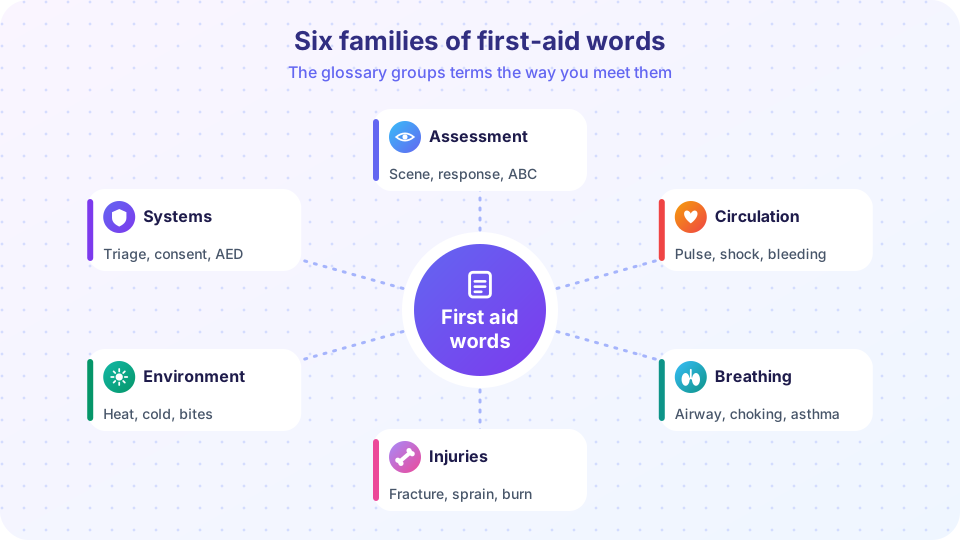
A searchable A to Z glossary of first-aid and emergency-care terms, from AED and anaphylaxis to triage and tourniquet, grouped by assessment, circulation, breathing, injuries, environment and systems.
First aid has its own vocabulary, and knowing the words makes everything else easier: you understand the dispatcher, the instructor and the crew who take over, and they understand you. This glossary collects the terms from the course in alphabetical order, with plain-language definitions. Use the search box below to find a word quickly, and use the groups to see how the words fit together.
Educational information, not medical advice. These definitions are for learning. They do not replace a certified first-aid course, a medical professional or emergency services. Terms and protocols vary a little between countries.
What you will learn
- The meaning of the key words used in this course, and how they group.
- How to search and review the glossary in a quick self-test.
- Where words from different lessons connect.
Key terms
- Assessment: the quick check of the scene, response and breathing that comes before any treatment.
- First aid: the immediate help given to a person who is injured or suddenly ill, before professional care.
- Emergency medical services (EMS): the ambulance and paramedic service reached by the emergency number.
- Casualty: a person who is injured or ill. Some courses say "patient" or "person".
- Red flag: a sign that suggests a serious problem.
The glossary, by family
Assessment
- ABC: airway, breathing and circulation, the order of life-saving checks.
- Mechanism of injury: how an injury happened, which indicates how serious it may be.
- Primary assessment: the first fast check for scene safety, response, airway, breathing and severe bleeding.
- Responsive: reacting to voice or touch. Unresponsive: not reacting.
- SAMPLE: signs and symptoms, allergies, medicines, past history, last food and drink, events.
- Scene safety: making sure the area is safe for you, the casualty and others.
Circulation
- Bleeding (hemorrhage): loss of blood from the vessels. Severe bleeding is a life threat.
- Cardiac arrest: the heart stops pumping effectively; the person is unresponsive and not breathing normally.
- Heart attack: damage to heart muscle caused by a blocked coronary artery.
- Pressure bandage: a firm bandage over a dressing that holds pressure on a wound.
- Shock: a life-threatening state in which the body does not get enough blood flow to its organs.
- Stroke: a loss of blood supply to part of the brain, caused by a blocked or burst vessel. TIA: a brief stroke-like episode.
- Tourniquet: a band placed high on a limb to stop life-threatening bleeding when pressure fails.
Breathing
- Airway: the passage that carries air from the mouth and nose to the lungs.
- Anaphylaxis: a severe, life-threatening allergic reaction.
- Asthma: a long-term condition in which the airways narrow and swell.
- Auto-injector: a spring-loaded device that injects a fixed dose of adrenaline.
- Choking: blockage of the airway by a foreign object.
- CPR (cardiopulmonary resuscitation): chest compressions and rescue breaths that keep blood and oxygen moving when the heart has stopped.
- Rescue breaths: breaths given to a person who is not breathing.
- Reliever inhaler: the rescue inhaler for asthma, usually blue.
- Spacer: a chamber that helps deliver inhaler medicine.
Injuries
- Burn: damage to skin and tissue from heat, chemicals, electricity or radiation. Scald: a burn from hot liquid or steam.
- Concussion: a temporary disturbance of brain function after a blow.
- Dislocation: a joint forced out of place.
- Dressing: a sterile pad placed directly on a wound.
- Fracture: a break in a bone; open if the skin is broken, closed if not.
- Immobilize: to stop an injured part from moving.
- Sling: a bandage that supports the weight of an arm.
- Splint: a rigid support secured along an injured part.
- Sprain: an injury to a ligament. Strain: an injury to a muscle or tendon.
Environment
- Carbon monoxide (CO): a colorless, odorless gas from burning fuel that starves the body of oxygen.
- Frostbite: freezing of skin and tissue.
- Heat exhaustion: a heat illness with heavy sweating and weakness. Heatstroke: a life-threatening heat illness with a core temperature around 40 °C or more and changes in mental state.
- Hypothermia: a core temperature below 35 °C.
- Poison center: a phone service for advice on poisoning.
- Rabies: a viral disease spread by the bites of infected mammals, preventable with prompt treatment.
Systems and law
- AED (automated external defibrillator): a portable device that analyzes the heart rhythm and delivers a shock if needed.
- Consent: permission to help. Implied consent: assumed for an unresponsive person.
- Good Samaritan law: a law protecting reasonable help given in good faith.
- Handover: the summary you give to the professionals who take over.
- Psychological first aid: practical, supportive help for people in distress; look, listen, link.
- Recovery position: a side-lying position that keeps the airway open for an unresponsive, breathing person.
- Triage: sorting casualties by urgency.
Try it
Search the glossary. Type part of a word or a definition. This is a small version of the glossary above, for quick review.
Now a quick self-test. Each question shows a definition and asks for the term.
Press Run (or Ctrl + Enter) to see the console output here.
No output.
Check your understanding
Quick check · 5 questions
of 5 answered You scored / 5 · perfect!
-
1. What does AED stand for?
An AED analyzes the heart rhythm and can deliver a shock. -
2. What is the difference between a sprain and a strain?
Ligaments connect bone to bone; tendons connect muscle to bone. -
3. What is implied consent?
For an unresponsive person, consent is implied. -
4. Which term means a core temperature below 35 degrees Celsius?
Hypothermia is a core temperature below 35 °C. -
5. What is SAMPLE used for?
SAMPLE is a checklist of questions to ask the casualty or bystanders.
Summary
- Words fall into families: assessment, circulation, breathing, injuries, environment and systems.
- Learn them in context and review them with the search box and the drill.
- Clear words help you talk to dispatchers, instructors and crews.
Next: First-aid cheat sheet
Track your progress
Create a free account to tick off lessons and pick up where you left off on any device.
of First Aid and Emergency Care lessons completed