


















Lesson 29 of 47 · Medical Emergencies
Heart attack and stroke
Learn the warning signs of a heart attack and a stroke, the FAST and BE-FAST checks, why minutes matter and what a first aider should and should not do.
Two of the most common causes of death in the world are problems with blood vessels. In a heart attack, a blood vessel that feeds the heart muscle is blocked. In a stroke, a blood vessel that feeds the brain is blocked or bursts. In both, the tissue that loses its blood supply starts to die, and every minute counts. People who get help early are far more likely to recover fully.
The main obstacle is not treatment, it is delay. Many people wait, hoping that the pain or weakness will pass, or they do not want to make a fuss. As a first aider you can break that pattern: you can recognize the signs, say the words "I think we should call an ambulance" and make sure the call is made.
What you will learn
- What happens in the body during a heart attack and during a stroke.
- The warning signs, including the less typical ones.
- The FAST and BE-FAST checks for stroke.
- What first aid to give, including when aspirin is and is not appropriate.
- The difference between a heart attack and cardiac arrest.
Key terms
- Heart attack (myocardial infarction): damage to heart muscle because blood flow through a coronary artery is blocked.
- Cardiac arrest: the heart stops pumping effectively, so the person is unresponsive and not breathing normally. It is a different emergency that needs CPR and a defibrillator.
- Ischemic stroke: a stroke caused by a blocked artery in the brain. About 85 in 100 strokes are of this kind.
- Hemorrhagic stroke: a stroke caused by a burst blood vessel bleeding into or around the brain.
- TIA (transient ischemic attack): stroke-like symptoms that go away within minutes or hours but are a warning and need urgent assessment.
Heart attack
The heart is a muscle, and it needs its own blood supply through the coronary arteries. Over years, fatty deposits (plaque) can build up in these arteries. If a plaque cracks, a blood clot can form on it and block the artery. The section of heart muscle beyond the block runs short of oxygen and begins to die. Treatments, such as opening the artery with a stent or clot-dissolving medicine, work best the earlier they begin.
Recognize it
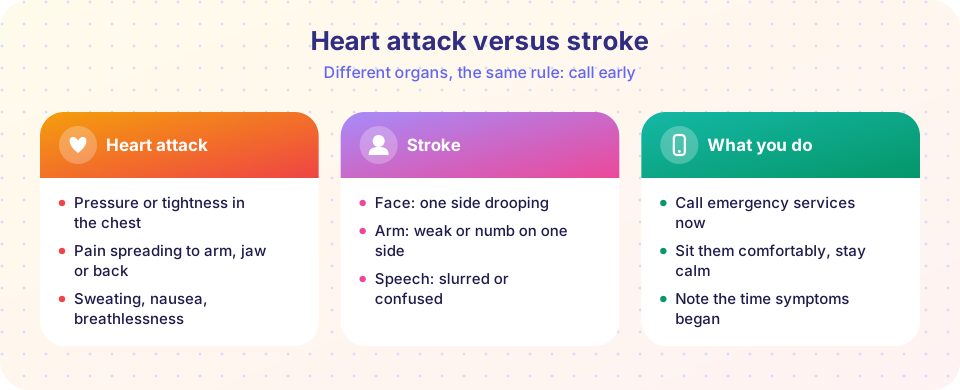
The classic picture is pressure, tightness or squeezing in the center of the chest, lasting more than a few minutes or coming and going. It may spread to the left arm or both arms, the shoulders, the neck, the jaw or the back. Other signs include shortness of breath, a cold sweat, nausea or vomiting, light-headedness and a sense of dread.
Not everyone has the classic picture. Women, older adults and people with diabetes are more likely to have less typical symptoms: unusual tiredness, shortness of breath, nausea, pain in the upper back, the jaw or the upper abdomen, with little or no chest pain. Do not dismiss these because they do not match the film version. Heartburn and a muscle strain can feel similar, but a first aider does not need to sort that out: when in doubt, call.
Angina is chest pain caused by narrowed arteries that appear on exertion or stress and settle with rest, usually within a few minutes, or with the person's own prescribed spray or tablet. Someone who has angina has a plan. If their pain is not relieved by rest and their medicine, or is more severe than usual, treat it as a possible heart attack.
First aid for a suspected heart attack
- Call your emergency number. Do this first, even if the person says they are fine. Do not let them drive themselves.
- Help them sit comfortably, often half-sitting with the back supported and knees bent, which eases breathing and strain on the heart. Loosen tight clothing. Keep them calm and still. Reassure them; fear makes the heart work harder.
- Consider aspirin. Aspirin stops platelets from clumping and can limit the size of the clot. International first-aid guidelines say that an adult with chest pain from a suspected heart attack can chew an aspirin (typically 300 mg or a similar adult dose, as taught in your local course) as soon as possible, provided they are not allergic to it, have not been told by a doctor never to take it, are not bleeding and the dispatcher or your protocol supports it. Do not give aspirin to children. If you are unsure, ask the dispatcher.
- Help with their own medicine. If they have a prescribed spray or tablet for angina, help them use it as their doctor taught. Do not give another person's medicine.
- Be ready for CPR. If they become unresponsive and are not breathing normally, they are in cardiac arrest: start CPR and use an AED (automated external defibrillator) as soon as one arrives.
A heart attack and cardiac arrest are not the same. A heart attack is a plumbing problem; cardiac arrest is an electrical one, in which the heart goes into a chaotic rhythm and stops pumping. A heart attack can lead to cardiac arrest, which is why you watch the person closely.
Stroke
The brain uses about a fifth of the body's blood and oxygen, and it cannot store them. When an artery is blocked, the brain cells downstream quickly stop working. In an ischemic stroke the cause is a clot or a narrowed vessel. In a hemorrhagic stroke a vessel bursts. The two look the same from outside, and only a brain scan in hospital tells them apart. That is why, as a first aider, you never give aspirin, food or drink to a person who may be having a stroke. Aspirin could make a hemorrhage worse, and swallowing may be impaired.
FAST and BE-FAST
The FAST test was designed so that the public can recognize a stroke in seconds. It builds on earlier prehospital scales developed by stroke researchers, such as the Cincinnati Prehospital Stroke Scale (Kothari and colleagues, 1999) and the Face Arm Speech Test (Harbison and colleagues, 2003).
- Face: ask them to smile. Does one side droop?
- Arm: ask them to raise both arms. Does one drift down or can it not lift?
- Speech: ask them to repeat a simple sentence. Is it slurred, strange or can they not speak?
- Time: if you see any of these, it is time to call emergency services at once.
BE-FAST adds Balance (sudden dizziness or loss of coordination) and Eyes (sudden loss of vision or double vision in one or both eyes). Other warning signs are a sudden severe headache with no known cause, sudden confusion, and sudden numbness on one side. Not every stroke is caught by FAST. If someone has sudden unusual symptoms, treat it as a possible stroke.
Why time matters
For an ischemic stroke, treatment with clot-dissolving medicine is generally given within a window of a few hours after symptoms start (often up to about 4.5 hours), and in selected patients with a large blocked artery a procedure to remove the clot can help for longer. Because the window is limited, the time the symptoms started is a critical fact. If the person woke with symptoms, the relevant time is when they were last known to be well.
In 2006 the neurologist Jeffrey Saver estimated that in a typical untreated large-vessel stroke, the brain loses about 1.9 million neurons for each minute without treatment. That is an estimate for illustration, not a prediction for any person, but it conveys why the phrase "time is brain" is used.
First aid for a suspected stroke
- Call emergency services at once and say the word "stroke".
- Note the time the symptoms started, or when they were last seen normal, and tell the crew.
- Keep the person safe and comfortable, seated or lying with the head slightly raised if they are drowsy. Do not let them walk about.
- Give nothing by mouth, no food, drink or medicine.
- Watch breathing and responsiveness. If they become unresponsive but are breathing normally, place them in the recovery position. If they are not breathing normally, start CPR.
- Reassure them. They may be frightened or unable to speak but still understand you. Speak calmly, one idea at a time.
A TIA may resolve before help arrives. Do not take that as good news. It is a warning that a full stroke may follow, and the person needs urgent assessment even if they feel normal again.
Common misconceptions
- "Chest pain is always dramatic." Many heart attacks are gradual, and women and people with diabetes often have atypical signs.
- "I will wait to see if it goes away." Delay is the biggest danger in both conditions.
- "Give aspirin for a stroke too." Never. A stroke can be a bleed, and aspirin could make it worse.
- "It went away, so it was nothing." A TIA is a warning that needs urgent assessment.
Try it
First, a BE-FAST demonstration. Tick what you see and read the action. This is a study demonstration, not a way to diagnose a stroke. In real life any suspicion means a call.
Now a plot of why speed matters. It uses the widely cited estimate of 1.9 million neurons lost per minute in an untreated large-vessel stroke. It is an illustration of the idea, not a prediction for a person.
Press Run (or Ctrl + Enter) to see the result here.
Program input · what you'd type while the program runs
Type the answers before you press Run, one per line. Each time the program reads a line (with input()), it gets the next line from this box.
Check your understanding
Quick check · 5 questions
of 5 answered You scored / 5 · perfect!
-
1. What is the first step when you suspect a heart attack?
Call first. An ambulance crew can start treatment on the way and can handle cardiac arrest. -
2. Why should you not give aspirin to someone who may be having a stroke?
A hemorrhagic stroke is a bleed. Aspirin affects clotting and could worsen it. -
3. What does BE-FAST add to FAST?
B is for balance and E is for eyes, to catch strokes that FAST can miss. -
4. Which description best matches a cardiac arrest?
Cardiac arrest means the person is unresponsive and not breathing normally. Start CPR and use an AED. -
5. A person had stroke symptoms that vanished after ten minutes. What should happen?
A TIA is a warning sign for a stroke and needs urgent assessment.
Summary
- Heart attack and stroke both start with a blocked blood vessel, and treatment works best when it starts early.
- A heart attack often brings pressure in the chest, pain spreading to the arm or jaw, sweating and breathlessness; women, older adults and people with diabetes may have subtler signs.
- Call first. Sit the person comfortably. Aspirin may be advised for a suspected heart attack, never for a suspected stroke.
- Use FAST or BE-FAST for stroke, note the time symptoms started and give nothing by mouth.
- Be ready for CPR and an AED if the person becomes unresponsive and is not breathing normally.
Track your progress
Create a free account to tick off lessons and pick up where you left off on any device.
of First Aid and Emergency Care lessons completed