


















Lesson 32 of 47 · Medical Emergencies
Chapter 6 review: medical emergencies
Review chapter 6: heart attack, stroke, choking, anaphylaxis, asthma, low blood sugar, seizures and fainting, with a one-page picture, a recap table and a ten-question quiz.
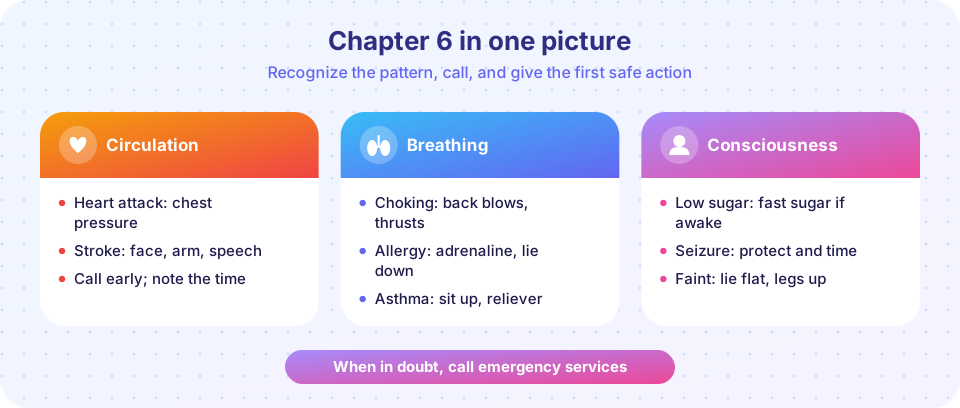
Medical emergencies ask you to recognize patterns rather than wounds. You have now met eight of them, each with its own signs and its own first steps. This lesson helps you hold them together: a one-page picture, a table of pattern, action and call-trigger, a quick practice with the key signs and a ten-question quiz. Use the explanations to find which lesson to reread.
Reminder: this is educational information, not a substitute for a certified first-aid course or emergency services. Doses, devices and protocols differ between countries. Follow your local emergency number and your own training.
What you will learn
- How to sort the eight emergencies into three systems and recall the key sign of each.
- Which first aid you give and what you must not do in each case.
- When every one of these becomes a call to emergency services.
Recap table
| Emergency | Key signs | First aid | Do not |
|---|---|---|---|
| Heart attack | Chest pressure, spreading pain, sweating, breathlessness | Call, sit comfortably, consider aspirin per local advice, be ready for CPR and AED | Let them drive or wait it out |
| Stroke | Face droop, arm weakness, speech trouble, balance, eyes | Call, note time, keep safe, nothing by mouth | Give aspirin, food or drink |
| Choking (adult, severe) | Cannot speak, cough or breathe | Back blows, abdominal thrusts, CPR if unresponsive | Slap while they can cough |
| Anaphylaxis | Swelling, wheeze, faintness after a trigger | Call, adrenaline in outer thigh, lie flat, hospital | Let them stand or wait |
| Asthma attack | Wheeze, cough, cannot finish sentences | Sit up, reliever with spacer, call if severe | Lie them flat |
| Low blood sugar | Shaky, sweaty, confused | Fast sugar if awake and swallowing; call if not | Food or drink if drowsy |
| Seizure | Unresponsive with jerking | Time, protect, recovery position afterward | Restrain or put objects in the mouth |
| Faint | Pale, dizzy, brief blackout | Lie flat, legs up, check breathing | Sit them up quickly |
Three habits
- Recognize the pattern and ask about the SAMPLE items: signs and symptoms, allergies, medicines, past history, last food and drink, events.
- Call early, with a clear location and a one-sentence description, and stay on the line.
- Support and watch. Keep the person comfortable, keep them calm, and be ready to begin CPR if they stop breathing normally.
Try it
A last practice: match the first action to the situation. These are short textbook cases; use them to rehearse the key words.
Check your understanding
Quick check · 10 questions
of 10 answered You scored / 10 · perfect!
-
1. What is the first action for a suspected heart attack?
Call first. The ambulance crew can start care and manage cardiac arrest. -
2. Why is aspirin never given for a suspected stroke?
From outside you cannot tell a clot from a bleed. Give nothing by mouth. -
3. What does the T in FAST stand for?
Face, Arm, Speech, Time: if you see signs, it is time to call. -
4. An adult is choking and cannot cough or speak. What comes first?
Severe choking needs back blows and thrusts. Start CPR if they become unresponsive. -
5. Where is an adrenaline auto-injector given?
The outer mid-thigh, through clothing if needed. -
6. A person with asthma is struggling. Which position is best?
Sitting upright eases breathing. Help with the reliever and spacer. -
7. A drowsy person with diabetes cannot swallow safely. What should you do?
Food or drink could block the airway. Call emergency services. -
8. What must you not do during a seizure?
Restraint and objects in the mouth cause injuries. -
9. A faint should pass within about:
If they do not wake in about a minute, treat them as unresponsive. -
10. Which of these is true of cardiac arrest, compared with a heart attack?
Cardiac arrest needs CPR and an AED at once.
Summary
- Eight patterns, three body systems: circulation, breathing and consciousness.
- Recognize, call early with a clear message, and support the person while you watch.
- Know the "do not" for each: no aspirin for stroke, no objects in a seizing mouth, no food for a drowsy person.
- Be ready to start CPR at any time.
Track your progress
Create a free account to tick off lessons and pick up where you left off on any device.
of First Aid and Emergency Care lessons completed