


















Lesson 28 of 47 · Medical Emergencies
Chapter 6 overview: medical emergencies
A guide to sudden illness in first aid: heart attack, stroke, choking, severe allergy, asthma, low blood sugar, seizures and fainting, and the habit of recognizing a pattern and calling early.
So far you have dealt with injuries: something hurt the body from outside. Many emergencies have no injury at all. A person is chatting at a family meal and suddenly grabs their chest. A child at a picnic wheezes after a bite of cake. A colleague gets confused and sweaty at their desk. These are medical emergencies: illnesses or conditions where the body's own systems fail or overreact.
The skill here is different. You cannot see a heart attack, a blocked brain artery or a low blood sugar. You recognize patterns (what the person tells you, what you see, what has happened in the last few minutes) and you match each pattern with a short list of safe first-aid actions. In most cases the single most valuable action is the same: call emergency services early, and tell them clearly what you see.
Educational information, not medical advice. This chapter explains common first-aid actions for medical emergencies as taught in international guidelines. It cannot diagnose anyone and cannot replace a certified, hands-on first-aid course, the person's own medical plan or emergency services. Medicine doses, device types and protocols vary between countries. Always follow your local emergency number's instructions.
What you will learn
- How to recognize a possible heart attack and a possible stroke, and why time matters.
- What to do for a choking adult, a person in a severe allergic reaction and a person having an asthma attack.
- How to help someone with low blood sugar, a seizure or a faint.
- How to give an emergency call that helps the dispatcher help you.
Key terms
- Medical emergency: a sudden illness or condition that threatens life or health without an obvious injury.
- Symptom: something the person tells you they feel (pain, nausea, dizziness). A sign is something you can see or measure (pale skin, fast breathing).
- Anaphylaxis: a severe, life-threatening allergic reaction.
- Auto-injector: a spring-loaded device that injects a fixed dose of adrenaline (epinephrine).
- Recovery position: a side-lying position that keeps the airway open for a person who is unresponsive but breathing normally.
The pattern approach
Imagine you arrive and the person is unwell. Use the same order as always: make sure the scene is safe, check whether the person responds and is breathing normally, and call for help if the situation is serious. If they are not breathing normally, you begin CPR (covered in chapter 3). If they are breathing, you ask questions and look for a pattern.
A useful short list of questions is SAMPLE: Signs and symptoms, Allergies, Medicines, Past medical history, Last food and drink, Events leading up. You do not need to be systematic like a clinician. Ask the person (or a bystander who knows them), and look for medical bracelets or cards. A person with diabetes, epilepsy or a serious allergy often carries identification and a plan.
The patterns in this chapter are:
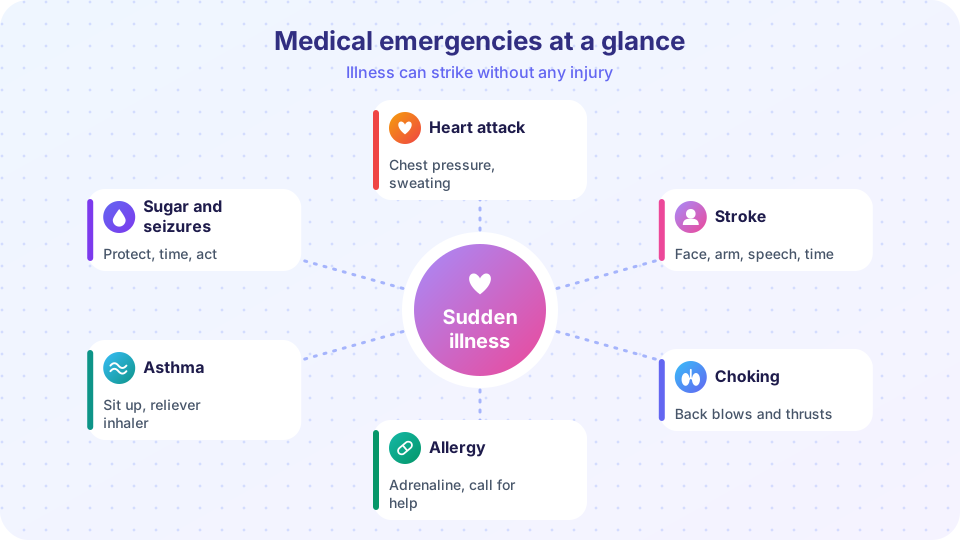
- Chest pressure, spreading pain, sweating: a possible heart attack.
- Face droop, arm weakness, speech trouble: a possible stroke.
- Cannot cough, speak or breathe after eating or with a toy: choking.
- Hives, swelling, wheeze or faintness after a food, sting or medicine: a possible severe allergic reaction.
- Wheeze, cough and tight chest in a person with asthma: an asthma attack.
- Shaky, sweaty, confused (and diabetic): low blood sugar.
- Sudden jerking with unresponsiveness: a seizure.
- Pale, dizzy, brief blackout when standing: a faint.
Chapter 6: three body systems
Your three moves
Do not guess a diagnosis. Describe what you see.
What each lesson covers
- Heart attack and stroke teaches the warning signs, FAST and BE-FAST, why aspirin is given for a heart attack in some situations but never for a stroke, and why minutes matter.
- Choking, severe allergy and asthma covers back blows and thrusts, adrenaline auto-injectors and reliever inhalers.
- Diabetes, seizures and fainting covers fast sugar, safe seizure care and the recovery position.
- Chapter 6 review pulls it together with a picture, a table and ten questions.
Making the emergency call
Whatever the emergency, the call is a first-aid skill. Stay calm and speak clearly.
- Give the exact location, including the street, the town, a landmark and which entrance. If you are not sure, say so and describe what you can see.
- Say what has happened in one sentence: "A man of about 60 has chest pain and is sweating."
- Answer the dispatcher's questions. They are trained to ask what helps them decide. Is the person awake? Breathing normally? Any known conditions or medicines?
- Follow the instructions they give, such as how to start CPR or where to find a defibrillator. Put the phone on speaker so your hands are free.
- Do not hang up until they tell you to, and be ready to call back if things change.
Emergency numbers differ by country: 112 works in the European Union and in many other countries, 911 in the United States and Canada, 999 in the United Kingdom and 000 in Australia. Many mobile phones can dial 112 from anywhere. Learn the number for the places you live, work and travel.
Try it
Sort the patterns. Each case describes a person; choose the most likely emergency. This is a study demonstration with textbook cases, not a way to diagnose real people.
Check your understanding
Quick check · 4 questions
of 4 answered You scored / 4 · perfect!
-
1. What is the best first thing to do for most medical emergencies?
Recognizing the pattern and calling early gives the person the best chance of getting care in time. -
2. What does the S in SAMPLE stand for?
SAMPLE: signs and symptoms, allergies, medicines, past history, last food and drink, events. -
3. Which number is the emergency number in the United Kingdom?
999 is the UK number; 112 also works from many phones. -
4. What should you do while talking to the emergency dispatcher?
Dispatchers give live instructions and need updates; speaker lets you help with your hands.
Summary
- Medical emergencies are illnesses without outside injury; you recognize patterns and match them to simple actions.
- Use the SAMPLE questions and look for medical identification.
- Call early with a clear address and a one-sentence description.
- This course is educational; a certified hands-on course is the real preparation.
Next: Heart attack and stroke
Track your progress
Create a free account to tick off lessons and pick up where you left off on any device.
of First Aid and Emergency Care lessons completed