


















Lesson 40 of 47 · Preparedness and Special Situations
First aid for children, infants and older adults
See how first aid changes for babies, children, pregnant people and older adults: choking, CPR, fever seizures, poisoning, falls and the signs that mean call at once.
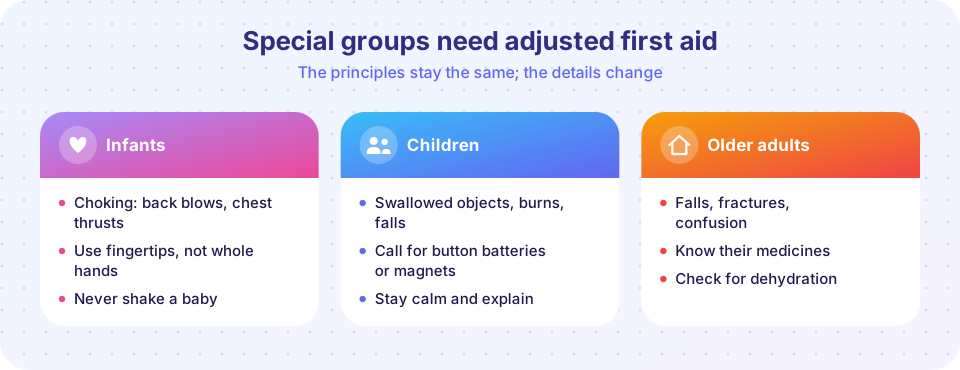
A child is not a small adult, and an 80-year-old is not a middle-aged adult who happens to be older. Body size, the shape of the airway, how quickly a person loses heat or fluid, which emergencies are common and how the signs show up all change with age. The principles of first aid stay the same: check the scene, call for help, support breathing and circulation, treat the main problem. But many of the details change, and some of them matter a great deal.
This lesson describes the main adjustments for infants (under one year), children (from one year to puberty), pregnant people, people with disabilities and older adults. It is an introduction. Pediatric first aid is a separate certified course in many countries, and anyone who looks after children should take it.
What you will learn
- The main differences between infants, children and adults in the body and in first aid.
- How to help a choking infant and a choking child.
- The key differences in CPR for babies and children.
- Common childhood emergencies: fever, febrile seizures, poisoning, burns, drowning.
- Why falls, medicines and confusion matter in older adults, and what to do about them.
Key terms
- Infant: a baby under one year of age. A child is between one year and puberty.
- Febrile seizure: a seizure triggered by fever in a young child, usually harmless and brief.
- Polypharmacy: the use of many medicines at once, common in older age and a cause of falls and confusion.
- Delirium: a sudden change in thinking and attention, often caused by illness. It is a medical emergency in older adults.
- Left lateral tilt: tilting a pregnant person to the left to keep the womb from pressing on the large vein that returns blood to the heart.
Why children are different
- Smaller airways that block more easily and swell faster. A small amount of swelling blocks a baby's airway far more than an adult's.
- Faster breathing and heart rates, which are normal for their size. A "fast" rate for an adult may be normal for a toddler.
- Large heads, short necks and soft bones, so head injuries are common and bones bend and crack ("greenstick") rather than break through.
- A bigger surface area for their weight, so they lose heat and water quickly. Hypothermia, heatstroke and dehydration develop faster.
- Small blood volume, so bleeding that looks minor may matter.
- They cannot always tell you what is wrong, so you read their behavior: a child who is unusually quiet, limp, pale or irritable is a worrying sign.
Children also tend to be frightened. Get down to their level, use a calm voice, explain simply and keep a parent close when you can.
Choking
Infant under one year
Signs of severe choking in a baby: they cannot cry, cough or breathe, may turn blue and may go limp. Abdominal thrusts are not used in babies.
- Call for help, or have someone call emergency services.
- Five back blows. Lay the baby face down along your forearm, supporting the head and jaw with your hand, with the head lower than the chest. Strike firmly between the shoulder blades with the heel of the other hand, up to five times.
- Five chest thrusts. Turn the baby face up on your forearm, head still lower than the body. Place two fingers on the lower half of the breastbone and push sharply inward about a third of the chest depth, up to five times. These are like chest compressions but sharper and slower.
- Repeat back blows and chest thrusts until the object comes out or the baby becomes unresponsive. Then start infant CPR.
Child over one year
Use back blows followed by abdominal thrusts as for an adult, with less force, standing or kneeling behind the child. Some guidelines teach abdominal thrusts alone for older children. Learn the local method. Do not sweep blindly with a finger.
Make the home safer: cut round foods such as grapes and hot dogs lengthwise, avoid whole nuts for young children, and supervise eating.
CPR in infants and children
The overall idea is the same as for adults. Because most cardiac arrests in children are caused by lack of oxygen (drowning, choking, illness) rather than a primary heart problem, breaths matter more in children and infants. Many guidelines teach starting with five rescue breaths, and then 30 compressions to two breaths.
Main differences:
- Hands: for an infant, use two fingers (or, with two rescuers, two thumbs with the hands encircling the chest) on the lower half of the breastbone. For a child, use one or two hands.
- Depth: about one third of the depth of the chest, roughly 4 cm for an infant and 5 cm for a child.
- Rate: 100 to 120 compressions per minute, as for adults.
- Breaths: gentle puffs, enough to make the chest rise. For infants, cover the mouth and nose with your mouth.
- Calling: if you are alone and have no phone nearby, many guidelines advise about one minute of CPR before leaving to call. If you have a phone, put it on speaker and call first.
- AED: pediatric pads or a pediatric setting are used for children under about eight if available; adult pads can be used if not.
Common childhood emergencies
- Fever and febrile seizures. Fever in a child is usually the body fighting an infection. A febrile seizure, usually between six months and five years, can be frightening but is usually harmless and brief. Protect the child, lay them on their side, time the seizure, put nothing in the mouth and call emergency services if it is the first one, lasts more than five minutes, or the child is not recovering. Do not cool a child with cold baths. Seek medical advice for a very young baby with a fever (the age threshold is set by local guidelines, often under three months), a stiff neck, a rash that does not fade under a glass, extreme drowsiness or trouble breathing.
- Falls and head injuries. Follow the head-injury advice from the previous chapter. In babies, bulging soft spots, repeated vomiting or unusual sleepiness are red flags.
- Burns and scalds. Hot drinks and bath water are common. Cool under running water for 20 minutes while keeping the child warm.
- Poisoning. Medicines, cleaning products, laundry pods, button batteries and magnets are the dangerous ones. Call the poison center or emergency services and keep the container. Store medicines and chemicals high and locked.
- Drowning. It takes seconds and is silent. Supervise within arm's reach near any water, including baths and buckets, and fence pools.
- Breathing problems. Croup (a barking cough with a noisy breath in) or asthma need calm, upright positions and medical help if the child struggles.
- Safe sleep. Babies should sleep on their backs on a firm, flat surface without soft bedding. Never shake a baby. If you suspect that a child is being harmed, report your concern to the appropriate authority in your country.
Pregnancy
A pregnant person is two patients, but the first aid is mostly the same. Key adjustments:
- Lie or tilt to the left (left lateral tilt) when unresponsive or in CPR, so that the womb does not compress the large vein returning blood to the heart. Place a rolled blanket under the right hip, or use manual displacement if you are trained.
- Choking: use chest thrusts, not abdominal thrusts.
- After any injury to the abdomen, even a minor fall or car crash, medical review is needed even if the person feels well.
- Call emergency services for vaginal bleeding, severe abdominal pain, severe headache, vision changes, seizures or no fetal movement after trauma.
Older adults
Older people are more likely to fall, to be taking several medicines, to have heart and lung disease and to have thin skin and fragile bones. Illness often looks different: a urinary infection can present as sudden confusion rather than fever and pain, and a heart attack may bring only weakness or breathlessness.
- Falls: about one in three people over 65 falls each year. After a fall, do not rush to pull them up. Ask where it hurts, look for injuries and keep them still if you suspect a hip, spine or head injury. If there is no injury and they are able, help them to a sitting and then a standing position with a sturdy chair. Anyone who has hit their head and takes blood-thinning medicine needs a medical check even if they feel well.
- Medicines: know what they take. Dizziness, falls and confusion can be side effects. Do not give someone else's medicines.
- Dehydration and temperature: older adults feel thirst less and regulate heat and cold less well. In heat or cold, check on them.
- Confusion: a sudden change in alertness or thinking (delirium) is a medical emergency, not "just old age".
- Skin: thin skin tears and bleeds easily; use gentle pressure and non-adhesive dressings.
- Communication: speak clearly, face the person, check hearing aids and glasses and allow time. For a person with dementia, stay calm, simple and reassuring.
People with disabilities
Ask the person how you can help and listen to their answer, or to a carer who knows them. Speak directly to the person, not only to the companion. Move a wheelchair user only with consent or in danger. Face a deaf person and write or gesture if needed. Describe what you are doing to a blind person. Use plain, short sentences for a person with an intellectual disability. A person with a disability may carry a medical card; check it.
Common misconceptions
- "Treat a child exactly like a small adult." Doses, depths and techniques differ, and breaths matter more in children.
- "Give abdominal thrusts to a choking baby." Never. Use back blows and chest thrusts.
- "A short febrile seizure always needs the emergency room." Many are harmless, but a first, long or non-recovering seizure needs a call.
- "Confusion is normal at 85." Sudden confusion is a medical sign.
- "Let them walk it off after a fall." An older person who fell needs to be checked for fractures and head injury.
Try it
First, pick the choking technique by age. It is a study demonstration; real skills must be practiced with a trained instructor.
Now a hazard hunt. Click everything in this toddler's room that could cause harm; then check your answers.
Check your understanding
Quick check · 5 questions
of 5 answered You scored / 5 · perfect!
-
1. What do you use for a choking infant under one year?
Abdominal thrusts are not used in babies. Use back blows and chest thrusts. -
2. Why do breaths matter more in children's CPR?
Choking, drowning and breathing problems are common causes in children. -
3. A toddler has a febrile seizure lasting seven minutes. What do you do?
A seizure over five minutes needs emergency help. -
4. In which position do you place a pregnant person who is unresponsive?
Left tilt keeps the womb off the large vein. -
5. An 84-year-old becomes suddenly confused and drowsy. What does this suggest?
Sudden confusion (delirium) is a sign of illness and needs urgent assessment.
Summary
- Children differ in airway size, heat and fluid loss and behavior; use gentler, adjusted techniques and take a pediatric course.
- Choking: infants get back blows and chest thrusts; older children get back blows and abdominal thrusts; pregnant or very large people get chest thrusts.
- Children's CPR emphasizes breaths; compress about one third of the chest depth.
- Older adults: falls, medicines, dehydration and sudden confusion matter; expect atypical signs.
- Ask, communicate and respect people with disabilities.
Track your progress
Create a free account to tick off lessons and pick up where you left off on any device.
of First Aid and Emergency Care lessons completed