


















Lesson 47 of 47 · Projects and Practice
Further study: where to go next in first aid
Plan your next steps after this first-aid course: hands-on certification, regular refreshers, specialist training, volunteering and related subjects on this site such as anatomy and public health.
You have reached the end of this first-aid course. You now know the vocabulary, the main emergencies and the steps that help. What you do next matters more than anything you read here, because first aid is a practical skill. A pair of hands that has done chest compressions on a manikin, applied a real pressure bandage and tied a real sling is far more useful than a head full of facts. This lesson shows a path from here: how to turn knowledge into competence, how to keep it fresh, how to specialize and how to connect first aid to other subjects.
Educational information, not a substitute for training. This course explains general principles for learners worldwide. It is not a qualification and does not replace a certified, hands-on course with an instructor, nor the advice of emergency services and health professionals. Requirements for training, certificates and workplace first aiders differ between countries.
What you will learn
- How to choose a certified first-aid course and what it should include.
- How often to refresh, and why skills fade.
- Which specialist courses suit which situations.
- How first aid connects to anatomy, public health and other subjects on this site.
Key terms
- Certified course: a course taught by an accredited provider that checks your skills and gives a certificate.
- Refresher: a shorter course that renews your skills before your certificate expires.
- Skill decay: the loss of practical skill over time without practice.
- Specialist training: first aid adapted to a setting, such as wilderness, pediatric or workplace.
- Community first responder: a trained volunteer who may be alerted to nearby emergencies.
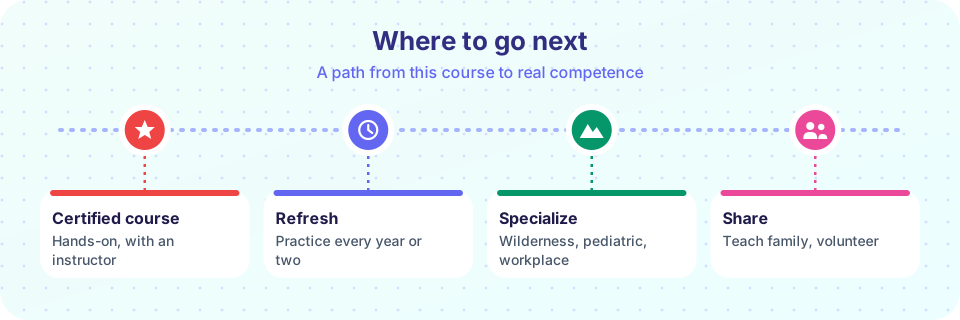
Step 1: take a certified hands-on course
Look for a course given by a national Red Cross or Red Crescent society, a recognized ambulance or first-aid organization, or another accredited provider in your country. A good course:
- is hands-on, with manikins for CPR, real bandages and splints and an AED trainer;
- is taught by an accredited instructor who gives feedback;
- covers adult, child and infant basics, or offers pediatric options;
- teaches local protocols, including your emergency number and local advice on choking, aspirin and bleeding control;
- gives a certificate with a validity period.
Many courses combine online theory with a short practical session. Courses for school staff, coaches, childcare workers and workplaces often have additional requirements.
Step 2: refresh regularly
Research on CPR training has repeatedly found that skills decline within months to a year after a course if they are not used. Guidelines also change as evidence improves. Plan to refresh at least every one to three years, or as the certificate says, and consider short practice sessions in between: ten minutes of compressions on a manikin each season, a review of your kit and plan twice a year, a walk-through of a scenario with your household.
Step 3: learn what your life needs
Different settings carry different risks. Consider specialist training if one of these applies to you:
- Pediatric first aid for parents, grandparents, teachers, childcare workers and coaches.
- Workplace first aid, especially in construction, manufacturing, kitchens and laboratories.
- Wilderness and remote first aid for hikers, climbers, sailors and guides, covering long waits for help, improvised splints, cold and heat illness and evacuation decisions.
- Mental health first aid to recognize and support someone in distress.
- Water safety and lifesaving for swimmers, lifeguards and boat owners.
- Sports first aid for coaches and players: concussion, joint injuries and heat.
- Stop the Bleed or similar bleeding-control courses for severe bleeding and tourniquets.
- Emergency preparedness and community response programs run by local authorities.
Step 4: share and serve
Teaching a family member to dial the emergency number and tell the address, showing colleagues where the AED is, and helping a neighbor build an emergency plan all multiply the value of what you know. Consider joining a school, club or community first-aid team, becoming a first aider at work or volunteering as a community responder or event first-aider, where available.
Connecting first aid to other subjects
First aid sits at the edge of several larger fields. If you want to go deeper into how the body works, start with Anatomy and Physiology, which explains the circulation, breathing and nervous systems behind the emergencies in this course. The study of infection and hygiene is in Microbiology. For how drugs act and why doses and allergies matter, see Pharmacology. How populations stay safe, from injury prevention to disaster planning and the evidence behind public campaigns, is the subject of Public Health and Epidemiology. And for the mind and its responses to stress and trauma, see Clinical Psychology. Nutrition and fitness matter too: Nutrition Science covers the fuel behind everything from blood sugar to recovery.
A useful way to study these subjects is to keep a question in mind from this course: why does the body respond the way it does when blood flow to the brain stops, or when an airway swells shut, and how does the first-aid step work against it?
A last word on confidence
Many people hesitate to help because they are afraid of making a mistake. Remember these facts. Doing something is nearly always better than doing nothing, especially calling for help and starting CPR for someone who is not breathing normally. Many places protect good-faith helpers by law. And your calm voice, your presence and your phone call are real first aid. Take the course, practice, and be ready.
Try it
Choose your situation and see a suggested next step. This is a simple guide for planning, not an assessment of your needs.
Check your understanding
Quick check · 4 questions
of 4 answered You scored / 4 · perfect!
-
1. What is the best next step after finishing a text course like this?
Practical skills need practice with an instructor and feedback. -
2. Why refresh your first-aid skills regularly?
Skill decay is well documented and guidelines are updated. -
3. Which course suits a mountain guide best as an addition to basic training?
Remote settings mean long waits and need adapted skills. -
4. What is true about helping in an emergency?
Calling for help and starting CPR are real first aid and can save lives.
Summary
- Turn knowledge into skill with a certified, hands-on course and refresh it every one to three years.
- Add specialist training that matches your life: pediatric, workplace, wilderness, mental health, water safety and bleeding control.
- Share what you know: plans, drills and teaching multiply the benefit.
- Connect first aid to anatomy, microbiology, pharmacology, public health, clinical psychology and nutrition.
- Be ready, stay calm and call for help.
Next: back to the First Aid and Emergency Care course page
Track your progress
Create a free account to tick off lessons and pick up where you left off on any device.
of First Aid and Emergency Care lessons completed