


















Lesson 22 of 47 · Bleeding, Wounds and Shock
Chapter 4 Review: Bleeding, Wounds and Shock
Review severe bleeding control, tourniquets, wound care, infection signs and shock with a one-picture summary, a recap table, a scenario drill and a quiz.
Chapter 4 covered the skills that keep blood in the body and flowing where it should. Together with the airway and CPR skills of chapter 3, they form the backbone of life-saving first aid. Use this page to check that you can recall the order of actions and the reasons behind them.
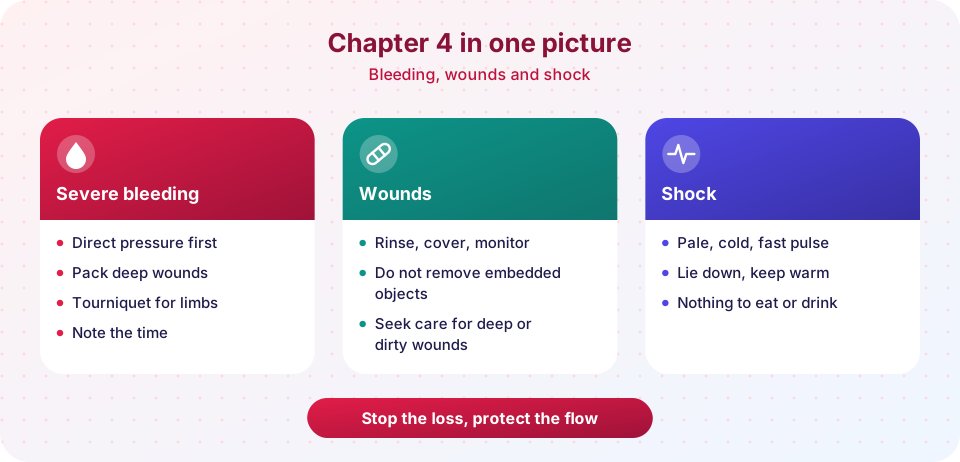
Educational information only. This course is not a substitute for a certified, hands-on first-aid course or for emergency services. Severe bleeding and shock are emergencies: call your local emergency number.
What you will learn
- A recap of the ladder for severe bleeding, wound care and shock.
- A scenario drill for choosing the next action.
- A mixed quiz covering the whole chapter.
Recap table
| Lesson | Key points |
|---|---|
| Controlling severe bleeding | Call, expose, direct pressure, pack deep wounds, pressure bandage, tourniquet 5 to 7 cm above the wound on a limb; write the time; do not loosen |
| Wounds, dressings and infection | Rinse with running water, cover, change daily; infection signs; tetanus; nosebleed lean forward and pinch 10 minutes; keep amputated part cool and moist |
| Shock | Pale, cold, clammy, fast weak pulse; treat the cause, lie down, keep warm, nothing by mouth, monitor and call early |
Decision guide
- Heavy bleeding? Call, press, pack, tourniquet if a limb and still bleeding.
- Minor wound? Rinse, cover, watch. Seek care if deep, dirty, bite, puncture or infected.
- Pale, cold, fast pulse after injury? Think shock: call, treat cause, lie down, keep warm.
One incident, three lessons
A worker slips while carrying a glass pane and a shard opens the inside of his forearm. Blood runs through his fingers. A colleague, calling emergency services on speaker, presses a folded shirt onto the wound with both hands. The shirt soaks through; she adds a second one on top and presses harder instead of lifting the first. After a few minutes the bleeding slows, so she wraps a firm bandage and checks that his fingers are warm and pink. That was bleeding control.
When the crew asks about the smaller cuts on his other hand, she explains that she rinsed them under the tap and covered them with plasters, and that nothing looks infected. That was wound care. Meanwhile the worker has turned pale and clammy and is breathing quickly. She lays him down, covers him with a coat, gives him nothing to drink and tells the crew his pulse is fast and weak. That was shock care, and it started because she recognized what the signs meant, not because someone told her. In this one scene she used the three lessons of the chapter in the right order.
Try it
This drill describes a situation. Decide your first action aloud, then compare.
Press Run (or Ctrl + Enter) to see the console output here.
No output.
Check your understanding
Quick check · 10 questions
of 10 answered You scored / 10 · perfect!
-
1. A pad on a bleeding wound is soaked through. What should you do?
Removing the pad disrupts clots; add layers and keep pressure. -
2. Where does a tourniquet go?
Above the wound on a single bone; high and tight if unsure. -
3. After a tourniquet is applied, what should you do?
Record the time; leave removal to the hospital. -
4. What is the best way to clean a minor wound?
Running water removes dirt without damaging tissue. -
5. Which signs suggest wound infection?
Spreading redness and fever mean see a doctor. -
6. How should you manage a nosebleed?
Leaning forward avoids swallowing blood; sustained pressure stops the bleeding. -
7. How do you store an amputated finger?
Keep it cool and moist, not frozen or soaked. -
8. Which sign is typical of shock?
Blood is diverted from the skin; the heart beats faster. -
9. What should you NOT give a person in shock?
Nothing by mouth: vomiting and possible surgery. -
10. Why is a small child at higher risk from a given blood loss?
At about 70 mL per kg, a 10 kg child has around 700 mL, so a little loss is a large fraction.
Summary
- Severe bleeding: call, expose, press, pack, tourniquet for limbs; write the time.
- Minor wounds: rinse, cover and watch; know the signs that need a clinician.
- Shock: call early, treat the cause, lie down, keep warm, nothing by mouth, monitor.
- Practice these skills with a trainer, and renew them regularly.
Track your progress
Create a free account to tick off lessons and pick up where you left off on any device.
of First Aid and Emergency Care lessons completed