


















Lesson 3 of 47 · Getting Started
Emergency Numbers and Making the Call
Learn emergency numbers around the world, what to say when you call, how dispatchers guide you, and how to give your location so help finds you fast.
The most valuable first-aid skill needs no equipment at all: calling for help, and doing it well. A clear call gets the right crew to the right place sooner, and the dispatcher on the line can coach you through CPR, bleeding control and other steps while the ambulance is on its way. Many people hesitate because they are not sure the problem is "serious enough" or because they panic and forget the address. This lesson removes both problems.
Educational information only. Emergency systems differ between countries. This lesson is not a substitute for a certified first-aid course or for emergency services. If someone is in danger now, call your local emergency number first.
What you will learn
- The emergency numbers used in many regions, and how to find yours.
- How to give your location when you are not sure where you are.
- A short script for describing the emergency.
- What dispatchers do and why you should stay on the line.
- When to call, and what to do if you are unsure.
Key terms
Dispatcher (or call-taker): the trained person who answers an emergency call, decides what resources to send and can coach you through first aid.
Emergency number: the short number that connects to ambulance, fire and police services; it is free from most phones.
Dispatcher-assisted CPR: instructions given by the call-taker while you perform CPR.
Callback number: the number the dispatcher can use to reach you again if the call drops.
Location accuracy: how precisely the system can place you; mobile networks help, but you should always say your location aloud.
Emergency numbers around the world
There is no single worldwide number, but a few are very widely used. These are common examples; always check the current number for the place you live or visit.
| Region | Common emergency number |
|---|---|
| European Union and many other countries | 112 |
| United States and Canada | 911 |
| United Kingdom | 999 (112 also works) |
| Australia | 000 (112 on many mobile phones) |
| New Zealand | 111 |
| India | 112 |
| Japan | 119 for ambulance and fire, 110 for police |
The number 112 is special: it is the official emergency number across the European Union and is also recognized by mobile networks in many other places, so on a mobile phone it often connects you to the local service even when you are abroad. On many phones, you can also call the emergency number from a locked screen, and sometimes without a SIM card or credit, because the network routes emergency calls on any available signal.
Some countries run text-to-emergency or video services for people who are deaf, hard of hearing or unable to speak. If that applies to you or a family member, find out in advance how your local system works and register if registration is needed.
When to call
Call the emergency number when a person:
- is unresponsive, or is not breathing or is breathing in an unusual way;
- has severe bleeding that does not stop with firm pressure;
- has chest pain, signs of a stroke, severe difficulty breathing, or a serious allergic reaction;
- has been seriously injured in a fall, crash, fire or drowning incident;
- is in a situation where you cannot keep yourself or them safe.
When in doubt, call. Dispatchers would rather talk you through a problem that turns out to be minor than learn about a serious one too late. If the situation is clearly not an emergency, such as a long-standing minor illness, use your local non-emergency health line or a family doctor. Many countries have separate numbers for these, such as 111 in England or similar nurse advice lines elsewhere.
Giving your location
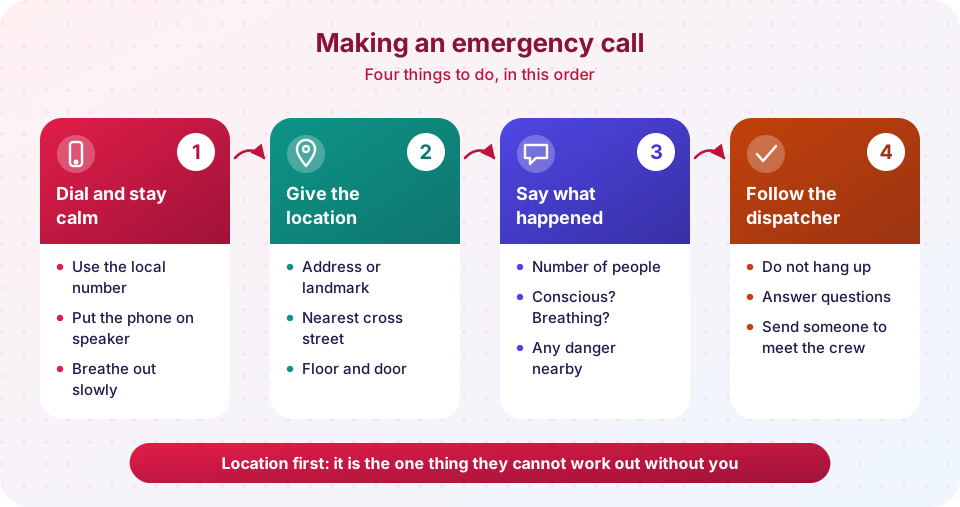
The dispatcher's first question is almost always "What is the address of the emergency?" and the second "What is your phone number?". Everything else is second to these because a crew that cannot find you cannot help you.
- At home or in a building: the full street address, the town, and details such as the floor, entrance and door code. Send someone to the street to wave down the ambulance if you can.
- On a road: the road name or number, the direction of travel, the nearest junction, a kilometer marker or landmark such as a petrol station or bridge.
- Outdoors: a trail name, a landmark, and map coordinates if your phone can show them. Many phones have a compass or maps app that displays latitude and longitude in a few taps. Some countries' systems also send the caller's phone location automatically, but this can be inaccurate indoors, so always say it aloud.
- When you do not know: say what you can see, read the nearest street sign, ask another person, or give the name of a nearby shop. Any clue helps.
What to say
Dispatchers use structured questions; you do not need to memorize them, but a simple script will keep you steady:
- Where? The location, repeated once.
- What happened? "My father has collapsed. He is not breathing." Use plain words. Avoid guesses about the diagnosis.
- How many people and what condition? "One person. He is unconscious."
- Is there any danger? Fire, traffic, a weapon, gas, an aggressive person.
- Your callback number and name.
Then listen. The dispatcher may tell you to start CPR, to bring an AED, to press on a wound or to unlock the door. Put the phone on speaker so both hands are free, and do not hang up until the dispatcher says you can. If someone else is with you, ask them to fetch the AED, unlock the door or meet the crew outside.
Press Run (or Ctrl + Enter) to see the console output here.
No output.
What happens after you call
The dispatcher enters the information into a system that selects and sends the nearest suitable crew, which may be an ambulance, a rapid-response car, a motorcycle paramedic or volunteer responders with a defibrillator. While the crew travels, the dispatcher keeps asking questions to update the crew and to guide you. Their questions may feel slow when you want action; they are not delaying help. The vehicle is usually already on its way.
If the call drops, ring back at once. If the condition changes, for example the person stops breathing, call again or tell the dispatcher on the line. If you are alone with a patient and need both hands for CPR, put the phone on speaker and place it beside you.
Calling responsibly
False or prank calls tie up lines that other people need. Call only for real emergencies; the police and fire service take hoax calls seriously, and in many places they are a crime. If you dial by accident, stay on the line and say it was a mistake; hanging up usually causes a callback or a crew being sent to check.
Practice, too. Learn the number for each country you travel to, write your home address and any access instructions on a card by the phone, and make sure children and older relatives know what to say. Rehearsing a 30-second call once can make a real call much calmer.
Press Run (or Ctrl + Enter) to see the console output here.
No output.
Common misconceptions
"I should check the person first and call later." If you are alone and it is an adult who is not breathing, call first (on speaker) and then begin CPR. For children and infants, some guidelines advise one minute of CPR first when you are alone and have no speaker phone; your course will tell you which rule to follow.
"The dispatcher is wasting my time with questions." The crew is usually already moving. Your answers help them prepare and help the dispatcher coach you.
"My location will be found automatically." It sometimes is, but not reliably, especially inside buildings. Always say it.
Check your understanding
Quick check · 4 questions
of 4 answered You scored / 4 · perfect!
-
1. Which number is the official emergency number across the European Union?
112 is the EU-wide emergency number and works on many mobile networks elsewhere too. -
2. What is the single most important piece of information for the call-taker?
Without a location the crew cannot reach the person, so give the address or landmark first. -
3. While the dispatcher is asking questions, what is usually happening?
Dispatching typically starts as soon as the location and basic problem are known. -
4. You are alone with an unresponsive adult who is not breathing. What helps most?
Calling early on speaker and starting compressions keeps blood flowing while help comes.
Summary
- Learn the emergency number where you live and where you travel; 112 works across the EU and on many mobiles.
- Give the location first, then what happened, how many people and any danger.
- Use speaker, stay on the line and follow the dispatcher's instructions.
- When in doubt, call; avoid hoax calls; rehearse your call script.
Next: Consent, Law and Ethics
Track your progress
Create a free account to tick off lessons and pick up where you left off on any device.
of First Aid and Emergency Care lessons completed