


















Lesson 31 of 47 · Medical Emergencies
Diabetes, seizures and fainting
Learn to help someone with low blood sugar, a seizure or a faint: fast sugar, protecting from injury, timing, the recovery position and when to call for help.
Some medical emergencies show up as a change in awareness: a person who becomes confused, drops to the floor, jerks, or just blacks out for a moment. Behind these changes are very different causes. Low blood sugar starves the brain of its main fuel. A seizure is a burst of abnormal electrical activity in the brain. A faint is a short drop in blood flow to the brain. Each needs a specific response, and the wrong response can do harm: for example, forcing food into the mouth of someone who is having a seizure.
This lesson teaches you to recognize each pattern, to give the matching first aid and to know when to call emergency services. Along the way you will learn the recovery position, one of the most useful skills in all of first aid, because it protects the airway of anyone who is unresponsive but breathing normally.
What you will learn
- Why the brain depends on blood sugar and what low blood sugar (hypoglycemia) looks like.
- How to give fast sugar safely, and when not to give food or drink.
- What to do during and after a seizure, and when it becomes an emergency.
- Why people faint and how to care for them.
- How to place an unresponsive, breathing person in the recovery position.
Key terms
- Hypoglycemia: low blood glucose, often defined as below about 4 mmol/L (70 mg/dL). It is a risk for people with diabetes who use insulin or certain tablets.
- Seizure: a sudden burst of abnormal electrical activity in the brain. Epilepsy is a condition in which seizures recur.
- Syncope (faint): a brief loss of consciousness caused by a short fall in blood flow to the brain.
- Fast-acting carbohydrate: sugar that is absorbed quickly, such as glucose tablets or juice.
- Recovery position: a side-lying position that lets fluid drain from the mouth and keeps the airway open.
Low blood sugar
Glucose is the brain's main fuel. In a healthy person, the hormones insulin and glucagon keep blood sugar steady. In diabetes, this control is impaired. People with type 1 diabetes make little or no insulin and must inject it; many with type 2 diabetes take medicines or insulin as well. If they take more insulin than needed, miss a meal, exercise a lot or drink alcohol, their blood sugar can fall too low.
Recognize it
Early signs are shakiness, sweating, hunger, pale skin, a fast pulse, headache, tingling lips and irritability. As the brain runs short of glucose, there is confusion, odd behavior (a person may seem drunk), slurred speech, poor coordination and then drowsiness, seizures or unconsciousness. Look for a medical bracelet, an insulin pen, a glucose meter or a sensor on the arm.
What to do
- If the person is awake and able to swallow, give fast-acting sugar straight away: for an adult, about 15 to 20 grams of carbohydrate. In practice that is a small glass (about 150 to 200 mL) of fruit juice or ordinary (not diet) soda, or glucose tablets as the packet states. Sugar dissolved in water works too.
- Wait about 10 to 15 minutes. If the person is not clearly better, give the same amount again and call emergency services. When they have recovered, give a longer-acting snack such as a sandwich or biscuits, and make sure they eat their next meal.
- If the person is drowsy, cannot swallow safely or is unconscious, do not put food or drink in their mouth. Place them in the recovery position if they are unresponsive but breathing, and call emergency services. Only a trained person should give glucagon, a hormone that raises blood sugar, and only if the person has it prescribed.
- If you are unsure whether the problem is low or high blood sugar, give sugar if the person is awake and able to swallow. For a person with diabetes, low blood sugar is more immediately dangerous, and a little sugar will not do much harm if their glucose turns out to be high.
High blood sugar (hyperglycemia) develops more slowly: great thirst, passing a lot of urine, tiredness, nausea, belly pain, fruity-smelling breath, fast deep breathing and drowsiness. It needs medical care. If you suspect it and the person is unwell, call.
Seizures
A seizure happens when many brain cells fire abnormally at once. Epilepsy is the most common cause, but seizures can also follow a head injury, low blood sugar, fever in young children, stroke, lack of oxygen, heavy alcohol use or withdrawal, or certain poisonings. Seizures take many forms. In a tonic-clonic seizure, the one most people picture, the person suddenly becomes unresponsive, stiffens, and then has rhythmic jerking movements for a minute or two. They may make noises, bite the tongue, lose bladder control and turn a bluish color around the lips because breathing is briefly disturbed. Afterward they are drowsy and confused for several minutes to an hour. Other seizures are subtler: staring, lip smacking, or a brief loss of awareness.
First aid during a seizure
- Stay with the person and note the time when the seizure began.
- Protect from injury. Move hard or sharp objects away. Put something soft, such as a folded jacket, under the head. Loosen tight clothing around the neck.
- Do not restrain them. Holding limbs does not stop a seizure and can cause injury.
- Do not put anything in the mouth. It is a myth that a person can swallow the tongue. Objects can break teeth or block the airway. Do not give food or drink.
- Clear the area of onlookers to give privacy and room.
After the seizure
When the jerking stops, check breathing. Roll the person into the recovery position and keep the airway open. Stay with them, speak calmly and reassure them as they wake. They may not know where they are. Do not give food or drink until they are fully alert. Offer to help them contact someone.
When to call emergency services
Call if the seizure lasts more than five minutes, if another seizure follows without recovery in between, if this is the person's first seizure, if they are injured, in water, pregnant, have diabetes or a medical alert for another serious condition, if they have trouble breathing afterward or do not begin to recover within a few minutes of the jerking stopping. A person with known epilepsy who has a brief, typical seizure and recovers well may not need an ambulance if they or their carers say this is normal for them.
Fainting
A faint (vasovagal syncope) is the most common cause of brief unconsciousness. Standing for a long time, heat, dehydration, strong emotion, pain or the sight of blood can trigger a reflex that slows the heart and widens blood vessels, so blood pools in the legs and the brain briefly gets too little. The warning signs are pallor, sweating, nausea, dizziness, tunnel vision and ringing in the ears.
What to do
- Catch them gently or lower them to the floor if you see the warning signs. Ask them to sit or lie down immediately; squeezing leg and arm muscles or crossing the legs and tensing them can sometimes abort the faint.
- Lie them flat and raise their legs by about 30 cm (a bag or chair). This helps blood return to the heart and brain. Loosen tight clothing and make sure they have air.
- Check breathing and look for injuries, since people can hurt their heads when they fall.
- They should wake within a minute or so. If they do not wake, treat them as unresponsive: check breathing, place them in the recovery position and call emergency services.
- Help them sit up slowly, give a drink and let them rest. Getting up too fast can bring another faint.
A faint is usually harmless, but call a doctor or emergency services if it happened during exercise, with chest pain, palpitations, shortness of breath, a severe headache, an injury, during pregnancy or in someone with a heart condition, or if the person is older and it has no clear trigger.
The recovery position
Use this for a person who is unresponsive but breathing normally, and who has no suspected spinal injury that you can avoid moving for. It stops the tongue and fluid blocking the airway.
- Kneel beside them. Place the arm nearest you at a right angle to the body, palm up.
- Bring the far arm across the chest and hold the back of that hand against their near cheek.
- With your other hand, lift the far knee and bend it so the foot is flat on the floor.
- Keeping the hand pressed to the cheek, pull on the bent knee to roll them toward you onto their side.
- Adjust the upper leg so the hip and knee are bent at right angles. Tilt the head back gently so the airway stays open, with the mouth pointing down.
- Call emergency services and check breathing regularly. If they stop breathing normally, roll them onto their back and start CPR.
If the person is pregnant, lie them on their left side. Change sides every half hour if they stay in the position for a long time.
Common misconceptions
- "Put a spoon or wallet in the mouth during a seizure." Never. It risks injury and does not help breathing.
- "A person who looks drunk is just drunk." Confusion and slurred speech can be low blood sugar, a head injury or a stroke.
- "Give insulin if someone with diabetes is unwell." A first aider does not give insulin. Low sugar needs sugar; high sugar needs medical care.
- "Fainting is always harmless." Usually, but faints with chest pain, exercise or injury need medical assessment.
Try it
A seizure stopwatch. Knowing how long a seizure has lasted is one of the most useful things a helper can tell the crew. Tick "demo speed" to watch one second stand for 30 seconds, so you can see the five-minute alert without waiting. This is a demonstration only.
Now a small decision function for the "confused or collapsed person with diabetes" case. It shows why awareness and the ability to swallow decide whether you give sugar by mouth. It is a demonstration, not a clinical tool.
Press Run (or Ctrl + Enter) to see the console output here.
No output.
Check your understanding
Quick check · 5 questions
of 5 answered You scored / 5 · perfect!
-
1. A person with diabetes is shaky, sweaty and confused but awake and able to swallow. What is the first action?
Awake and able to swallow: give fast-acting sugar, then reassess after 10 to 15 minutes. -
2. What should you never do during a seizure?
Nothing should go in the mouth. It can break teeth or block the airway, and a person cannot swallow their tongue. -
3. When do you call emergency services for a seizure?
Long, first-time, repeated or complicated seizures need emergency care. -
4. How should you position someone who has fainted?
Lying flat with raised legs helps blood return to the brain. -
5. A faint victim has not woken after a minute. What do you do?
A faint should pass within about a minute. If not, treat it as unresponsive.
Summary
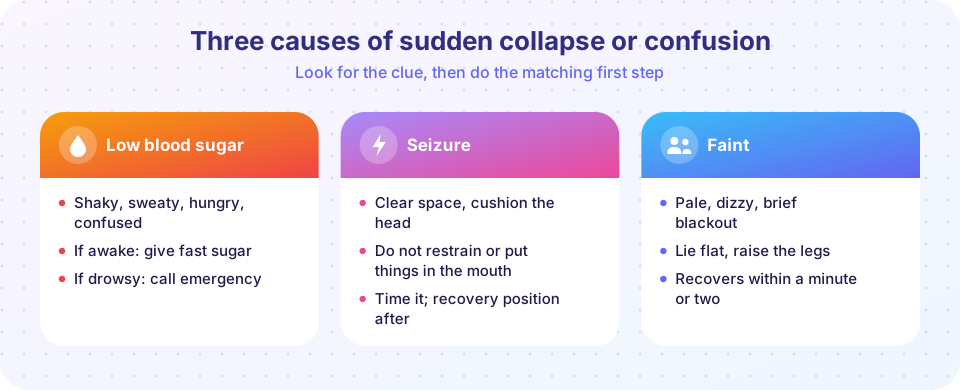
- Low blood sugar: awake and able to swallow, give 15 to 20 g of fast sugar and reassess; drowsy or unconscious, give nothing by mouth and call.
- Seizure: note the time, protect from injury, do not restrain or put anything in the mouth, use the recovery position afterward, call if long, first or complicated.
- Faint: lie flat with raised legs; if there is no recovery in a minute, treat as unresponsive.
- The recovery position protects the airway of an unresponsive, breathing person.
Next: Chapter 6 review
Track your progress
Create a free account to tick off lessons and pick up where you left off on any device.
of First Aid and Emergency Care lessons completed