


















Lesson 5 of 47 · Getting Started
Chapter 1 Review: Getting Started
Review the first chapter of first aid: the three aims, emergency calls, consent and ethics, with a one-picture summary, recap table and a ten-question quiz.
You have finished the first chapter. Before moving on to scene safety and CPR, take ten minutes to pull the ideas together. The most reliable way to remember is to retrieve: look at the picture, then try to say each point aloud without reading, then take the quiz.
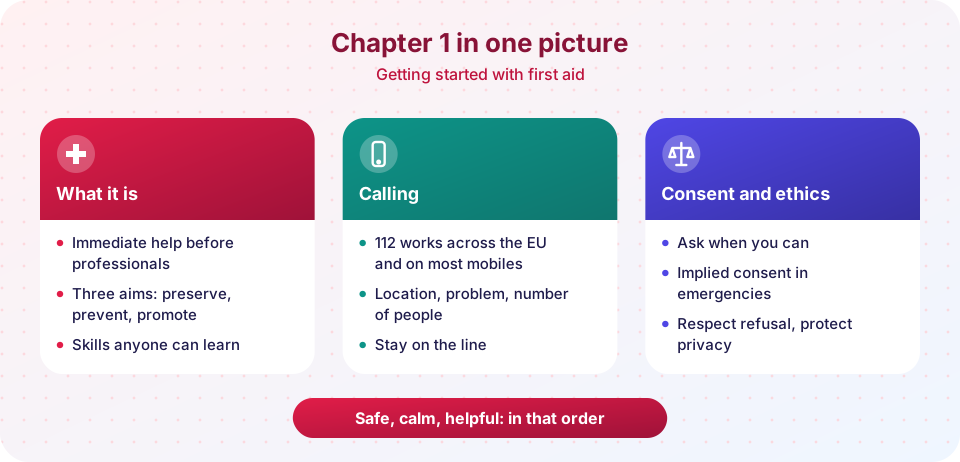
Educational information only. This course is not a substitute for a certified first-aid course or for emergency services. In an emergency, call your local emergency number.
What you will learn
- A one-page recap of lessons 1 to 4.
- Which ideas to practice now, before the CPR chapters.
- How to test yourself with a mixed quiz.
Recap table
| Lesson | Big idea | One sentence to remember |
|---|---|---|
| Course map | Nine chapters from the urgent to the everyday | Learn the most urgent skills first, then practice with a real course |
| What is first aid? | Three aims | Preserve life, prevent worsening, promote recovery |
| Emergency numbers | Calling well | Location first, stay on the line, use speaker |
| Consent, law and ethics | Respecting the person | Ask when you can, assume yes when you cannot, accept a capable adult's no |
Skills to practice this week
- Write the emergency number for your region and your home address on a card by the phone.
- Say your 30-second call script aloud twice (see the lesson on calling).
- Ask a family member to role-play a refusal, and practice staying calm, explaining and staying nearby.
- Check where the nearest AED is in your usual places: school, work, gym, station.
A worked scenario that uses the whole chapter
You are in a park when a man in his sixties sits down heavily on a bench and slumps sideways. A jogger stops beside you. What do you do, using only what chapter 1 taught you?
First, the aims: your priority is to preserve life, so you check quickly whether he is responding and breathing. Second, consent: he is slumped and does not answer when you speak and tap his shoulder, so consent is implied and you can give urgent help. Third, the call: you turn to the jogger and say, "You in the blue shirt, call 112 now, tell them we are at the bandstand in the north corner of the park, one man collapsed, not responding." You have named a person, given a task and handed over the location, so the call does not depend on a hopeful "somebody".
Fourth, ethics and law: you act in good faith within your training, speak calmly, shield him from onlookers with your jacket and keep what you saw to yourself afterwards, except what the ambulance crew needs. The next chapters add the details that make the help effective: how to scan for danger, protect yourself and run the scene, and then the checks and CPR themselves. Notice how much of the rescue already depends on decisions rather than equipment: calling, naming, asking and respecting.
Try it
A flashcard drill that shuffles the key questions of the chapter. Say each answer aloud before you read it.
Press Run (or Ctrl + Enter) to see the console output here.
No output.
Check your understanding
Quick check · 10 questions
of 10 answered You scored / 10 · perfect!
-
1. Which is the correct order of priority for first aid?
Threats to life always come first, then preventing deterioration, then recovery. -
2. Which event in 1859 inspired the Red Cross movement?
Henry Dunant saw the wounded after Solferino and wrote about it in 1862; the Red Cross followed in 1863. -
3. What does 112 refer to?
112 is the EU emergency number and works on many mobiles elsewhere. -
4. The dispatcher asks many questions. What is probably happening?
Dispatch normally starts as soon as location and basic facts are known. -
5. You are with an adult who does not respond and is not breathing normally. Which consent applies?
They cannot answer and life is at risk, so consent is implied. -
6. An awake adult says no thanks to your help. What is best?
Capable adults may refuse; staying nearby lets you act if they lose consciousness. -
7. Which statement about Good Samaritan laws is most accurate?
Their purpose is to remove fear of liability for good-faith help. -
8. Which is a duty-to-rescue style rule?
Several countries make failing to help or summon help a criminal offence. -
9. Which principle is respected when you ask for permission before treating?
Autonomy means respecting the person's right to decide about their own body. -
10. What is the best way to remember the key points of this chapter?
Retrieval and spacing produce better recall than re-reading.
Summary
- First aid aims to preserve life, prevent worsening and promote recovery.
- A good call gives the location first and keeps the line open.
- Consent is expressed when possible, implied in life-threatening emergencies, and refusal by a capable adult is respected.
- Laws differ by country; stay within your training and act in good faith.
Track your progress
Create a free account to tick off lessons and pick up where you left off on any device.
of First Aid and Emergency Care lessons completed