


















Lesson 8 of 47 · Principles and Scene Safety
Infection Control and Personal Protective Equipment
Learn how infections spread, how gloves, handwashing and face shields protect you and the patient, and how to remove gloves, handle sharps and clean up safely.
When you help someone who is bleeding, vomiting or coughing, your skin may meet blood or body fluids. The real risk of catching an infection from a single first-aid encounter is small, and it should never stop you from giving life-saving help. But small risks are worth reducing when the remedy is cheap and quick. Infection control also protects the patient: your hands can carry germs into a wound. A few habits, learned once, do both jobs.
Educational information only. This lesson is not a substitute for a certified first-aid course or for professional medical advice. If you think you have been exposed to blood or body fluids, seek medical advice promptly.
What you will learn
- How infections spread, and which routes matter in first aid.
- What standard precautions are and what personal protective equipment (PPE) a first aider should carry.
- How to wash hands properly and remove gloves safely.
- How to handle sharps, waste and spills, and what to do after an exposure.
Key terms
Pathogen: a germ, such as a virus, bacterium or fungus, that can cause disease.
Standard precautions: basic practices applied to every patient, because you cannot tell who is infected by looking.
PPE (personal protective equipment): gloves, face shields, eye protection, aprons and masks that act as barriers.
Bloodborne virus: a virus carried in blood, such as hepatitis B, hepatitis C or HIV.
Sharps: needles, blades or glass that can pierce skin.
How infections spread
Infection needs a chain of links: a pathogen, a place where it lives (a reservoir such as a person), a way out, a way of travelling, a way in, and a susceptible person. Infection control works by breaking a link. The routes that matter most for first aiders are:
- Contact: touching blood, body fluids, broken skin or a contaminated surface and then touching your own mouth, eyes, nose or a wound.
- Droplets: large particles from coughing, sneezing or talking that travel a short distance.
- Airborne particles: smaller particles that can hang in the air in poorly ventilated rooms.
- Bloodborne: blood entering your body through a cut, a needle stick or the lining of the eye, nose or mouth.
Skin is an excellent barrier when it is intact. Most risks come from fresh cuts on your hands, splashes into your eyes or mouth, and needle-stick injuries. Hepatitis B vaccination is recommended for people with a workplace first-aid role and many other health workers; ask your doctor or employer about it.
A lesson from history
In the 1840s, the Hungarian doctor Ignaz Semmelweis worked in a Vienna maternity hospital where one ward had far more deaths from childbed fever than another. He noticed that the high-mortality ward was staffed by doctors and students who also performed autopsies. After he introduced handwashing with a chlorine solution in 1847, deaths in that ward fell sharply. His findings were met with resistance, but they anticipated germ theory, which Louis Pasteur and Robert Koch later developed. The lesson: washing hands matters, even when you cannot see the germs.
Standard precautions and PPE
Because you cannot know who carries what, treat every patient with the same precautions:
- Gloves. Single-use gloves are the first piece of PPE. Nitrile gloves are a good choice because many people are allergic to latex. Use a fresh pair for each patient, and change them if they tear.
- Hand hygiene. Wash before putting gloves on if you can, and always after taking them off.
- Face shield or pocket mask. A small plastic shield with a one-way valve lets you give rescue breaths without mouth-to-mouth contact. If you have no barrier and are unwilling to give breaths, give compressions only, which is a safe and effective option for adults.
- Eye protection. Glasses or goggles reduce risk from splashes when you are dealing with heavy bleeding or vomiting.
- Apron or spare clothing. Useful in a bigger incident.
- Masks. A surgical mask worn by you and, if tolerated, by a coughing patient reduces droplet spread. In an outbreak, follow local guidance.
A small kit in your car, bag or workplace with gloves, a face shield, wipes, dressings and a waste bag is enough for most situations.
Washing hands properly
Soap and running water remove germs by lifting them off the skin; alcohol-based hand rubs kill many of them. The World Health Organization teaches that a full soap-and-water wash takes about 40 to 60 seconds, and an alcohol rub 20 to 30 seconds. Public-health bodies often summarize the soap wash as "at least 20 seconds" of scrubbing. The method is more important than the clock:
- Wet your hands and apply soap.
- Rub palms together, then the backs of the hands, then between the fingers.
- Scrub the backs of the fingers, the thumbs and the fingertips in your palms.
- Rinse well and dry with a clean towel or air; damp hands spread germs.
Use an alcohol-based rub (at least 60 to 70 percent alcohol) when your hands are not visibly dirty and you have no water. If they are visibly dirty or bloody, wash with soap and water.
Putting on and removing gloves
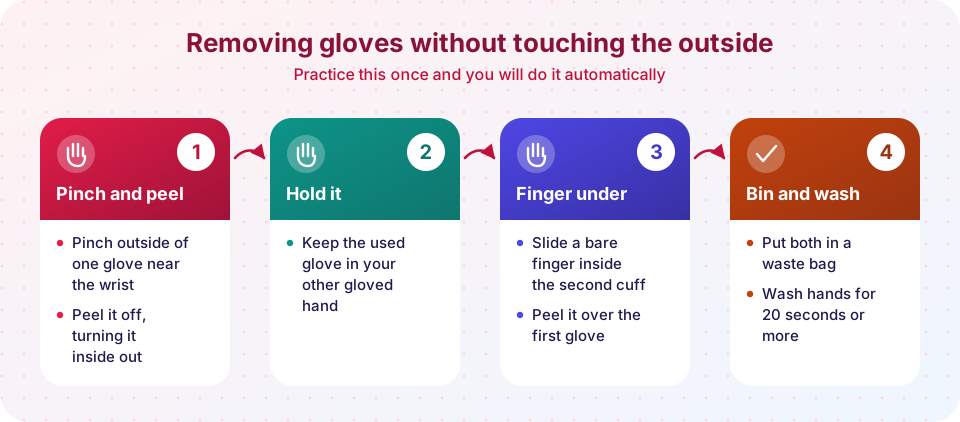
Put gloves on with clean, dry hands, check them for holes and cover any cuts on your own hands with a waterproof dressing first. When you take them off, the outer surface is contaminated, so the aim is to keep it from touching your skin. The method shown at the top of this lesson is:
- Pinch the outside of one glove near the wrist and peel it away, turning it inside out.
- Hold the removed glove in your other gloved hand.
- Slide a bare finger under the cuff of the second glove, without touching the outside, and peel it off over the first glove, so that the first is inside the second.
- Put the bundle in a waste bag and wash your hands.
Press Run (or Ctrl + Enter) to see the console output here.
No output.
Sharps, waste and spills
- Never recap, bend or break needles. If you find loose needles, do not pick them up by hand; use tongs or a stiff piece of card and put them in a rigid container, or leave them for the emergency crew.
- Waste. Dressings and gloves with blood on them go in a sealed bag, then in normal waste unless local rules require clinical waste handling. Ambulance crews and health facilities have specific waste routes.
- Spills. Wear gloves, cover the spill with absorbent material, clean the area with a disinfectant approved locally, then wash hands. For large spills, follow your workplace rules.
- Your own skin. Cover cuts and sores with waterproof dressings before you start.
If you are exposed
If blood or body fluid gets on your skin, wash it with soap and water. If it splashes in your eyes, rinse with plenty of clean water for several minutes. If you are pricked by a needle or cut by a contaminated sharp, let it bleed gently, wash with soap and running water and do not scrub or suck the wound. Then seek medical advice quickly: in some situations, preventive treatment given within hours can greatly reduce infection risk. Tell your doctor or employer what happened and write it down.
Common misconceptions
"I can catch HIV from a quick first-aid contact." Transmission needs specific conditions, such as blood entering your bloodstream, and the risk from ordinary first aid is very low. Do not let fear stop you from helping.
"Alcohol gel replaces handwashing." It is a good second choice when hands are not visibly dirty, but it does not remove blood or dirt.
"Gloves make handwashing unnecessary." Gloves have tiny holes and your hands are contaminated when you take them off. Wash anyway.
Check your understanding
Quick check · 5 questions
of 5 answered You scored / 5 · perfect!
-
1. Which glove material is often preferred in first-aid kits because of allergy concerns?
Nitrile gloves avoid the latex allergy problem and protect well. -
2. Which sequence correctly describes glove removal?
The aim is to keep the contaminated outside from touching your skin. -
3. What should you do after a needle-stick injury?
Prompt washing and medical assessment let doctors decide on preventive treatment. -
4. Who is credited with showing in 1847 that handwashing cut deaths from childbed fever?
Semmelweis introduced handwashing with chlorine solution in a Vienna maternity ward. -
5. If you do not have a barrier device and do not want to give mouth-to-mouth breaths, what can you do for an adult in cardiac arrest?
Hands-only CPR is recommended when you are unwilling or unable to give breaths.
Summary
- Infection spreads through contact, droplets, air and blood; standard precautions treat every patient the same.
- Gloves, handwashing, face shields and covered cuts are cheap, effective barriers.
- Remove gloves so that the contaminated side stays inside; wash hands afterwards.
- Treat sharps carefully; after an exposure, wash and seek medical advice quickly.
Track your progress
Create a free account to tick off lessons and pick up where you left off on any device.
of First Aid and Emergency Care lessons completed