


















Lesson 30 of 47 · Medical Emergencies
Choking, severe allergy and asthma
Learn how to help an adult who is choking, a person in a severe allergic reaction and someone having an asthma attack, with back blows, auto-injectors and inhalers.
Breathing is the most urgent need the body has. Three common emergencies threaten it from different directions. In choking, something blocks the airway from inside. In anaphylaxis, a severe allergic reaction causes swelling and narrowing of the airway and a drop in blood pressure. In an asthma attack, the small airways in the lungs tighten and fill with mucus so that air cannot flow.
All three can go from mild to life-threatening in minutes, and in all three an informed bystander can make a difference before the ambulance arrives. The skills here are specific: where to hit, which device to press, how many puffs to give. The protocols differ slightly by country, so treat this lesson as a clear explanation of the principles, and learn the exact version taught where you live.
What you will learn
- How to tell mild choking from severe choking, and the steps for a choking adult.
- How to recognize anaphylaxis and use an adrenaline auto-injector.
- How to help a person who is having an asthma attack with a reliever inhaler.
- Which signs mean call emergency services at once.
Key terms
- Foreign-body airway obstruction: the medical name for choking: something blocks the airway.
- Anaphylaxis: a sudden, severe allergic reaction affecting the whole body.
- Adrenaline (epinephrine): the medicine that reverses the dangerous effects of anaphylaxis. It comes in auto-injectors with fixed doses.
- Reliever inhaler: a rescue inhaler for asthma, usually blue, which relaxes the airway muscles quickly.
- Spacer: a plastic chamber that makes an inhaler easier to use and gets more medicine into the lungs.
Choking in an adult
The airway and the food pipe both start at the back of the throat. A piece of food, a toy or a sweet can slip into the airway and block it. Choking often happens during meals, while talking or laughing with food in the mouth, and in people who have been drinking alcohol or who have difficulty swallowing.
Mild or severe?
Ask: "Are you choking?" The answer tells you which situation you are in.
- Mild choking. The person can speak, cough forcefully, cry or breathe. Encourage them to keep coughing. Coughing is the most effective way to clear the airway. Stay with them. Do not slap their back while they are coughing effectively, and do not put your fingers in the mouth.
- Severe choking. The person cannot speak, cough or breathe. They may clutch the throat, make no sound, turn pale or blue and become unconscious. This is an emergency.
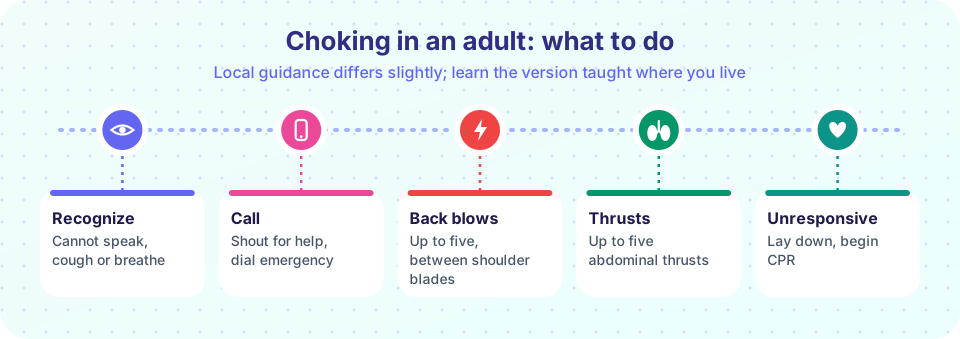
Steps for severe choking in an adult
- Shout for help and have someone call your emergency number. If you are alone, start treating first.
- Give up to five back blows. Lean the person forward so that the object can come out of the mouth rather than slide deeper. Support the chest with one hand and, with the heel of the other hand, strike firmly between the shoulder blades, up to five times. Check after each blow whether the object has come out.
- If that fails, give up to five abdominal thrusts. Stand behind the person, wrap your arms around the waist, make a fist with one hand just above the navel and below the breastbone, grasp it with the other hand and pull sharply inward and upward. Repeat up to five times.
- Alternate five back blows with five abdominal thrusts until the object comes out or the person becomes unresponsive.
- If they become unresponsive, lay them on the ground, make sure help is on the way and start CPR. Chest compressions can push air out and sometimes dislodge the object. Each time you open the airway to give breaths, look in the mouth and take out an object you can see. Do not sweep blindly with your fingers.
Different guidelines differ in detail. European resuscitation guidelines teach back blows followed by abdominal thrusts, as above. Some courses and some countries teach abdominal thrusts alone for adults. Both approaches aim to raise pressure in the airway and force the object out. Learn the version taught by your own course.
For a person who is pregnant or very large, where you cannot reach around the abdomen, give chest thrusts instead of abdominal thrusts: put your hands in the center of the breastbone, as for CPR, and thrust inward sharply.
Anyone who has received abdominal thrusts should be checked by a doctor afterward, because the thrusts can bruise internal organs. Infants and children need adapted techniques, covered in a later lesson.
Severe allergic reaction (anaphylaxis)
An allergy is an immune system that reacts to something harmless as if it were a threat. In anaphylaxis the reaction involves the whole body and begins within minutes of contact, though it can take up to a couple of hours. Common triggers are foods (peanuts, tree nuts, milk, eggs, fish, shellfish, sesame), insect stings (wasps, bees), medicines (such as penicillin) and latex. Chemicals released in the body make blood vessels leak and widen, the airways swell and the blood pressure falls.
Recognize it
Think of three groups of signs, and consider the trigger:
- Airway and breathing: a hoarse voice, a swollen tongue or throat, a feeling of a lump in the throat, noisy breathing, wheeze, cough or trouble breathing.
- Circulation: pale, clammy skin, dizziness, a very fast pulse, feeling faint or collapse.
- Skin and gut: hives (itchy raised welts), flushing, swelling of the lips, face or eyes, vomiting and belly pain.
Skin signs alone are an allergic reaction but not yet anaphylaxis. Trouble with the airway, breathing or circulation after a likely trigger means anaphylaxis.
What to do
- Call emergency services and say "anaphylaxis".
- Use the person's adrenaline auto-injector straight away if they have one. Remove the safety cap, press the device firmly against the outer middle part of the thigh (through clothing is fine) and hold it for the time the device instructions say. Note the time. Auto-injectors come in different strengths for different body weights; use the one prescribed for the person.
- Lie them flat with the legs raised. If they have trouble breathing, let them sit up. Do not let them stand or walk, because a sudden drop in blood pressure can cause collapse. If they are pregnant, lie them on the left side. If they are unresponsive but breathing, use the recovery position.
- If there is no improvement after about five minutes, and a second auto-injector is available, give a second dose, as the device or your local protocol says.
- Stay with them. Even if they feel better, they must go to hospital, because symptoms can return hours later.
Adrenaline is safe to use in anaphylaxis and the risk of waiting is greater than the risk of giving it. If you are unsure whether it is anaphylaxis and the person has a prescribed auto-injector and trouble breathing, the guidance is to use it.
Asthma attack
Asthma is a long-term condition in which the airways become inflamed and sensitive. During an attack the muscle around the airways tightens, the lining swells and mucus builds up, so the person wheezes, coughs, feels tight in the chest and gets short of breath. Triggers include colds, exercise, cold air, pollen, pets, smoke and strong smells.
What to do
- Sit the person upright and stay calm. Do not make them lie down. Loosen tight clothing.
- Help them use their reliever inhaler (usually blue). Ideally use a spacer. Give one puff at a time: shake the inhaler, put one puff into the spacer, ask the person to breathe in slowly and hold the breath for a few seconds. Repeat. Many guidelines advise one puff every 30 to 60 seconds, up to 10 puffs, while following the person's own asthma action plan if they have one. Some countries use a different pattern, such as four puffs, four breaths and a wait of four minutes. Learn the local protocol.
- Call emergency services if the attack is severe or does not improve: they cannot speak a full sentence, are using their neck and shoulders to breathe, have blue or gray lips, are exhausted or confused, or the reliever does not help. If it is their first attack, call.
- If they become unresponsive and are not breathing normally, start CPR.
Someone who has recovered from an attack still needs their doctor to review the asthma plan.
Common misconceptions
- "Slap them on the back while they cough." If they can cough, let them. Back blows are for severe choking where they cannot cough.
- "Antihistamines are enough for anaphylaxis." They can ease itching but do not reverse airway swelling or low blood pressure. Adrenaline does.
- "Wait to see if it gets worse before using the auto-injector." Delay is dangerous. Use it as soon as you recognize anaphylaxis.
- "Lie an asthma patient down to relax." Sitting upright eases breathing.
Try it
First, a choking decision helper for an adult. It walks through the questions in order. This is a learning demonstration and does not replace hands-on practice.
Next, a small script that lays out the common reliever schedule of one puff every 30 to 60 seconds. It prints the times so you can see how long a full round takes. Real decisions follow the person's own plan and local protocols.
Press Run (or Ctrl + Enter) to see the console output here.
No output.
Check your understanding
Quick check · 5 questions
of 5 answered You scored / 5 · perfect!
-
1. An adult is choking but coughing forcefully and can speak. What do you do?
A strong cough is the best way to clear the airway. Intervene only if they can no longer cough or speak. -
2. Where do you inject an adrenaline auto-injector?
The outer mid-thigh is the standard site and works through clothing. -
3. A person in anaphylaxis feels faint. What position do you use if they have no breathing trouble?
Lying flat helps blood return to the heart. Let them sit up if breathing is hard. -
4. A person with asthma is struggling to breathe. What is the best first step?
Sitting upright and using the reliever, ideally with a spacer, is the first step. -
5. Why must a person who got adrenaline for anaphylaxis go to hospital even if they feel better?
A reaction can come back hours later and the person needs observation.
Summary
- Mild choking: encourage coughing. Severe choking: back blows, abdominal thrusts, then CPR if unresponsive. Learn the local version.
- Anaphylaxis: call, give adrenaline into the outer mid-thigh, lie flat with legs raised and go to hospital.
- Asthma attack: sit up, reliever inhaler with a spacer, one puff at a time, call if severe or not improving.
- All three are breathing emergencies where seconds matter.
Track your progress
Create a free account to tick off lessons and pick up where you left off on any device.
of First Aid and Emergency Care lessons completed