


















Lesson 6 of 47 · Principles and Scene Safety
Chapter 2 Overview: Principles and Scene Safety
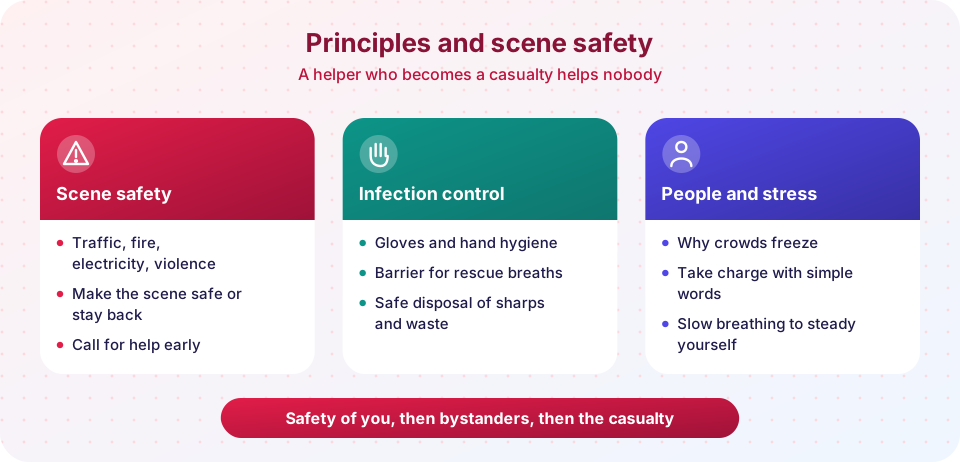
Overview of chapter 2: why your own safety comes first, how to scan a scene, protect yourself from infection and lead calmly when others freeze.
Imagine you see a car in a ditch with smoke rising from the hood. Every instinct says run and help. The best first aiders, though, do something that looks like hesitation: they stop, look and think for a few seconds. That pause is the subject of this chapter. A helper who becomes a second casualty cannot help, and may add a burden to the rescue.
Educational information only. This course is not a substitute for a certified first-aid course or for emergency services. If there is danger now, move to safety and call your local emergency number.
What you will learn
- Why the order is always you, then bystanders, then the casualty.
- What the next four lessons cover and how they connect.
- A three-second habit you can use at any scene.
Safety first
Order matters
Hazards to scan for
Protect against infection
Lead with a calm voice
Lessons in this chapter
- Scene Safety and Dynamic Risk Assessment: how to scan a scene in seconds, the main hazard types and what to do when a scene is not safe.
- Infection Control and Personal Protective Equipment: gloves, hand hygiene, safe disposal and how infections actually spread.
- The Bystander Effect, Stress and Leading a Scene: the classic experiments on why groups freeze, how stress affects your body and thinking, and techniques to take charge.
- Chapter 2 Review: a one-picture recap and a ten-question mixed quiz.
The big picture
Three ideas run through the chapter.
Risk is dynamic. A scene that was safe a minute ago can change: a driver may not have seen the crash, a crowd may turn aggressive, a fire may spread. Professionals call the habit of rechecking dynamic risk assessment. You will practice it as a quick loop of look, think, act and look again.
Barriers are cheap and effective. The chance of catching an infection while giving first aid is small, but simple barriers, especially gloves and handwashing, make it smaller still. They also let you help without worry about blood or vomit.
People are part of the scene. A crowd can be a resource, if you give direction, or a hazard, if everyone freezes or crowds in. Social psychologists have studied the freeze response for more than half a century, and the findings translate into practical advice you can use.
A worked example: the car in the ditch
Back to the smoking car. Here is how the ideas of this chapter play out in about thirty seconds.
You park well short of the crash and switch on your hazard lights. You stop and look: the car is on its side, the engine is smoking, a driver is slumped inside, and fuel is dripping onto the road. Traffic is passing 20 meters away. You name the hazards: traffic, smoke, fuel and the risk of fire. You decide that you cannot safely pull the driver out of a smoking car with leaking fuel, so you do not go in. You make safe what you can: you ask a passer-by to stand well up the road and wave drivers down, and you tell onlookers to stay back. You call emergency services and say clearly: one casualty, car on its side, smoke and fuel leaking, traffic on the road.
You have not touched the driver yet, but you have done the most helpful things anyone could have done in those seconds. If the smoke clears, the fuel stops and the scene becomes safe, you can approach and apply the skills of the next chapters. If the fire grows, you have already kept yourself and others out of its way. This is the habit the chapter builds: hesitate on purpose, so you can act well.
Try it
Press Run (or Ctrl + Enter) to see the console output here.
No output.
Check your understanding
Quick check · 4 questions
of 4 answered You scored / 4 · perfect!
-
1. In what order should safety be considered at an emergency scene?
You cannot help if you become a casualty; bystanders next, then the injured person. -
2. What does dynamic risk assessment mean?
Risks change, so you look, think, act and look again. -
3. Which is the cheapest barrier against infection?
Single-use gloves and handwashing are simple and effective in most first-aid situations. -
4. Which of these is NOT a hazard to scan for?
A sleeping dog far away is not an immediate risk, though an aggressive animal could be.
Summary
- Always protect yourself first, then bystanders, then the casualty.
- Scan, decide, act and recheck: risk changes.
- Gloves and handwashing greatly reduce infection risk.
- People at the scene need direction; a calm voice and simple tasks help.
Track your progress
Create a free account to tick off lessons and pick up where you left off on any device.
of First Aid and Emergency Care lessons completed