


















Lesson 39 of 47 · Preparedness and Special Situations
Kits, plans and the law of first aid
Build a sensible first-aid kit, write a household emergency plan and understand consent, duty of care and Good Samaritan laws in general terms before you ever need them.
A first-aid kit sitting in a cupboard is not preparation. Preparation is a kit that is stocked, in a place everyone knows, with items that people can use, together with a plan for who does what and a clear idea of what you are allowed and expected to do. This lesson covers the three practical parts of preparedness: equipment, planning and the law.
None of it is difficult, and all of it can be done in an afternoon. The payoff is time. When someone is bleeding or not breathing, the minute you save by knowing exactly where the pressure bandage is, and that someone has already called, can matter a great deal.
What you will learn
- What goes into a basic first-aid kit and how to keep it ready.
- How to write a one-page household emergency plan.
- What consent means in first aid and when it is implied.
- What duty of care and Good Samaritan laws mean in general, and why local rules matter.
- Why you should note what happened and hand over clearly.
Key terms
- First-aid kit: a container with supplies for treating common injuries and illnesses until professional help arrives.
- Implied consent: the assumption that an unresponsive person would want help.
- Duty of care: a legal or ethical obligation to act with reasonable care. Whether bystanders have a duty to help depends on the country.
- Good Samaritan law: a law that protects people who give reasonable emergency help in good faith from liability.
- Scope of practice: what you have been trained to do. Good first aid stays within it.
The first-aid kit
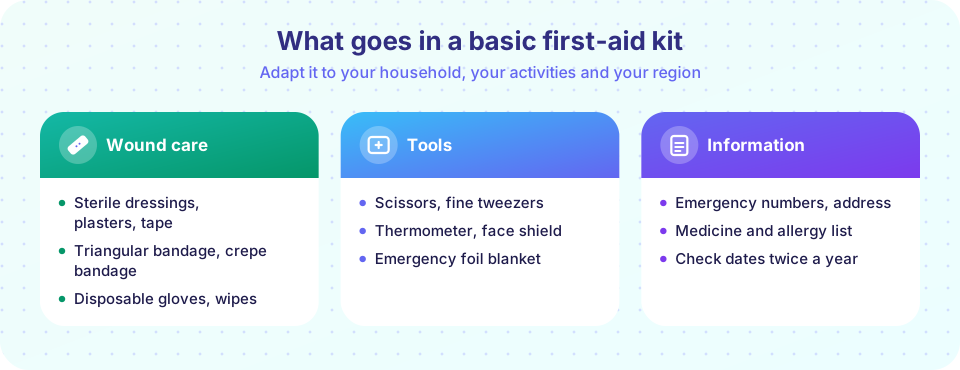
There is no single perfect kit. The right one depends on where it lives (home, car, backpack, workplace, boat), who uses it (young children, older adults, people with allergies) and what you do (hiking, workshops, sports). Many countries have standards for workplace kits. For a household, the following list is a reasonable base and can be extended.
Wound care
- Sterile dressings in several sizes, including a large one for heavy bleeding, and a pressure bandage or an emergency trauma dressing.
- Adhesive plasters (bandages) in assorted sizes, including waterproof ones.
- Medical tape and a crepe or elastic bandage for support and compression.
- Triangular bandages for slings and as padding.
- Saline eyewash or sterile saline pods and antiseptic wipes for cleaning around wounds.
- Burn dressings or cling film and a cold pack (instant, single-use).
Tools
- Disposable gloves (nitrile, so they suit people with latex allergy) and a face shield or pocket mask for rescue breaths.
- Blunt-ended scissors and fine-tipped tweezers.
- A digital thermometer.
- A foil emergency blanket.
- Safety pins, a torch with spare batteries and a tick remover.
Information and personal items
- A card with emergency numbers, your address and the nearest hospital.
- A short first-aid guide, a notepad and a pen to record times and observations.
- Personal medicines the household needs, such as a prescribed adrenaline auto-injector or inhaler, kept as their prescriber instructs. Whether to keep other over-the-counter medicines depends on your household and local advice; read labels and follow the dose instructions, and keep medicines out of children's reach.
Keeping it ready
- Put it where it is easy to find, not buried, and tell everyone in the household where it is. Keep it out of reach of small children but not locked away from adults.
- Check it twice a year, perhaps when the clocks change or on a birthday, and replace used or expired items.
- Keep a smaller kit in the car and in bags for trips. Add items for the activity: blister dressings for hiking, a space blanket for cold climates, tweezers for ticks.
- Know how to use what is in it. An unused bandage in a drawer is only as helpful as your practice.
The household emergency plan
A plan is a short document, ideally one page, that everyone at home can follow without thinking. It should answer these questions.
- Who do we call? Emergency number, the poison center, family doctor and neighbors. Save them in phones and write them on the page.
- What is our address, and how do we describe it to a dispatcher? Include a landmark and how to get in. Teach children to say it.
- Where are the kit, the fire extinguisher, the main switches and the nearest AED?
- Who does what? One person calls, one fetches the kit and defibrillator, one meets the ambulance at the door.
- Medical information: allergies, conditions, regular medicines, doctor details and any advance directives for each household member.
- Where do we meet if we must leave the house, and who is responsible for children and pets?
- When do we practice? A short drill once or twice a year makes the plan real.
A workplace or school plan adds named first aiders, a record book for incidents and a procedure for informing parents or managers.
The law of first aid, in general terms
Law differs between countries and often between states or provinces. What follows are common principles, not legal advice. A certified first-aid course in your region will teach the rules that apply to you.
Consent
- A conscious adult who can understand and decide has the right to accept or refuse help. Ask: "My name is Sam. I know first aid. May I help you?" If they say no, respect that, stay nearby if you can and call emergency services if the situation is serious.
- For an unresponsive adult (or one who cannot decide), consent is implied. The law assumes a reasonable person would want help.
- For children, consent normally comes from a parent or guardian. If they are present, ask. If a child needs urgent help and no parent is available, emergency help is generally justified.
- If you know of a valid advance directive or a "do not resuscitate" order that has been shown to you, follow what your training and local rules say; if in doubt in a real emergency, begin help and let professionals sort it out.
Duty to help
In some countries, including several in continental Europe, the law requires people to give or call for help if they can do so without danger to themselves. In many English-speaking countries, a stranger has no legal duty to help, though people in certain roles (lifeguards, teachers, workplace first aiders, carers) do. Whatever the law says, calling emergency services is something nearly everyone can and should do.
Good Samaritan protection
Many places have Good Samaritan laws or similar rules that protect people who give reasonable help in good faith from being successfully sued for honest mistakes. They usually do not cover gross negligence, reckless behavior or help given for payment by someone with a duty. They vary a great deal, so check what applies where you live.
Acting within your training
- Do what you were trained to do, no more. Do not try surgery, give injections other than a person's own auto-injector, or give medicines you are not trained to give.
- Stay until help arrives, or hand over to a person who is trained or better qualified.
- Protect yourself: wear gloves, wash your hands afterward and do not put yourself in danger.
- Respect privacy. Share what you know with the medical team, not with onlookers or the internet.
Write it down and hand over
As soon as you can, note the time, what you saw and heard, what you did, what the person said, and who took over. Hand over clearly to the crew: age, what happened, signs and treatment given, and how the person has changed. This helps the crew and protects you.
Common misconceptions
- "I will be sued if I help." In most places, people who act reasonably and in good faith are rarely successfully sued, and Good Samaritan laws protect many helpers. The usual risk of doing nothing is far greater.
- "A kit with 200 items is better." A smaller kit that you can use is better than a large one you do not understand.
- "I did a course ten years ago, so I am set." Skills fade. Refresh at least every one to three years, or as your certificate says.
- "Consent always means a signature." In an emergency, spoken or implied consent is enough.
Try it
First, check the dates on a kit. This Python demonstration takes a list of items with expiry dates and prints which ones to replace, using a fixed date so that the result is the same every time.
Press Run (or Ctrl + Enter) to see the result here.
Program input · what you'd type while the program runs
Type the answers before you press Run, one per line. Each time the program reads a line (with input()), it gets the next line from this box.
Now a consent helper. Choose a situation and read the general principle. It is a study demonstration, not legal advice.
Check your understanding
Quick check · 5 questions
of 5 answered You scored / 5 · perfect!
-
1. How should you treat an unresponsive adult in an emergency?
For an unresponsive person, consent is implied. -
2. How often should you check a household first-aid kit?
Check dates and replace used items regularly. -
3. What is the effect of a Good Samaritan law?
Details differ, but the principle is protection for honest, reasonable help. -
4. Why use nitrile gloves in a kit?
Nitrile gloves suit people with latex allergy. -
5. What should you tell the ambulance crew at handover?
A clear handover helps the crew and protects you.
Summary
- A good kit is stocked, findable and used: wound care, tools and information; check it twice a year.
- A one-page emergency plan names the numbers, the address, the roles, the medical information and the meeting place.
- Consent is expressed for a conscious adult and implied for an unresponsive one; parents give consent for children when they are present.
- Good Samaritan laws, duties to help and training rules differ by country; learn yours, stay within your training and hand over clearly.
Track your progress
Create a free account to tick off lessons and pick up where you left off on any device.
of First Aid and Emergency Care lessons completed