


















Lesson 19 of 47 · Bleeding, Wounds and Shock
Controlling Severe Bleeding: Pressure, Packing and Tourniquets
Learn how to stop life-threatening bleeding: direct pressure, packing a deep wound, pressure bandages and when and how to apply a tourniquet to a limb.
A person with a severe, uncontrolled bleed can lose enough blood to die in a few minutes, long before an ambulance arrives in most places. The remedy does not need medicines or a hospital. It needs hands, a clean cloth and the confidence to press hard. In the early 2010s, after mass-casualty events in the United States, trauma surgeons recommended that the public be taught the same bleeding-control skills as soldiers, and in 2015 the American College of Surgeons launched the "Stop the Bleed" campaign. The core message has since been taught around the world: you can save a life with three actions, press, pack and, if needed, a tourniquet.
Educational information only. This lesson is not a substitute for a certified first-aid or bleeding-control course with hands-on practice, and it is not medical advice. Call your local emergency number for severe bleeding. Practice with a trainer before you need these skills.
What you will learn
- How to recognize life-threatening bleeding and estimate how much has been lost.
- The ladder of actions: direct pressure, wound packing, pressure bandage, tourniquet.
- How to apply and record a tourniquet, and how to improvise safely.
- What to do about embedded objects, internal bleeding and your own safety.
- What the evidence says about tourniquet safety.
Key terms
Direct pressure: firm pressure applied directly on the bleeding point with a pad or hand.
Wound packing: pushing gauze deep into a wound to put pressure on the source from inside.
Haemostatic gauze: gauze coated with a substance such as kaolin or chitosan that helps blood to clot.
Tourniquet: a strap with a tightening device (windlass or ratchet) that stops blood flow to a limb.
Junctional area: a place where a limb joins the body, such as the groin or armpit, where a tourniquet cannot be applied.
Recognizing a life-threatening bleed
Think "severe" when you see:
- blood spurting or flowing steadily, soaking through clothing or pooling on the ground;
- bleeding that does not slow after a few minutes of firm pressure;
- a large wound, or an amputation or crush injury;
- signs of shock such as pale, clammy skin, rapid pulse, confusion or drowsiness.
In trauma teaching, blood loss is grouped into four classes by how much of the blood volume has gone:
| Class | Blood lost | Typical findings |
|---|---|---|
| I | up to about 15% | Often few signs; person may be anxious |
| II | about 15 to 30% | Fast pulse and breathing; skin pale |
| III | about 30 to 40% | Low blood pressure, confusion, very fast pulse |
| IV | over 40% | Life-threatening; may lose consciousness |
For a 70 kg adult with about 5 liters of blood, class III corresponds to roughly 1.5 to 2 liters. A small child can reach the same stage with a few hundred milliliters.
Press Run (or Ctrl + Enter) to see the result here.
Program input · what you'd type while the program runs
Type the answers before you press Run, one per line. Each time the program reads a line (with input()), it gets the next line from this box.
The ladder of actions
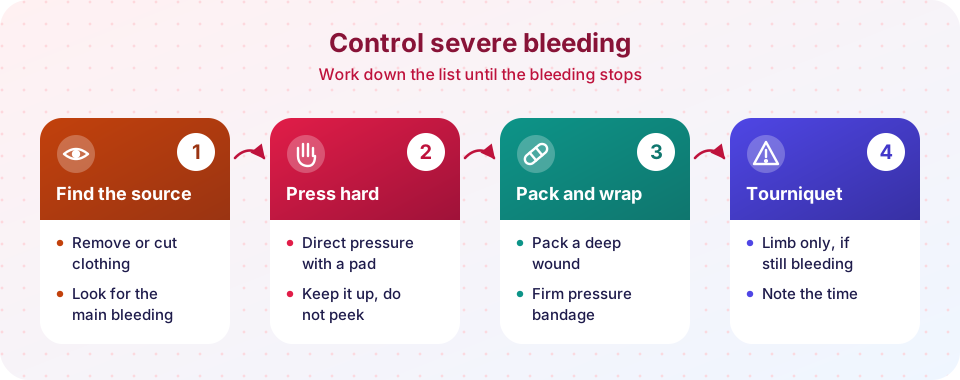
1. Call, protect yourself, find the bleeding
Call emergency services at once (speaker), put on gloves if you have them, and expose the wound: cut or tear away clothing so you can see where the blood is coming from. Blood pooling under the person may hide a second wound, so look carefully.
2. Direct pressure
Place a clean pad, such as gauze, a folded shirt or a towel, directly on the wound and press hard with the heel of your hand. Use both hands if you can, and lean your body weight onto your straight arms. Hold the pressure continuously without lifting to "check", for at least 10 minutes or until help arrives. If blood soaks through, do not remove the pad: put another on top and press harder. Lift only when the bleeding is clearly controlled, and keep pressure on while you wait.
When bleeding slows, secure the pad with a firm bandage, wrapped tightly enough to keep pressure on without cutting off the blood supply to the fingers or toes beyond it. Check that the skin below the bandage is warm and of normal color; loosen slightly if the fingers are cold, blue or numb.
Elevating the limb is sometimes recommended in addition to pressure. Evidence for it is weak, and it must never replace pressure.
3. Pack a deep wound
If the wound is deep, such as in the groin, armpit, neck or a gunshot or stab wound, the bleeding may be coming from the bottom of the wound where a surface pad cannot reach. Pack it: push gauze, ideally a roll of haemostatic gauze, deep into the wound with your fingers until the wound is filled. Then press firmly on top for at least three minutes (check your course). Wrap with a pressure bandage. If you have only a cloth, push it into the wound and press.
4. Tourniquet for limbs
If bleeding from an arm or leg is life-threatening and is not controlled by direct pressure, or if you cannot keep pressure on (several casualties, an unsafe scene, wounds you cannot reach), use a tourniquet.
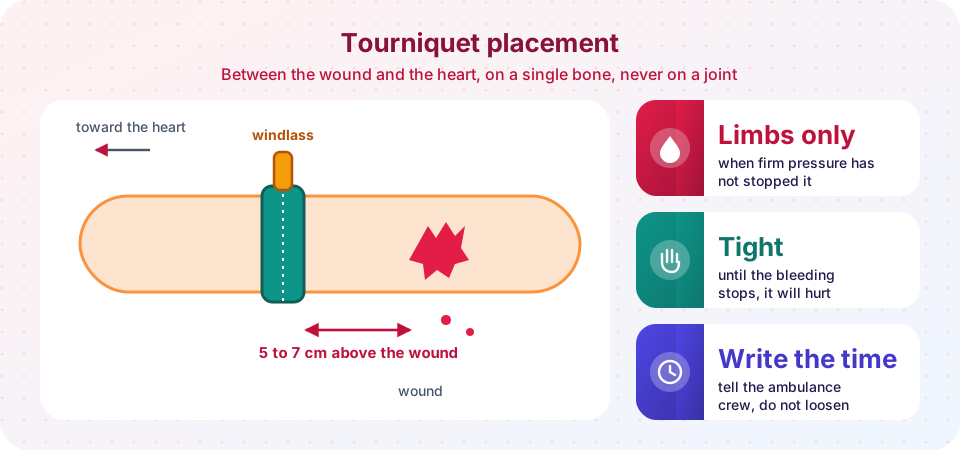
- Place it 5 to 7 cm (2 to 3 inches) above the wound, between the wound and the heart, on a single bone, and not on a joint. If you cannot see the wound, place it as high as possible on the limb ("high and tight").
- Pull the strap tight, then turn the windlass rod (or ratchet) until the bleeding stops. It will hurt; this is expected and is not a reason to loosen it.
- Lock the windlass in its clip and secure the strap.
- Write the time of application on the tourniquet or on the person's skin or forehead and tell the paramedics.
- Do not loosen or remove it; leave that to the hospital team. If it fails to stop the bleeding, tighten it further, or apply a second one just above the first.
A commercial tourniquet, with a strap at least 3.8 cm (1.5 inches) wide and a windlass, is far more reliable than an improvised one. In an emergency without a commercial tourniquet, a broad strip of cloth, such as a folded triangular bandage, tightened with a stick or similar rod can work, but narrow cords, wires and belts cut into tissue and often fail. Practice before you need it.
Why tourniquets were once feared
For decades first-aid courses discouraged tourniquets because of fear of limb loss from nerve and tissue damage. Experience from the wars in Iraq and Afghanistan changed that. Studies of military casualties found that prompt tourniquets for limb bleeding saved many lives, and serious complications were uncommon when they were released or replaced in hospital within about two hours. Civilian trauma systems have since reported similar results. The balance is clear: for life-threatening limb bleeding, the risk of dying from blood loss is greater than the risk from the tourniquet.
After bleeding is controlled
- Lie the person down and keep them still and warm; bleeding control is followed by shock care (see the lesson on shock).
- Do not give food or drink.
- Reassess: watch breathing, color, alertness and the dressing or tourniquet every few minutes.
- Hand over to the ambulance crew: when, where, what you did and the tourniquet time.
Special situations
- Embedded object. Do not pull it out; it may be plugging a blood vessel. Press around it, pad both sides and secure it in place.
- Internal bleeding. After a heavy blow or fall, a person may bleed inside without visible blood. Signs include pain, bruising or a swollen belly, pale cold skin, a fast pulse and drowsiness. Call emergency services, lay them down and treat for shock.
- Neck, scalp and groin. Scalp wounds bleed heavily, so press firmly. Neck and groin cannot use tourniquets; press with packing.
- Your own bleeding. If you are the one who is injured, use the same steps on yourself, and call for help.
Try it
A short sequence trainer lets you rehearse the order of actions and see what comes next. It is a teaching aid, not a replacement for practice.
Press Run (or Ctrl + Enter) to see the console output here.
No output.
Common misconceptions
"Never use a tourniquet, you will lose the limb." For life-threatening limb bleeding it is recommended; the limb is rarely lost if the device is used correctly and released by professionals within hours.
"Lift the dressing to see if it has stopped." Lifting breaks the clot. Keep pressure on and add layers.
"Make it loose enough to be comfortable." A tourniquet must be tight enough to stop the bleeding; it is painful.
"Pull out the knife or glass." Leave embedded objects in place.
Check your understanding
Quick check · 6 questions
of 6 answered You scored / 6 · perfect!
-
1. What is the first thing to do for severe external bleeding?
Call for help and press hard on the wound with a clean pad. -
2. Where should a tourniquet be placed on a limb?
It goes above the wound on a single bone; if unsure, place it high and tight. -
3. What should you do after applying a tourniquet?
Record the time and tell the crew; leave removal to professionals. -
4. A blood-soaked pad is on a wound. What next?
Removing a soaked pad disturbs clots; add layers. -
5. What do you do with an object embedded in a wound?
It may be plugging a vessel. -
6. Why is a 10 kg child at greater risk from the same blood loss?
About 70 mL per kg means only around 700 mL in total for 10 kg.
Summary
- Life-threatening bleeding is controlled in a ladder: direct pressure, pack deep wounds, pressure bandage, tourniquet on limbs.
- A tourniquet goes 5 to 7 cm above the wound, tight enough to stop the bleeding; record the time and do not loosen it.
- Leave embedded objects in place; treat shock after bleeding is controlled.
- Practice with a trainer; knowledge alone is not enough.
Track your progress
Create a free account to tick off lessons and pick up where you left off on any device.
of First Aid and Emergency Care lessons completed