


















Lesson 7 of 47 · Principles and Scene Safety
Scene Safety and Dynamic Risk Assessment
Learn to scan an emergency scene in seconds, recognize traffic, fire, electrical, chemical and violent hazards, and decide when to help and when to stay back.
Rescue stories often end in tragedy for a reason that has nothing to do with bravery: the first person to run in becomes the second casualty. Swimmers drown trying to save swimmers, people collapse in gas-filled rooms, and drivers are struck while helping at a crash. The first rule of first aid is therefore the least heroic one: make sure you can help without being hurt.
Educational information only. This lesson is not a substitute for a certified first-aid course or for emergency services. Never put yourself at serious risk to help. Call your local emergency number early.
What you will learn
- A five-step routine for checking a scene in about five seconds.
- How to recognize the main hazards: traffic, fire and smoke, electricity, chemicals, water, structures and violence.
- How to weigh risk against benefit, and when it is right to stay back.
- When you may need to move a casualty, and how to do so safely.
Key terms
Hazard: anything that could cause harm, such as moving traffic or a live wire.
Risk: the chance that a hazard will actually harm someone, combined with how serious that harm would be.
Dynamic risk assessment: continuously checking and updating your view of risk as a situation changes.
Primary hazard / secondary hazard: the first danger (for example a crash) versus dangers it causes (fuel leaking, traffic stopping suddenly).
Scene size-up: the quick look at the scene that tells you what happened, who is involved and what could go wrong.
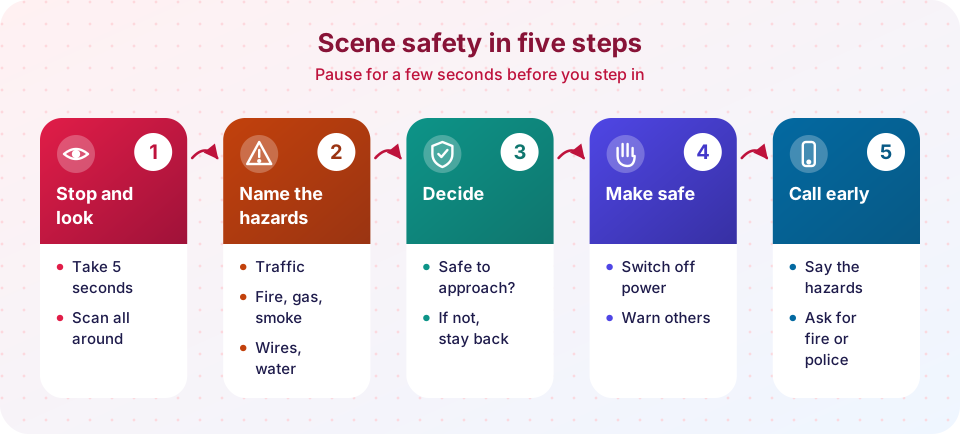
Five steps for a five-second look
- Stop. Do not rush. Take one slow breath. Even five seconds of observation cuts the risk of walking into danger.
- Look and listen. Scan the whole scene, not just the casualty. Look above (wires, falling objects), around (vehicles, crowds, animals) and below (fluids, broken glass, water). Smell for gas or smoke.
- Name the hazards. Say them in your head, or aloud: "traffic, spilled fuel, a gap in the wall."
- Decide. Can you reach the person without serious risk? Can you stay safe while you help? Can you leave quickly if things change? If any answer is no, do not go in.
- Make it safe, and call. Remove or reduce the hazard if you safely can: switch off power at the source, turn on hazard lights, warn others. Then call emergency services and tell them about the hazards, so they bring fire, police or special rescue teams.
This routine is general. Your course may use a memory aid such as "DRSABCD" (Danger, Response, Send for help, Airway, Breathing, CPR, Defibrillation) or "DRABC". The first letter is always about danger.
Main hazard types
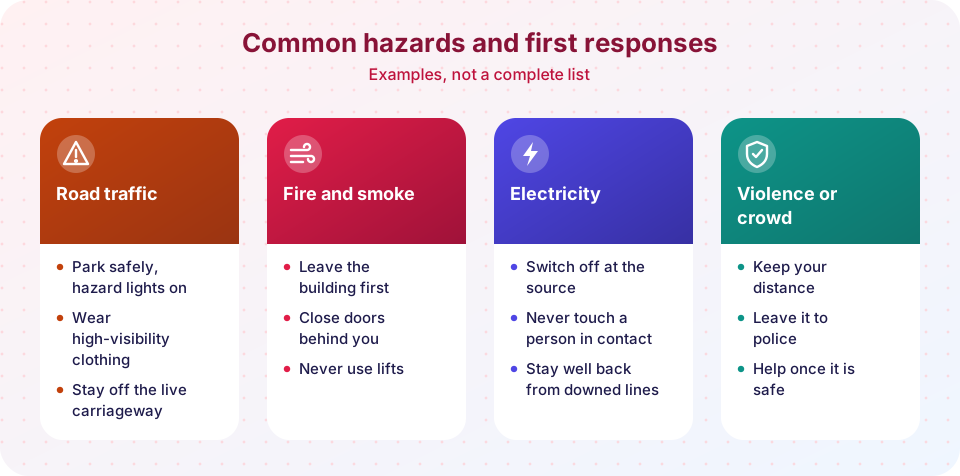
Road traffic. Crashes are one of the most common settings where first aiders are injured. If you are driving, stop well before the crash so that you are not part of it, put on your hazard lights and, if local rules and conditions allow, place a warning triangle far enough back for drivers to react. Put on a high-visibility vest if you have one. Stay off the carriageway, and do not stand in front of or behind damaged vehicles. Turn off ignitions if you can reach them safely and check for fuel leaks.
Fire, smoke and gas. Smoke and fumes can disable a person in minutes. In a building, leave first and close doors behind you to slow fire; never use lifts. Do not go back in for a person unless you are trained and equipped. Tell the fire service where the person was last seen. If you smell gas, do not touch light switches or use a flame; leave, and call from outside.
Electricity. Water conducts electricity, and damaged cables can be live. Switch off power at the source if you can reach the switch safely, or unplug the appliance by the plug. Never touch a person who is still in contact with a live conductor. For fallen high-voltage lines or electric rail, stay far away and wait for the utility and emergency services. Warn others to keep back.
Chemicals and fumes. Look for placards, labels, strange smells, spills and people coughing or collapsed with no visible injury. Stay upwind and uphill, keep others away, and describe what you see to the dispatcher. Specialist teams will handle the cleanup.
Water. Drowning rescue is one of the deadliest first-aid settings for would-be rescuers. The slogan reach, throw, don't go says it all: reach with a pole or branch, throw a float or rope, and do not enter the water unless you are trained and equipped. Call for help first.
Structures and falls. After an earthquake, collapse or explosion, walls can fall without warning. Stay out of unstable buildings and wait for specialist rescue.
Violence and crowds. If someone is armed, aggressive or in a fight, you are not safe. Keep your distance, leave it to the police and help once the scene is secured. If you are threatened, retreat. Where a crowd presses in, ask clear bystanders to step back and keep a path open for the ambulance.
Animals and environment. Dogs, livestock, snakes and insects, plus weather such as extreme cold or heat, lightning and rising water, can be hazards. Include them in your scan.
Weighing risk and benefit
Rescue professionals use a rule of thumb that helps when you are torn: accept a small risk to save a life, accept no risk to save property, and accept no more than a tiny risk to help someone who is probably already dead. For first aiders without special training, the practical meaning is simple: if the hazard could seriously hurt you and you cannot control it, do not go in. Stay back, call for the right team and do everything you can from a distance, such as keeping others away, preparing for the crew and giving directions.
A risk matrix is a helpful tool. Imagine each hazard on two scales: how likely it is to hurt you and how severe the harm would be. Something both likely and severe, like a live wire in a puddle, is a stop sign. Something unlikely and mild, like a small graze from broken glass you can avoid, is manageable.
Moving a casualty
The general rule is do not move a casualty unless you must. Moving an injured person can worsen spinal or other injuries. The exceptions are:
- an immediate danger that you cannot remove, such as fire, rising water or unstable structures;
- the person is not breathing and you cannot give CPR where they are, for example on a slope or in a narrow gap;
- you need to reach another casualty who is in a more serious condition.
If you must move someone, move them only as far as needed to reach safety, and use a method that supports the head, neck and back as much as possible. A common emergency method for a person on the floor is a clothing drag: grip their jacket or shirt at the shoulders, support the head with your forearms, and pull in a straight line along the floor. Your course will teach the details.
Try it
A risk matrix puts likelihood and severity together to guide decisions. It is a teaching model, not a precise calculation.
Press Run (or Ctrl + Enter) to see the result here.
Program input · what you'd type while the program runs
Type the answers before you press Run, one per line. Each time the program reads a line (with input()), it gets the next line from this box.
The second demonstration is a scene checklist. It does not replace judgement: it only trains the habit of asking the questions.
Press Run (or Ctrl + Enter) to see the console output here.
No output.
Common misconceptions
"Real helpers rush in." Skilled rescuers are slow at the start and fast later. They spend seconds on safety so they can spend minutes helping.
"I must never move an injured person." You should avoid moving them unless danger or the need for CPR makes it necessary.
"If it is safe for professionals it is safe for me." Professionals have training, equipment and teams. Your safe zone is smaller.
Check your understanding
Quick check · 5 questions
of 5 answered You scored / 5 · perfect!
-
1. What should you do first when you come to an emergency?
A few seconds to scan the scene prevent you becoming a casualty. -
2. A person is in contact with a live electrical appliance. What is the safest first action?
Never touch a person still in contact with live electricity; cut the power at the source first. -
3. What does the slogan 'reach, throw, don't go' refer to?
Reach with a pole, throw a float, and do not enter the water unless trained and equipped. -
4. When is it appropriate to move a casualty?
Move only when danger or the need for CPR makes it necessary, and as little as possible. -
5. If a violent person is present, what is the best action?
Your safety comes first; police secure the scene.
Summary
- Stop, look, name the hazards, decide, make safe and call: five steps in about five seconds.
- Typical hazards: traffic, fire and smoke, electricity, chemicals, water, structures, violence, animals and weather.
- Accept small risks for life-saving help but no serious risks you cannot control; stay back and call specialists.
- Move a casualty only if danger or CPR requires it.
Track your progress
Create a free account to tick off lessons and pick up where you left off on any device.
of First Aid and Emergency Care lessons completed