


















Lesson 9 of 47 · Principles and Scene Safety
The Bystander Effect, Stress and Leading a Scene
Learn what the bystander effect is, what Darley and Latane really found, how stress changes your body and thinking, and how to lead a scene calmly.
You turn a corner and see someone on the pavement, not moving. Ten people are walking past, glancing at the person and then looking away. Is it because they do not care? Social psychologists have studied this question for more than fifty years and their answer is more hopeful than the headlines: most people want to help, but a handful of mental traps make it harder in a crowd. Knowing the traps, and a few techniques for calming your own nerves, makes you more likely to act and more effective when you do.
Educational information only. This lesson describes research in social psychology and general stress-management ideas. It is not a substitute for a certified first-aid course, for emergency services or for mental health care. If an emergency affects you strongly afterwards, talk to someone you trust or a health professional.
What you will learn
- What the bystander effect is, and what the classic experiments and later studies found.
- Why the story of Kitty Genovese is more complicated than the textbooks used to say.
- How the body's stress response helps and hinders you, and a technique to steady yourself.
- How to take charge: clear, short instructions to named people.
- How to look after yourself after a distressing event.
Key terms
Bystander effect: the finding that the presence of other people can make any one person less likely to help.
Diffusion of responsibility: a feeling that someone else will act, so the duty is shared out and weakened.
Pluralistic ignorance: everyone looks to others to decide whether something is an emergency, and each person sees calm faces that reflect their own uncertainty.
Audience inhibition: fear of embarrassment if you misjudge the situation in front of others.
Stress response: the body's rapid reaction to a perceived threat, driven by adrenaline and related hormones.
The classic study
In 1968, two New York psychologists, John Darley and Bibb Latané, published an experiment that became one of the best-known in social psychology. College students were told they were taking part in a discussion about campus life through an intercom, each in a separate booth so that they would stay anonymous. During the discussion, one speaker, actually a recording, said he was prone to seizures, became distressed, stammered for help and fell silent.
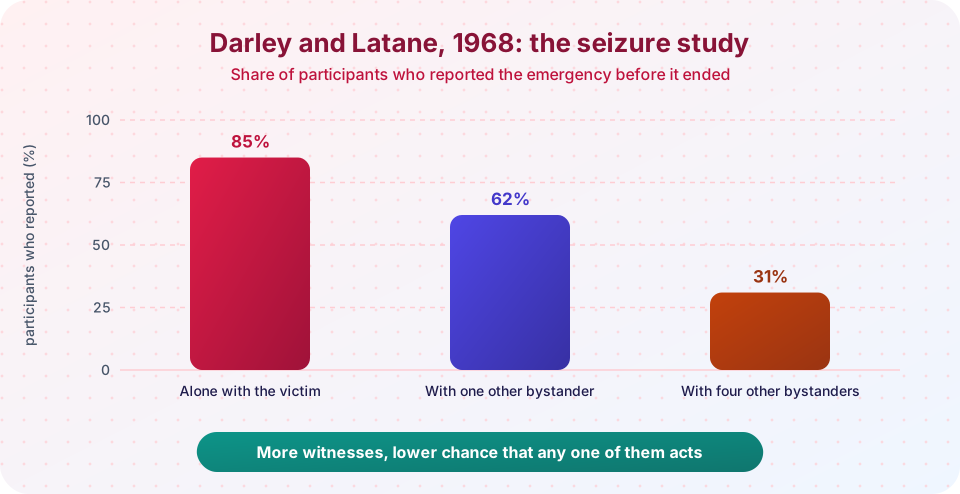
The researchers measured how many participants left the booth to report the problem before the "seizure" ended. The results depended strongly on who the participants believed was listening:
| Participant believed that... | Reported before the end |
|---|---|
| Only they and the victim were present | 85% |
| One other bystander was present | 62% |
| Four other bystanders were present | 31% |
Darley and Latané did not think the students were callous. In interviews the participants had been upset and worried. The researchers argued that diffusion of responsibility was at work: the more people who could help, the less personal responsibility each one felt. Later work added two more mechanisms, pluralistic ignorance and audience inhibition. In an ambiguous situation we check other people's reactions; if everyone stays calm and passive, we all conclude "it must be fine".
The researchers also described a five-step path to helping: notice the event, interpret it as an emergency, feel personal responsibility, know how to help, and decide to act. A person can fail at any step. This is why training matters: knowing what to do removes a whole step from the chain.
The Kitty Genovese story, corrected
The bystander effect became famous after the 1964 murder of Kitty Genovese in New York. Newspaper accounts said 38 neighbors watched her being attacked and none helped. The story became a symbol of urban indifference and inspired much of the early research.
Later researchers found that the account was exaggerated. In 2007 the psychologists Rachel Manning, Mark Levine and Alan Collins examined court records and reported that the number of witnesses was far lower than claimed, that few of them understood what they were hearing, and that some did try to help, such as calling the police or going to her. The story shows how a vivid anecdote can shape theory, and why scientists check the sources.
What later research says
Be wary of treating the 1968 numbers as a law. The Darley and Latané experiment used a small number of participants in a particular setting, and later studies show the effect depends on conditions.
- A large meta-analysis by Peter Fischer and colleagues (2011), which combined results from about 100 studies, found that the bystander effect is real on average but much weaker in clearly dangerous emergencies and when the bystanders can see and talk to each other, as in real life.
- A 2020 analysis of security-camera footage of 219 real public conflicts in three countries found that people stepped in in the great majority of cases, and that more bystanders was associated with a higher chance that at least one would help.
- Groups of friends tend to help more than groups of strangers, and people who have first-aid training are more willing and more able to act.
The summary for a first aider: do not assume the crowd will act, and do not assume the crowd is indifferent. Be the person who starts.
Press Run (or Ctrl + Enter) to see the result here.
Program input · what you'd type while the program runs
Type the answers before you press Run, one per line. Each time the program reads a line (with input()), it gets the next line from this box.
Stress and your body
When you realize someone is in danger, your brain triggers the sympathetic nervous system. Adrenaline and noradrenaline flood the body: heart rate and blood pressure rise, breathing speeds up, muscles tense and blood sugar rises. This is useful for running or lifting, but it also affects how well you think and move. Many people report tunnel vision, a feeling of time slowing down, shaking hands, a dry mouth and trouble remembering instructions or even their own phone number. Fine hand movements, such as dialling a number or tying a bandage, suffer first.
An old idea, the Yerkes–Dodson law (1908), says that performance rises with arousal up to a point and then falls: too little stress and you do not act, too much and you freeze or fumble. The inverted-U picture is a useful teaching image, although modern researchers regard the original experiments as limited and the exact shape as depending on the task. What research on training supports more strongly is stress inoculation: practicing skills in realistic conditions makes them easier to perform under pressure, because the steps are automatic and less of your working memory is used.
Steadying yourself
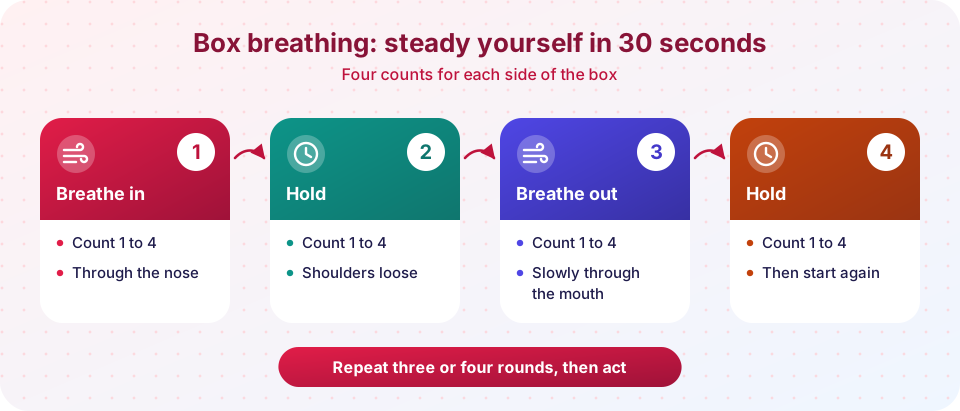
Slow breathing activates the parasympathetic system, which calms the heart rate. Box breathing, used by clinicians, athletes and the military, is a simple way to do it: breathe in for a count of four, hold for four, breathe out for four, hold for four, and repeat three or four rounds. Other helpful habits:
- Say your first step aloud: "Danger. Is it safe?".
- Use a checklist you have rehearsed, such as DRABC.
- Plant your feet, relax your shoulders and slow down your speech.
- Remind yourself: "I only need to do the next step."
Taking charge
In a group, someone has to lead. You do not have to be the most senior; you just have to speak first and clearly. A few rules:
- Speak up with confidence. "I know first aid. I am going to help. Everyone else, please stay back."
- Point and name. Research on diffusion of responsibility suggests giving a specific task to a specific person: "You in the green jacket, call the emergency number and tell me what they say. You with the bag, fetch the first-aid kit. You, go to the gate and wave the ambulance in."
- Use short, concrete instructions and ask people to repeat them back so you know they heard.
- Ask them to report back when the task is done ("Come and tell me when you have called"), so that tasks do not silently fail.
- Manage the crowd. Ask bystanders who are not helping to step back, form a ring for privacy, and keep a path for the ambulance.
- Hand over. When the crew arrives, give a short report: what happened, what you found, what you did and when.
After the event
Even a successful rescue can leave you shaken. Racing thoughts, trouble sleeping, shaking or a sense of guilt are common and usually fade within days to weeks. Talk with someone you trust, rest, and avoid dwelling alone on "what ifs". If the person died or the experience was frightening, it is normal to grieve or feel numb. If distress lasts more than a few weeks or interferes with daily life, speak with a doctor or a mental health professional. Many emergency services and employers offer support to first aiders.
Common misconceptions
"People in crowds are just selfish." Interview and camera studies show most people want to help; the problem is uncertainty and shared responsibility, which clear leadership can fix.
"Stress means I will freeze." It can, but practice and a slow-breathing routine make a big difference. Many people report that once they start, the first step is the hardest.
"If I did everything right, I should feel fine." Strong emotions after a serious incident are normal even when your actions were correct.
Check your understanding
Quick check · 5 questions
of 5 answered You scored / 5 · perfect!
-
1. In Darley and Latane's 1968 study, what happened as the participant believed more people could hear the emergency?
Reporting fell from 85% (alone) to 62% (one other) to 31% (four others). -
2. What is diffusion of responsibility?
With more potential helpers, each person feels a smaller share of the responsibility. -
3. What did later research find about the bystander effect?
The meta-analysis and later camera studies show a more nuanced picture. -
4. What is the best way to get help from a crowd?
A named person with a clear task breaks diffusion of responsibility. -
5. Which is a simple technique to steady yourself under stress?
Slow breathing activates the parasympathetic system and calms the heart rate.
Summary
- The bystander effect is the tendency for any one person to help less when others are present; its causes include diffusion of responsibility, pluralistic ignorance and audience inhibition.
- Darley and Latané (1968) found 85%, 62% and 31% reporting; later research shows the effect is smaller in clear emergencies, and the Genovese story was exaggerated.
- Stress affects thinking and fine movements; slow breathing, rehearsal and checklists help.
- Lead with a clear voice, name people and give them single tasks, then ask for feedback.
- Look after yourself afterwards and seek support if distress lasts.
Next: Chapter 2 Review
Track your progress
Create a free account to tick off lessons and pick up where you left off on any device.
of First Aid and Emergency Care lessons completed