


















Lesson 23 of 47 · Fractures and Injuries
Chapter 5 overview: fractures and injuries
See the big picture of first aid for broken bones, sprains, dislocations and head or spine injuries: what to look for, what to do and what to leave alone.
A bone, a joint or a head can be hurt in a second: a fall from a bike, a bad landing in a football match, a slip on wet stairs. Most of these injuries are painful but not life-threatening, and good first aid makes them less painful and less likely to turn into something worse. A few of them, such as a suspected neck injury or a head injury with confusion, are emergencies where the best thing you can do is keep the person still and bring help quickly.
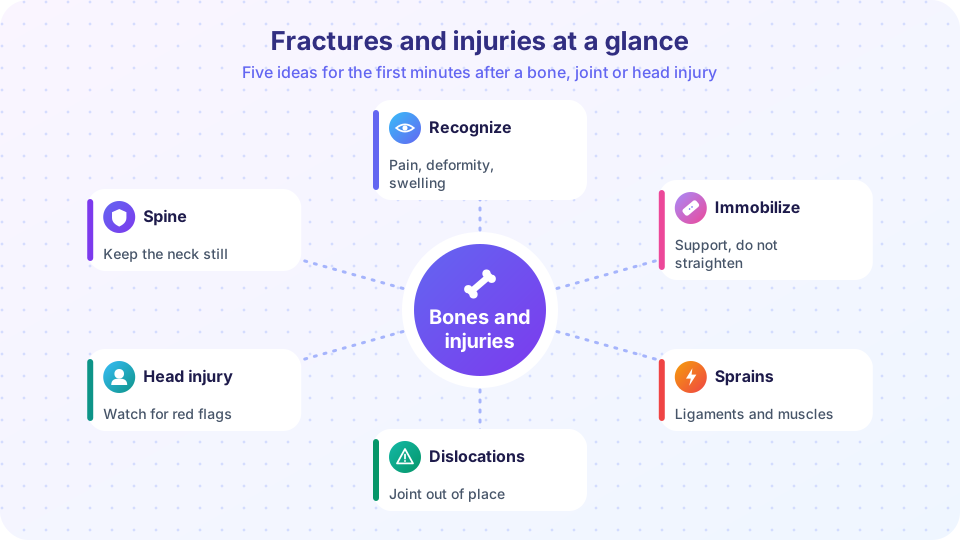
This chapter teaches you how to tell the cases apart, what a helper actually does in the first minutes, and just as important, which well-meant actions cause harm. You will learn to recognize a fracture, to support it with a splint or a sling, to treat sprains and strains sensibly, to recognize a dislocation, and to watch a person with a head or spine injury until responders take over.
Educational information, not a substitute for training. This course explains general first-aid principles for learners worldwide. It is not medical advice and it cannot replace a certified, hands-on first-aid course or the instructions of emergency services. Guidelines differ between countries and change over time. In a real emergency, call your local emergency number (for example 112, 911, 999 or 000) and follow the dispatcher's instructions.
What you will learn
- How to recognize a probable fracture, a sprain, a strain and a dislocation from what you can see and what the person tells you.
- Why you immobilize an injury in the position you found it instead of straightening it.
- How to decide when to call emergency services and when a visit to a clinic is enough.
- How to watch a person with a head injury, and the red flags that mean "call now".
- Why a suspected spine injury changes almost every other rule.
Key terms
- Fracture: a break or crack in a bone. It may be closed (skin intact) or open (bone or a wound shows through the skin).
- Immobilize: to stop an injured part from moving, usually with a splint, a sling or the person's own body position.
- Sprain and strain: a sprain is an injury to a ligament (it joins bone to bone); a strain is an injury to a muscle or tendon.
- Dislocation: a joint whose bones have been forced out of their normal position.
- Red flag: a sign that suggests a serious problem and means you should call for help.
The big picture
First aid for injuries follows the same logic you met in the first part of this course: check that the scene is safe, find and treat life threats such as not breathing or heavy bleeding, and only then deal with the injury itself. A broken arm matters very little if the person is not breathing. This ordering is why this chapter comes after the chapters on assessment, CPR and bleeding.
Once the life threats are handled, three questions guide almost every injury.
- What could be hurt? Ask what happened. A fall from standing height is different from a fall down stairs or a car crash. The mechanism of injury tells you how much force went into the body and where to look.
- What can I see and feel? Look for deformity, swelling, bruising, wounds and unnatural positions. Compare with the other side of the body. Ask where it hurts, and ask about numbness or tingling.
- What makes it worse and what makes it better? Movement usually makes bone and joint pain worse. Support and stillness usually make it better. The aim of first aid is to remove the movement.
Chapter 5 at a glance
Joints and heads
Your three habits
Reassess every few minutes.
What each lesson covers
- Fractures, bones and splinting explains how bones break, how to recognize open and closed fractures and how to splint an arm, a leg or a finger.
- Sprains, strains and dislocations covers soft-tissue injuries, modern advice for the first days, and why you never push a dislocated joint back.
- Head, neck and spine injuries teaches the red flags, how to support a suspected spine injury and what to do about concussion.
- Chapter 5 review puts it all on one page and gives you ten questions.
A word about pain and fear
Injured people are frightened as well as hurt. Your voice is part of first aid. Introduce yourself, ask permission to help, explain what you are about to do and keep your tone calm. Tell the person not to move the injured part and not to try to get up. If a child is hurt, get down to their level and keep a parent or carer close if you can. Giving a pain reliever is not part of basic first aid in many courses: it can mask changes you should be watching, and some people are allergic or already taking something. If you are in a setting where medicines are part of your role, follow your training and local rules.
Try it
This small exercise lets you practice the central decision of the chapter: how urgent is each situation? It is a learning demonstration with simplified cases, not a medical tool.
Check your understanding
Quick check · 4 questions
of 4 answered You scored / 4 · perfect!
-
1. In what order do you deal with problems when someone is injured?
Scene safety and life threats such as breathing and severe bleeding come before any bone or joint injury. -
2. What is a sprain?
A sprain is an injury to a ligament, the tissue that joins bone to bone. A strain involves muscle or tendon. -
3. Which finding is a red flag after a head injury?
Vomiting and increasing drowsiness suggest pressure or bleeding inside the skull and need emergency care. -
4. Why do helpers usually avoid giving pain relievers as basic first aid?
Basic first-aid courses focus on non-drug measures; medicines can mask changes and carry risks that a helper cannot check.
Summary
- Deal with life threats before injuries; then use look, support and call.
- Immobilize injuries where they lie and keep the person calm and still.
- Sprains and strains are soft-tissue injuries; fractures and dislocations involve bones.
- Head and spine injuries have red flags that mean call emergency services now.
- This course is educational information; a certified hands-on course teaches the skills properly.
Track your progress
Create a free account to tick off lessons and pick up where you left off on any device.
of First Aid and Emergency Care lessons completed