


















Lesson 35 of 47 · Environmental Emergencies
Burns, electric shock and drowning
Learn to cool burns for 20 minutes, handle chemical and electrical injuries safely, and respond to drowning with reach, throw and call instead of going in.
Fire, electricity and water are part of every home and every holiday. They are also three of the most dangerous hazards a first aider will meet, and for each of them the first rule is not about the casualty at all: it is about you. A rescuer who touches a person still in contact with a live wire becomes a second casualty. A rescuer who swims out to a panicking swimmer without training can be pulled under. And a first aider who grabs a hot pan to help burns their own hand.
This lesson covers how to treat burns and scalds, chemical burns, electric shock and drowning. In each case you will learn what the hazard does to the body, what the first-aid priority is, and what well-meant actions to avoid.
What you will learn
- How to recognize burn depth and how to cool a burn properly.
- How to estimate burn size and decide when a burn needs urgent care.
- What to do for a chemical burn, including in the eye.
- How to deal safely with electric shock and what happens afterward.
- How to help a person who is drowning without putting yourself at risk.
Key terms
- Burn depth: superficial burns affect the outer skin layer, partial-thickness burns go deeper and blister, and full-thickness burns destroy the whole skin thickness.
- Total body surface area (TBSA): the percentage of the body covered by a burn.
- Scald: a burn from hot liquid or steam.
- Reach, throw, wade, go: the order of water-rescue choices, from safest to most dangerous.
- Hypoxia: low oxygen in the body. In drowning it is the main cause of harm.
Burns and scalds
A burn is damage to the skin and the tissue under it caused by heat, chemicals, electricity or radiation, such as sunburn. Hot drinks and bath water cause most childhood burns, and flames and hot oil cause many adult ones. The skin is a barrier against infection and keeps the body's water and heat in, so large burns cause fluid loss, infection and loss of temperature control.
Depth
- Superficial (first-degree): red, dry and painful, like mild sunburn. It heals in a few days without scarring.
- Partial thickness (second-degree): red or pink and moist, with blisters, and very painful. Healing takes weeks, and deeper ones may scar.
- Full thickness (third-degree): white, leathery, charred or waxy, and often painless in the middle because the nerve endings are destroyed, though the edges hurt. It needs surgery.
You cannot always judge depth at first, and a burn can deepen over the first day. Treat them all the same way at first.
First aid for a thermal burn or scald
- Make the scene safe and stop the burning. Move the person away from the heat source. If clothes are on fire: stop, drop and roll, or smother the flames with a blanket. Take off clothing soaked with hot liquid unless it is stuck to the skin.
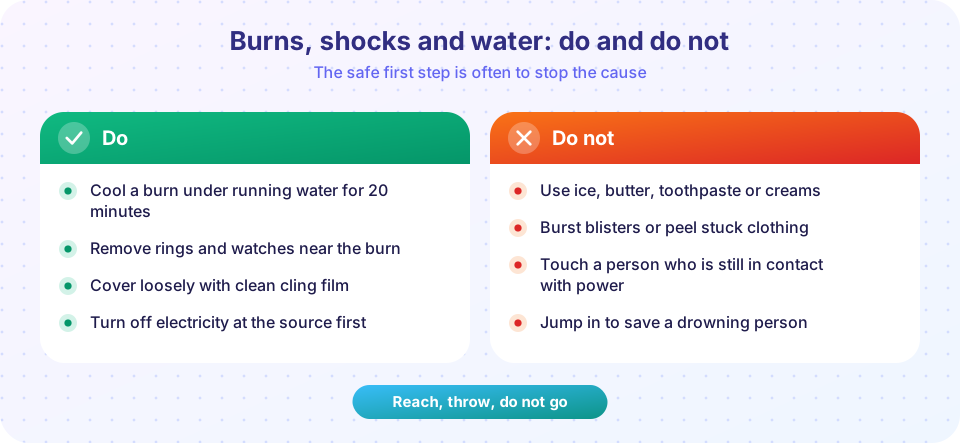
- Cool the burn with cool running water for 20 minutes. Use tap water at a comfortable cool temperature. Start as soon as you can; cooling is still worth doing up to a few hours after the burn. It reduces pain, limits how deep the damage goes and helps healing. Do not use ice or very cold water, which can deepen the injury and cool the person too much. For large burns, cool the burn, but keep the rest of the person warm to avoid hypothermia, especially for children.
- Remove rings, watches and tight clothing near the burn, before swelling starts.
- Cover loosely with cling film (plastic wrap) laid along the limb rather than wrapped around it, or a clean non-fluffy dressing. This keeps out air and germs and eases pain.
- Do not apply butter, oil, toothpaste or creams, and do not burst blisters or pull off stuck material.
- Treat pain and shock, keep the person warm and get medical help as below.
When a burn needs urgent care
Call emergency services or go to an emergency department for burns that are deep or white and leathery; larger than the person's palm with fingers (the palm and fingers are about 1 percent of the body surface); on the face, hands, feet, genitals or over a joint; going right around a limb; caused by chemicals or electricity; in babies, young children, older adults or pregnant people; or with breathing problems or burns around the mouth and nose after smoke (inhalation injury). When in doubt, get advice.
Estimating size: the rule of nines
For adults, doctors use the rule of nines to estimate burn size roughly: head and neck 9 percent, each arm 9, the front of the trunk 18, the back of the trunk 18, each leg 18 and the genital area 1. Children have larger heads in proportion and smaller legs, so the figures differ. You do not need to memorize it to give first aid, but it helps you describe a burn to a dispatcher.
Chemical burns
Acids, alkalis such as drain cleaner and oven cleaner, bleach and many industrial chemicals can burn on contact. The harm continues as long as the chemical stays on the skin.
- Protect yourself. Wear gloves if possible, avoid fumes and do not touch the chemical.
- Brush off dry powder from the skin before wetting it, then remove contaminated clothing.
- Flush with plenty of running water for at least 20 minutes, more for strong alkalis, keeping the water running away from healthy skin.
- Call emergency services and keep the container or label to tell them what it was. Do not try to neutralize a chemical with another one.
Chemical in the eye: hold the eyelids open and flush the eye with running water (or saline) for 15 to 20 minutes, with the affected eye lower than the other so that water does not run into it. Call emergency services, and do not let the person rub the eye.
Electric shock
Electric current can cause burns where it enters and leaves the body, interfere with the heart's rhythm, stop breathing, throw people so they get a second injury such as a fall, and cause muscles to clamp around the source so the person cannot let go.
- Do not touch the person until the current is off. Switch off at the main switch, unplug the appliance or turn off at the fuse box. If you cannot switch it off for low-voltage household electricity, push the person or the source away using a dry, non-conducting object such as a wooden broom handle while standing on dry material. Never use anything metal or wet.
- High voltage (overhead lines, railways, substations): stay well back, keep others away and call emergency services and the power company. Do not approach until you are told the current is off. Wet ground near a fallen line can carry current.
- Once it is safe, check responsiveness and breathing. If they are unresponsive and not breathing normally, start CPR and use an AED.
- Treat burns at the entry and exit points by cooling and covering them.
- Call medical help for everyone who has had an electric shock, even if they feel fine. The heart rhythm can be disturbed hours later, and burns inside the body can be bigger than they look.
A person struck by lightning carries no charge: it is safe to touch them, and they need CPR if they are not breathing normally. Move yourself and them to a safe place if the storm continues.
Drowning
Drowning is a process in which breathing is impaired by submersion in liquid. The main problem is lack of oxygen. It can happen in seconds, in a few centimeters of water for a small child, in complete silence, and in the sea, in rivers, in pools and even in a bath. Drowning is a leading cause of accidental death in children in many countries.
Rescue: reach, throw, wade, go
Choose the safest option that works.
- Call for help first, or send someone to call emergency services.
- Reach with a long object such as a pole, a branch or a towel while you lie or stay anchored on the bank.
- Throw a lifebuoy, a rope, a floating cooler or anything that floats. Tell the person to hold on.
- Wade only if the water is shallow and you can stay safe, ideally holding something.
- Go into the water only if you are trained, equipped and it is safe. A panicking person can pull a rescuer under.
Care after rescue
- Take the person out of the water, supporting the head and neck if there was a dive or a fall.
- Check responsiveness and breathing. If they are unresponsive and not breathing normally, open the airway and give five rescue breaths first (because oxygen is the issue), then start CPR, and use an AED after wiping the chest dry. Do not waste time trying to drain water from the lungs.
- If they are breathing, place them in the recovery position, remove wet clothes, cover them and watch. Vomiting is common.
- Everyone who has needed rescue from water should go to hospital, even if they seem to recover, because lung problems can develop or worsen over the next hours.
Prevention is the best first aid: fence pools, supervise young children within arm's reach, wear life jackets on boats, never swim alone or after alcohol, and learn to swim.
Common misconceptions
- "Put ice on a burn." Ice damages tissue. Use cool running water for 20 minutes.
- "Butter or toothpaste soothes a burn." They trap heat and raise infection risk.
- "Pull the person off the wire." First switch off the power. Touching a live person can electrocute you.
- "Drowning is loud and obvious." It is often silent and fast.
- "Pump the water out of the lungs." Start with breathing and CPR instead.
Try it
First, the rule of nines. Tick the burned areas on an adult and see the estimate. This is a study calculator; real estimates are made by clinicians and vary by age.
Next, a decision function for burns. It combines the main reasons to get urgent care. It is a demonstration, not a substitute for judgment.
Press Run (or Ctrl + Enter) to see the console output here.
No output.
Check your understanding
Quick check · 6 questions
of 6 answered You scored / 6 · perfect!
-
1. How long should you cool a burn under cool running water?
Cool running water for 20 minutes reduces pain and limits damage. Do not use ice. -
2. A person is in contact with a damaged household appliance and cannot let go. What first?
Break the contact with the current safely, without touching the person while the power is on. -
3. What is the safest way to help a person struggling in deep water if you are untrained?
Reach or throw, do not go. -
4. What should you do first for a dry chemical powder on the skin?
Brush off dry powder, remove contaminated clothing and then flush with plenty of running water. -
5. Why does everyone who had an electric shock need medical assessment?
The heart rhythm can be disturbed hours later, and internal injury can be greater than it looks. -
6. In drowning, what do you start with if the person is unresponsive and not breathing normally?
Drowning is a lack-of-oxygen emergency, so rescue breaths come first, followed by CPR.
Summary
- Burns: stop the burning, cool with cool running water for 20 minutes, remove rings, cover loosely, no ice, butter or creams; know the signs of a serious burn.
- Chemical burns: protect yourself, brush off dry chemical, flush for 20 minutes or more; flush the eye for 15 to 20 minutes.
- Electric shock: make it safe and switch off first; assess breathing, treat burns and get everyone checked.
- Drowning: reach, throw, do not go; five rescue breaths then CPR; hospital for all rescued people.
Track your progress
Create a free account to tick off lessons and pick up where you left off on any device.
of First Aid and Emergency Care lessons completed