


















Lesson 34 of 47 · Environmental Emergencies
Heat and cold: heatstroke, hypothermia and frostbite
Understand how heat illness and cold injury develop in stages, how to cool or rewarm someone safely, and which signs mean call emergency services immediately.
Your body is a furnace and a thermostat. Cells burn fuel and release heat, and the brain's thermostat keeps the core temperature near 37 degrees Celsius by adjusting blood flow, sweating and shivering. Enzymes and nerves work within a narrow range. A few degrees up and the brain begins to malfunction. A few degrees down and the heart rhythm and the mind slow, and eventually stop.
Heat and cold injuries are among the most preventable emergencies, and they are also among the easiest to miss at the start. People do not collapse suddenly; they go through stages. The first aider who recognizes an early stage can often stop the process before it becomes dangerous. This lesson covers the stages of heat illness, the stages of hypothermia and the freezing injury called frostbite.
What you will learn
- The stages of heat illness and what to do at each stage.
- How to cool someone with heatstroke while you wait for help.
- The stages of hypothermia and how to rewarm safely without causing harm.
- How to recognize and treat frostbite, and which common practices to avoid.
Key terms
- Heat exhaustion: a heat illness with heavy sweating, weakness and nausea, where the person is still thinking clearly.
- Heatstroke: a life-threatening heat illness with a core temperature around 40 °C or more and changes in mental state.
- Hypothermia: a core temperature below 35 °C.
- Frostbite: freezing of skin and the tissue beneath, most often fingers, toes, nose and ears.
- Rewarming: bringing body temperature or frozen tissue back toward normal, gently.
Heat illness
When the air is hot and humid, sweat does not evaporate easily, and the body cannot shed its heat. Exercise adds heat. The risk is greatest for infants and young children, older adults, people who are ill or on certain medicines, people who are not used to the climate, and athletes or workers exerting themselves in the heat. Dehydration speeds the process.
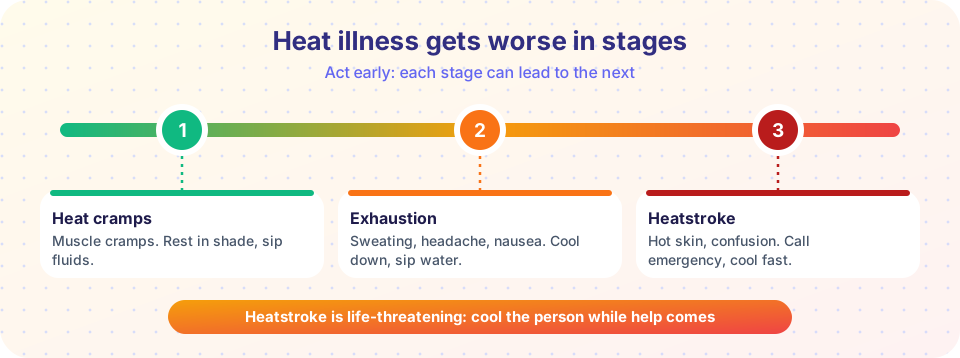
Heat cramps
Painful muscle cramps, usually in the legs, abdomen or arms, after exertion in the heat. The person is otherwise alert. Move them to a cool place, rest, stretch gently and give sips of water or an oral rehydration drink.
Heat exhaustion
The body is losing too much water and salt. Signs include heavy sweating, pale, cool and clammy skin, a headache, dizziness, nausea or vomiting, weakness, a fast but weak pulse and sometimes fainting. The person is still alert and can think and speak normally.
First aid:
- Stop activity and move them to a cool, shaded place or an air-conditioned room.
- Lay them down and raise the legs a little.
- Loosen or remove extra clothing.
- Cool them with a fan, wet cloths on the skin or a cool shower.
- Give small, frequent sips of cool water or oral rehydration drink if they are alert and not vomiting.
- If they do not improve within about 30 minutes, or if they get worse, call emergency services. Heat exhaustion can become heatstroke.
Heatstroke
Heatstroke is a medical emergency. The core temperature rises to around 40 °C or higher, and the brain is affected. The person may be confused, agitated, irritable, have slurred speech, behave strangely, have a seizure or collapse. The skin is often hot; it may be dry or still sweaty (after exertion it often remains sweaty). The pulse is fast. Without rapid cooling it can cause organ failure and death.
First aid: cool first, and call.
- Call emergency services at once.
- Move the person to the shade or a cool place and remove excess clothing.
- Cool them as fast as you can. In heatstroke caused by exertion (athletes, soldiers, workers) the best method is immersion in cold water, with the head out, if you have a tub, a pool or a stock tank and enough helpers to keep them safe. If you cannot immerse them, wet the skin with cold water, fan them strongly and put cold packs or wet towels at the neck, armpits and groin, where large vessels lie close to the surface. Turn them often.
- Keep cooling until help arrives, and stop when the person is alert or the ambulance crew takes over. Do not give anything by mouth if they are confused or drowsy.
- If they become unresponsive and are not breathing normally, start CPR.
Never leave a child or a pet in a parked car. The temperature inside can rise to a dangerous level within minutes, even on a mild day.
Cold injuries
Hypothermia
Hypothermia begins when the body loses heat faster than it can make it. It is not only an arctic problem. People get hypothermia indoors in unheated rooms, in cool rain, after falling into cold water, or after a night outdoors, and older adults, infants and those who are wet, hungry, tired, intoxicated or injured are most at risk. Wind and wetness speed the loss of heat.
The stages are a guide, not a ladder with fixed rungs:
- Mild (core about 32 to 35 °C): shivering, cold and pale skin, fast breathing, clumsiness and poor judgment. Mountain rescuers talk about the "umbles": stumbles, mumbles, fumbles and grumbles.
- Moderate (about 28 to 32 °C): shivering often stops, confusion and drowsiness deepen, speech slows and the pulse becomes slow.
- Severe (below about 28 °C): the person is unresponsive, the muscles are stiff, breathing and pulse are very slow and can be hard to detect. The heart is irritable, and rough handling can trigger a dangerous rhythm.
First aid:
- Call emergency services for anything beyond mild hypothermia, and for anyone confused or unwell.
- Get them out of the wind and wet. Take them indoors if possible, or to a shelter.
- Remove wet clothes and replace them with dry ones. Insulate from the ground with a mat, blankets or a sleeping bag. Cover the head, and wrap the person in blankets, with a waterproof or foil layer on the outside.
- Handle gently and keep them horizontal if they are very cold or drowsy.
- Give warm, sweet drinks only if they are alert and can swallow. No alcohol and no caffeine.
- Add gentle warmth to the trunk (warm packs wrapped in cloth to chest, armpits, groin), not to the arms and legs. Do not use a hot bath.
- Do not rub the limbs. It does not warm the core and it can hurt cold tissue.
- Check breathing carefully, for up to a minute, because breathing and pulse can be very slow in a cold person. If there is no normal breathing, start CPR and use an AED. A hypothermic person may appear dead and still be saved, so rescuers keep going until professionals say to stop.
Frostbite
Frostbite occurs when skin and the tissue beneath freeze. It most often affects fingers, toes, ears, nose and cheeks, and it risks the person in extreme cold, wind and wet, in tight boots or gloves, and when circulation is poor. Frostnip is a milder stage: the skin is cold, numb and white or pale, but no tissue is frozen, and it recovers on warming.
Signs of frostbite: skin that looks white, gray or waxy-yellow; it feels hard, cold and numb; after rewarming it may be red, swollen, painful and blistered. Deeper frostbite turns dark.
First aid:
- Get the person out of the cold and treat hypothermia first if present.
- Remove rings, watches and tight or wet clothing before swelling.
- Rewarm only if there is no risk of refreezing. Rewarming and then re-exposing the tissue to freezing is worse than leaving it frozen until you reach safety. Immerse the area in warm, not hot, water at about 37 to 39 °C for 15 to 30 minutes, until the tissue is soft and color returns.
- Do not rub or massage frozen skin, and do not apply direct heat from a fire, heater or heating pad, because numb skin can burn.
- Protect the area. Cover loosely with sterile dry dressings and put cotton between fingers or toes. Do not burst blisters.
- Get medical care. Do not walk on frostbitten feet if you can avoid it.
Prevention
Drink before you are thirsty in the heat, rest in the shade, wear light and loose clothing, and acclimatize slowly. Check on infants, older neighbors and people who live alone during a heatwave. In cold, dress in layers, keep dry, cover the head, hands and feet, eat well and avoid alcohol. In both, never let a person exert themselves to exhaustion in extreme conditions.
Common misconceptions
- "Heatstroke means no sweating." After exertion, a person with heatstroke often is still sweating. Confusion and a high temperature matter more.
- "Give hot drinks and a hot bath to a very cold person." Rapid, uneven warming and rough handling are dangerous. Insulate and warm the trunk gently.
- "Rub frostbitten skin to bring back the blood." Rubbing damages frozen tissue.
- "Alcohol warms you up." It widens the skin vessels so you lose heat faster.
Try it
First, a staging tool for heat illness. Tick what you see, and read the suggested stage and action. This is a study demonstration: if in doubt in real life, cool the person and call.
Now a Python table of temperature bands. It classifies a core temperature and shows the bands on a chart. The boundaries are commonly used teaching values, and real clinical care uses more detail.
Press Run (or Ctrl + Enter) to see the result here.
Program input · what you'd type while the program runs
Type the answers before you press Run, one per line. Each time the program reads a line (with input()), it gets the next line from this box.
Check your understanding
Quick check · 5 questions
of 5 answered You scored / 5 · perfect!
-
1. A hiker is alert, sweating heavily, pale, clammy and nauseous after a hot climb. What is this most likely?
Heavy sweating, pale clammy skin and nausea with a clear mind suggest heat exhaustion. Cool and rest. -
2. What is the best first-aid approach for heatstroke?
Heatstroke is life-threatening. Call and cool rapidly, ideally with cold-water immersion for exertional cases. -
3. Why not rub frostbitten skin?
Frozen tissue is fragile. Rubbing damages it. -
4. How do you rewarm a very cold, drowsy person?
Insulate, handle gently and warm the trunk. Avoid alcohol, rubbing and hot baths. -
5. Why should you check breathing for up to a minute in a very cold person?
A very cold person may seem lifeless; check carefully, and start CPR if there is no normal breathing.
Summary
- Heat illness is a ladder: cramps, exhaustion, heatstroke. Heatstroke (confusion, about 40 °C or more) is an emergency: call and cool fast.
- Hypothermia (core below 35 °C): shelter, dry insulation, gentle handling, warm the trunk, warm sweet drinks if alert, no alcohol.
- Frostbite: remove rings, rewarm in warm (not hot) water only if no risk of refreezing, never rub, protect and seek care.
- Prevent both with clothing, fluids, acclimatization and checking on those at risk.
Track your progress
Create a free account to tick off lessons and pick up where you left off on any device.
of First Aid and Emergency Care lessons completed