


















Lesson 10 of 47 · Principles and Scene Safety
Chapter 2 Review: Principles and Scene Safety
Review scene safety, infection control, the bystander effect and stress with a one-picture summary, a recap table, a scenario drill and a ten-question quiz.
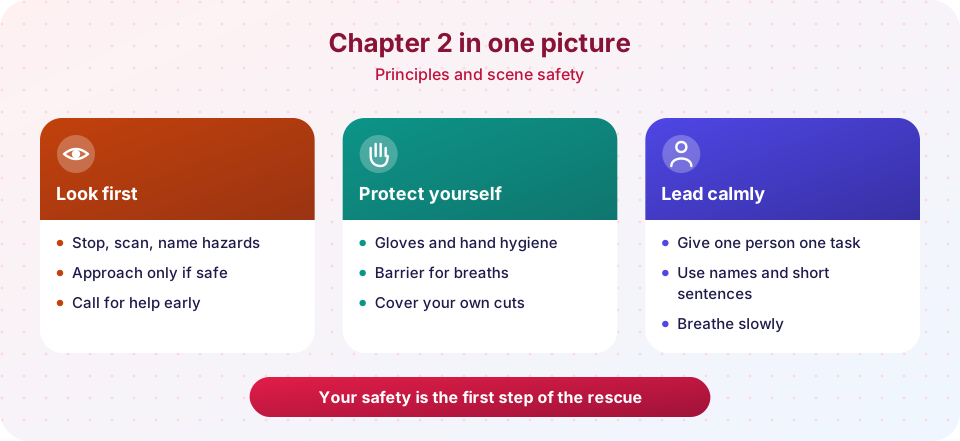
Chapter 2 gave you the habits that come before any treatment: look before you step in, protect your own skin, and handle the people around you. These habits are what let you use every later skill safely. Use this page to check that you can recall them without the lessons in front of you.
Educational information only. This course is not a substitute for a certified first-aid course or for emergency services. If there is danger now, move to safety and call your local emergency number.
What you will learn
- A one-page recap of lessons 1 to 3 of this chapter.
- A scenario drill that practices the "stop, look, decide" routine.
- A mixed quiz that tests the whole chapter.
Recap table
| Lesson | Key points |
|---|---|
| Scene safety | Stop, look, name hazards, decide, make safe, call; reach-throw-don't-go for water; move a casualty only if you must |
| Infection control and PPE | Standard precautions; nitrile gloves, handwashing, face shield, covered cuts; remove gloves inside out; sharps and exposure steps |
| Bystander effect and stress | Diffusion of responsibility; Darley and Latané 85%, 62%, 31%; box breathing; name people and give single tasks |
The chapter in three questions
- Is it safe? For you, then the bystanders, then the casualty.
- Am I protected? Gloves on, cuts covered, barrier ready, hands washed afterwards.
- Who is doing what? You lead: a named person calls, another fetches the AED, another meets the crew.
Linking the lessons
The three lessons are really one skill seen from three sides. Scene safety protects your body from the physical environment. Infection control protects it from invisible hazards, and protects the patient from you. Stress and group behavior protect your mind and organize the people around you. In a real scene they run together: while you scan for hazards you are also pulling on gloves, giving a bystander a task and slowing your breathing.
A useful exercise is to take any emergency you have read about in the news and ask three questions: what hazards could the first people on scene have missed, what barriers should they have had, and what would a clear leader have said? Doing this without pressure trains the thinking you will need with pressure. If you want to go deeper, return to the Darley and Latané table in the third lesson and ask what you would do differently if you were the one participant out of six who knows what to do.
Finally, remember that these habits are not about caution for its own sake. They exist so that help arrives. A rescuer who is safe, protected and calm is one who can keep helping for as long as it takes.
Try it
This drill describes a scene and asks what to do first. Change the scene to practice different situations and say your answer aloud before you read the output.
Press Run (or Ctrl + Enter) to see the console output here.
No output.
Check your understanding
Quick check · 10 questions
of 10 answered You scored / 10 · perfect!
-
1. What is the correct priority at a scene?
A helper who becomes a casualty cannot help; protect yourself first. -
2. A person is trapped in a smoke-filled room. What is the best action for an untrained helper?
Smoke disables in minutes; untrained rescuers should not enter and should give the fire service the information. -
3. Which sequence describes 'reach, throw, don't go'?
It is a water rescue rule that keeps the helper out of the water. -
4. In which situation is moving an injured person justified?
Moving is a last resort for danger or CPR, and should be limited. -
5. Which glove type is often preferred to avoid latex allergy?
Nitrile gloves are widely used in first-aid kits. -
6. After removing gloves, what should you do?
Hands can be contaminated when gloves come off, so always wash. -
7. In the 1968 seizure study, what share of participants reported the emergency when they thought four others were also listening?
Reporting was 85% alone, 62% with one other and 31% with four others. -
8. Which technique best counters diffusion of responsibility?
Named people with single tasks cannot assume someone else will act. -
9. What is box breathing?
It is a slow-breathing pattern that calms the stress response. -
10. After a distressing emergency, which statement is correct?
Reactions are normal; professional support helps if distress persists.
Summary
- Scene safety first: stop, look, name hazards, decide, make safe, call.
- Gloves, handwashing, barriers and covered cuts cut infection risk to the helper and the patient.
- Crowds can freeze; take charge, name people and give single tasks.
- Slow breathing and rehearsal steady you; look after yourself afterwards.
Track your progress
Create a free account to tick off lessons and pick up where you left off on any device.
of First Aid and Emergency Care lessons completed