


















Lesson 2 of 47 · Getting Started
What Is First Aid?
Learn what first aid is, its three aims, where it came from, who can give it and why the first minutes decide so much, with a survival-time chart.
First aid is the help you give to someone who is hurt or suddenly ill until a doctor, paramedic or nurse can take over. It can be as simple as washing and covering a grazed knee, or as demanding as pushing on the chest of a person whose heart has stopped. What joins these very different acts is timing: first aid happens in the gap between the problem and professional care, and what you do in that gap often shapes the outcome.
Educational information only. This lesson describes general first-aid principles and is not a substitute for a certified first-aid course or for emergency services. In an emergency, call your local emergency number.
What you will learn
- The definition and three aims of first aid.
- What first aid is not: where it ends and medical treatment begins.
- Key moments in the history of first aid, from Solferino to public defibrillators.
- Why the first minutes matter, and how to read a survival-time chart without over-trusting it.
- Who can give first aid and what makes someone a good first aider.
Key terms
First aider: a person trained to give first aid. Anyone can become one.
Triage: sorting patients by urgency, so the most life-threatening problems are treated first.
Cardiac arrest: the heart stops pumping blood effectively; the person collapses, is unresponsive and is not breathing normally.
Bystander CPR: cardiopulmonary resuscitation started by a member of the public before the ambulance arrives.
Scope of practice: the limits of what you have been trained and are allowed to do.
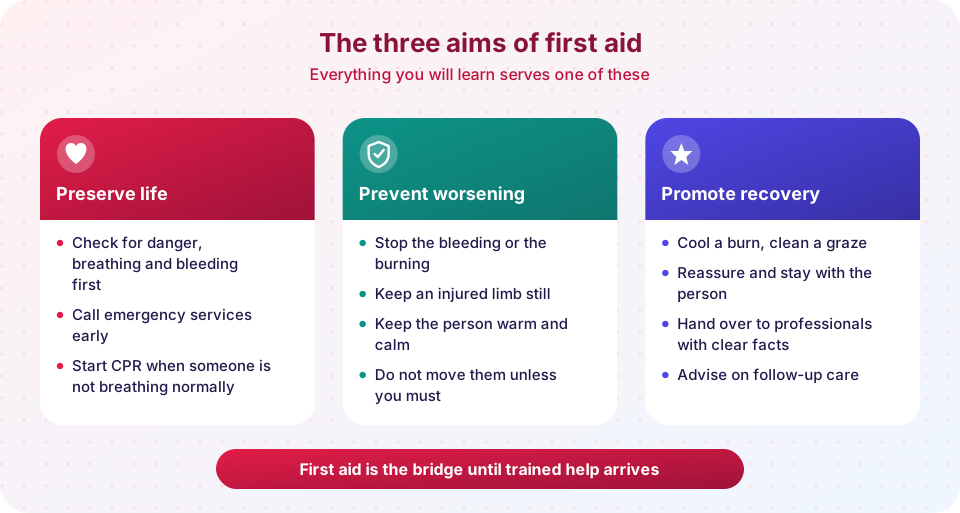
The three aims: the "three Ps"
Many courses summarize the purpose of first aid in three verbs. They also give you an order of priorities when you are overwhelmed.
- Preserve life. Anything that threatens life in the next few minutes comes first: a blocked airway, no breathing, severe bleeding. If you only have the time and skill to do one thing, do this.
- Prevent the condition from worsening. Stop the bleeding from becoming worse, stop a burn from burning, stop a broken bone from moving and damaging nearby blood vessels, keep a cold person from getting colder.
- Promote recovery. Cool the burn, clean the graze, reassure and stay with the person, and hand over clear information to the professionals. Even small acts such as a calm voice improve how a person copes.
Some organizations add a fourth aim, protect the unconscious, or speak of relieve pain. The idea is the same: do the most helpful thing for the person with the skills you have.
What first aid is not
First aid is a bridge, not a destination. It is not diagnosis or treatment of disease; first aiders describe what they see ("pale, sweating, chest pain for ten minutes") and act on it, but they do not try to decide which illness it is. It also does not usually involve medicines. The few exceptions, such as helping a person with asthma use their own inhaler or helping someone with a known severe allergy use their own adrenaline auto-injector, rely on the person's own prescribed medicine and on clear local rules.
Knowing the limits protects you and the patient. When a problem is beyond what you were taught, the correct first-aid action is to call for help, make the person safe and comfortable, and watch them closely.
A brief history
First aid in the modern sense grew out of war and industry, and then spread to ordinary life.
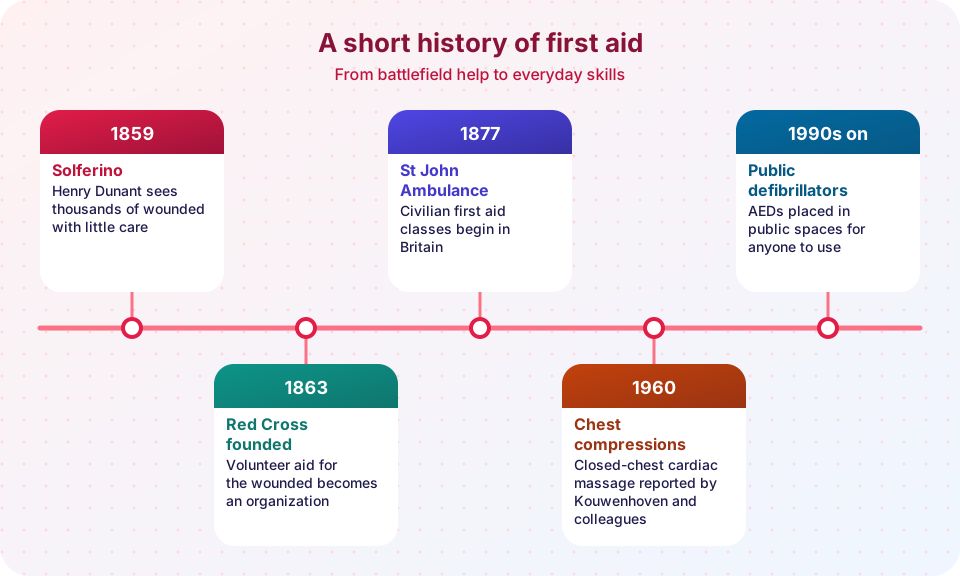
- 1859: Solferino. The Swiss businessman Henry Dunant passed through the village of Solferino in northern Italy just after a huge battle and found thousands of wounded soldiers with almost no care. He organized local volunteers to help soldiers of every side. His book A Memory of Solferino (1862) proposed that every country should have trained volunteer helpers.
- 1863: Red Cross. A committee in Geneva, including Dunant, founded what became the International Committee of the Red Cross. The idea of neutral, trained aid for the wounded spread across the world as the Red Cross and Red Crescent movement.
- 1877: St John Ambulance. In Britain the St John Ambulance Association began to teach first aid to civilians, such as railway workers and miners, whose jobs carried risks of injury. Similar training grew in many countries.
- 1960: chest compressions. Doctors William Kouwenhoven, James Jude and Guy Knickerbocker reported that pressing rhythmically on the closed chest could keep blood moving in a person whose heart had stopped. Combined with mouth-to-mouth ventilation that had been developed in the same decade, this became CPR.
- 1990s onward: public defibrillators. Small automated external defibrillators (AEDs) that talk the user through each step were placed in airports, casinos and public buildings, putting a tool once restricted to doctors into the hands of ordinary people.
Today the evidence is reviewed by expert panels such as ILCOR, whose scientific statements feed into guidelines from national councils: the American Heart Association, the European Resuscitation Council and others. They agree on the large principles and differ in details, a theme you will meet again in the CPR lessons.
Why the first minutes matter
In cardiac arrest, the brain begins to suffer within minutes without blood flow. A rule of thumb widely quoted in resuscitation teaching is that, in a person with a shockable heart rhythm, the chance of survival falls by around 7 to 10 percent for each minute without CPR or defibrillation, and by something like 3 to 4 percent per minute when bystanders give CPR. The numbers come from older studies in specific settings and should be treated as a teaching illustration rather than a precise law. Even so, the message is robust: early CPR and early defibrillation save lives, and the person on the floor cannot wait for you to feel ready.
Here is a plot of that rule of thumb. It is a simple straight-line model.
Try it
Press Run (or Ctrl + Enter) to see the result here.
Program input · what you'd type while the program runs
Type the answers before you press Run, one per line. Each time the program reads a line (with input()), it gets the next line from this box.
The second demonstration sorts a few situations into "call now", "call if worried" and "home care". It is a teaching demonstration with simplified rules, not a triage tool.
Press Run (or Ctrl + Enter) to see the console output here.
No output.
Who can give first aid?
Anyone. You do not need a licence to help someone who is hurt, and in many places the law protects people who help in good faith. What you do need is humility about your skills. Good first aiders share a few habits: they stay calm and speak calmly, put their own safety first, ask permission when they can, do the basic things well rather than rare things badly, and stay with the person until relief arrives.
Some people have a legal or professional duty to give first aid, such as lifeguards or designated workplace first aiders. Chapter 1 returns to law and ethics in the lesson on consent.
Common misconceptions
"I might make it worse, so it is safer to do nothing." For someone who is not breathing, doing nothing is the harmful choice. Guidelines for CPR specifically say that compressions are better than nothing even if you are untrained.
"You have to know exactly what is wrong." You do not. Recognizing "not responding and not breathing normally" is enough to call and start CPR.
"First aid means bandages." Bandages are a small part. Calling the ambulance, checking breathing and staying calm matter more than any dressing.
Check your understanding
Quick check · 5 questions
of 5 answered You scored / 5 · perfect!
-
1. Which of these is NOT one of the three aims of first aid?
First aiders preserve life, prevent worsening and promote recovery; diagnosis is left to health professionals. -
2. Who is credited with inspiring the Red Cross after seeing the aftermath of the battle of Solferino?
Dunant described the suffering at Solferino in 1862 and helped found the Red Cross in 1863. -
3. In a rule-of-thumb model, what happens to the chance of survival from cardiac arrest each minute without CPR or defibrillation?
The widely quoted illustration is a fall of about 7 to 10 percent per minute, though real numbers vary by setting. -
4. What should you do if a problem is beyond what you were trained to do?
Staying within your training and calling for help is the correct first-aid action. -
5. Which statement about mistakes is best supported by guidelines?
Guidelines encourage even untrained bystanders to start hands-only CPR.
Summary
- First aid is immediate help before professional care, with three aims: preserve life, prevent worsening, promote recovery.
- It began on battlefields and in industry and now includes bystander CPR and public AEDs.
- Early CPR and early defibrillation change outcomes; the numbers in rules of thumb are illustrative.
- Anyone can learn it; staying within your training and calling for help are part of doing it well.
Track your progress
Create a free account to tick off lessons and pick up where you left off on any device.
of First Aid and Emergency Care lessons completed