


















Lesson 16 of 47 · Assessment and CPR
Choking: Back Blows, Thrusts and Prevention
Learn to tell mild from severe choking and what to do for adults, children and infants: coughing, back blows, abdominal or chest thrusts, CPR and prevention.
Choking happens when something blocks the airway, so air cannot reach the lungs. It is frightening to watch, but it is one of the emergencies where quick, simple action by a bystander often succeeds. Choking can be caused by food, small toys, coins or button batteries, and it is more common in small children, who explore the world with their mouths, and in older adults, who may have trouble swallowing. Most episodes are mild and resolve by themselves with coughing; a few are severe, and in those you may have only a minute or two.
Educational information only. This lesson is not a substitute for a certified, hands-on first-aid course, and it is not medical advice. Choking protocols differ between organizations and are updated regularly; follow your local training and the dispatcher. If a person cannot breathe, call your local emergency number.
What you will learn
- How to recognize mild versus severe choking.
- The sequence for a conscious adult or child: coughing, back blows, abdominal thrusts.
- Special cases: infants, pregnant or large people, and what to do on your own.
- What to do if the person becomes unresponsive.
- Why anyone treated for choking should be checked by a doctor, and how to prevent it.
Key terms
Foreign body airway obstruction (FBAO): a blockage of the airway by something that should not be there.
Back blows: firm slaps with the heel of the hand between the shoulder blades.
Abdominal thrusts: quick inward and upward pressure on the upper abdomen, sometimes called the Heimlich maneuver.
Chest thrusts: pushes on the lower half of the breastbone, like compressions but sharper; used for infants.
Universal choking sign: both hands clutching the throat.
Recognizing choking
Mild obstruction. The person can speak, cough, cry or breathe, although it may be noisy. Air is passing around the blockage. A strong cough is the most effective way to clear it.
Severe obstruction. The person cannot speak, cough effectively or breathe. They may grab their throat, make high-pitched or no sounds, turn blue or grey, and become unable to cry (in a child). If untreated, they become unconscious within a few minutes.
Choking is easy to confuse with a heart attack, an asthma attack or a severe allergic reaction. Ask: "Are you choking?" If they nod and cannot speak, treat it as severe choking.
Mild choking: encourage coughing
Stay with the person and ask them to cough. Do not slap their back at this point, as a blow might push the object deeper. Do not put your fingers into their mouth. Watch closely: if the cough becomes weak, silent or ineffective, treat it as severe.
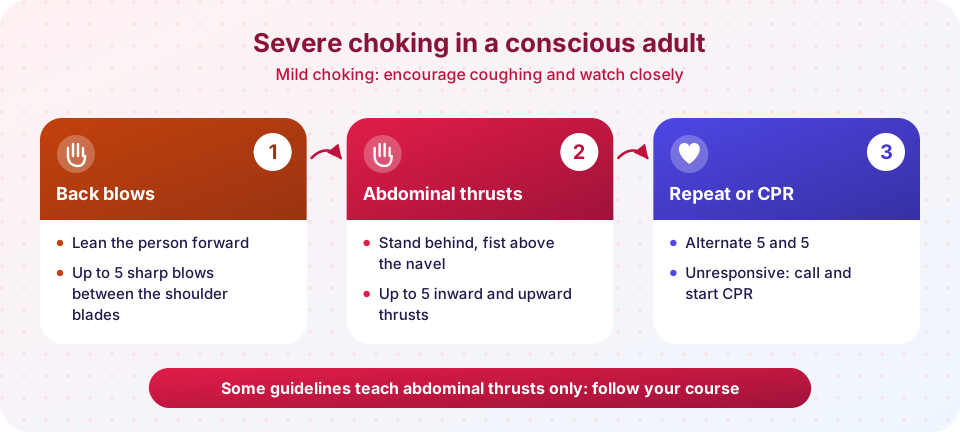
Severe choking in a conscious adult or child (over 1 year)
- Call for help. Ask someone to call emergency services, or call on speaker while helping.
- Give up to five back blows. Stand to the side and slightly behind. Support the chest with one hand and lean the person well forward so that the object can come out of the mouth rather than slip further down. With the heel of your other hand, give up to five sharp blows between the shoulder blades. Check after each blow whether the obstruction has cleared.
- Give up to five abdominal thrusts. Stand behind the person and put your arms around the upper abdomen. Make a fist with one hand and place it, thumb side in, just above the navel and well below the breastbone. Grasp the fist with the other hand and pull sharply inward and upward. Give up to five thrusts, checking after each.
- Repeat the cycles of five back blows and five thrusts until the object comes out or the person becomes unresponsive.
The alternating pattern is taught by the European Resuscitation Council and the Red Cross movement. Some other organizations, including the American Heart Association, historically taught abdominal thrusts alone for adults and children; more recent updates have moved closer to the alternating method, but you should do what your course teaches. The abdominal thrust, popularized by the American surgeon Henry Heimlich in the 1970s, remains a core technique everywhere.
Special cases
- Pregnant or very large people. You cannot reach around the abdomen, so give chest thrusts: place your fist on the lower half of the breastbone and pull straight back.
- Alone and choking. Call emergency services if you can. Try to cough. Make a fist and press it above your navel with a quick inward-and-upward thrust, or lean over a firm edge such as a chair back or table and press your abdomen against it.
- Wheelchair users. Give back blows, or thrusts from behind if you can reach the abdomen.
Choking in an infant (under 1 year)
An infant's organs are small and fragile, so abdominal thrusts are not used.
- Call for help.
- Lay the baby face down along your forearm, supporting the head and jaw with your hand, with the head lower than the chest. Rest your arm on your thigh.
- Give up to five back blows between the shoulder blades with the heel of your hand.
- If the blockage remains, turn the baby face up, supported along your other arm, with the head lower than the chest. Give up to five chest thrusts with two fingers on the lower half of the breastbone, just below the nipple line, sharper and slower than compressions.
- Repeat until the object comes out or the baby becomes unresponsive.
Never do a blind finger sweep in a baby's or child's mouth. Remove an object only when you can see it and it is within easy reach.
If the person becomes unresponsive
Lay them on the floor, call emergency services if you have not, and start CPR with 30 compressions (or 15 for children and infants where your guidelines say so). The compressions can help dislodge the object. Each time you open the airway for breaths, look in the mouth and remove any object you can see. Do not stop CPR to search. Continue until help arrives or the person starts to breathe.
After the event
Even if the object comes out, anyone who received abdominal or chest thrusts, or who has persistent cough, difficulty swallowing, or pain, should see a doctor, because thrusts can cause internal injury and some objects stay behind. A swallowed button battery, magnets or other sharp objects require urgent medical evaluation even if the child seems well.
Prevention
Most choking in children is preventable.
- Cut round foods such as grapes, hot dogs and cherry tomatoes lengthways, and into small pieces.
- Avoid hard foods for young children: whole nuts, popcorn, hard sweets, raw carrot sticks.
- Make children sit down to eat and avoid running with food.
- Keep small objects out of reach. A quick test: any object that fits through the inside of a toilet-paper roll, about 3.2 cm in diameter, is small enough to block a young child's airway.
- Keep button batteries and magnets away from children.
- Adults: chew food well, avoid talking while eating, and take care with alcohol.
The second demonstration walks through the response for different situations. It is a simplified teaching aid.
Press Run (or Ctrl + Enter) to see the console output here.
No output.
Common misconceptions
"Slap the back of anyone who coughs." Only when obstruction is severe and the person cannot cough. Otherwise, let them cough.
"Give them water to wash it down." Fluids can make a severe obstruction worse; do nothing by mouth.
"Hold a child upside down by the legs." This is unsafe and not recommended.
"Once the object is out, all is well." Get checked by a doctor, especially after thrusts.
Check your understanding
Quick check · 5 questions
of 5 answered You scored / 5 · perfect!
-
1. A person is coughing loudly and can speak. What should you do?
A strong cough is the best way to clear a mild obstruction. -
2. Which sequence is taught for severe choking in a conscious adult by the ERC and many others?
Back blows and thrusts alternate until the object is cleared or the person becomes unresponsive. -
3. What is used instead of abdominal thrusts for an infant?
Infants get 5 back blows then 5 chest thrusts. -
4. A choking adult becomes unresponsive. What now?
Lay them down and start compressions; they may dislodge the object. -
5. Why should someone be checked by a doctor after abdominal thrusts?
Abdominal and chest thrusts can bruise or injure organs.
Summary
- Mild choking: coughing; severe choking: cannot speak, cough or breathe.
- Conscious adult or child: up to five back blows, then up to five abdominal thrusts, repeat; infants: five back blows and five chest thrusts.
- Unresponsive: call and start CPR.
- Always get checked by a doctor after thrusts; prevent choking with careful feeding and safe toys.
Next: Chapter 3 Review
Track your progress
Create a free account to tick off lessons and pick up where you left off on any device.
of First Aid and Emergency Care lessons completed