


















Lesson 42 of 47 · Preparedness and Special Situations
Chapter 8 review: preparedness and special situations
Review chapter 8: first-aid kits, emergency plans, consent and the law, children, infants, older adults, disasters, triage and psychological first aid, with a picture, a table and a ten-question quiz.
This chapter was about the work you do before and around emergencies: the kit and plan that save minutes, the laws that shape what you may do, the adjustments for infants, children, pregnancy, older age and disability, and the larger scale of disasters, where triage and psychological first aid matter. Use this lesson to pull it together before the practice chapter.
Reminder: this is educational information, not a substitute for a certified first-aid course (including pediatric training), legal advice or emergency services. Laws, techniques and crisis numbers differ between countries.
What you will learn
- How to recall the main ideas of each lesson in the chapter.
- Which adjustments apply to which group of people.
- Which actions are unwise in a disaster and in mental health crises.
Recap table
| Topic | Key ideas | Do | Avoid |
|---|---|---|---|
| Kit | Wound care, tools, information | Check twice a year, keep findable | A huge kit you cannot use |
| Plan | Numbers, address, roles, medical info, meeting place | Write one page, practice yearly | Assuming you will remember |
| Law | Consent, duty, Good Samaritan, scope | Ask; imply consent if unresponsive; stay within training | Going beyond your training |
| Infants | Back blows and chest thrusts for choking | Support the head, use fingertips | Abdominal thrusts, shaking |
| Children | Breaths matter, faster loss of heat and fluid | Calm explanations, pediatric course | Treating as small adults |
| Pregnancy | Left tilt, chest thrusts for choking | Review after abdominal injury | Lying flat on the back when unresponsive |
| Older adults | Falls, medicines, delirium | Check for injury before lifting | Calling confusion normal |
| Disaster | Safety, bleeding control, START triage | Share tasks, re-triage | Entering unsafe places |
| Psychological first aid | Look, Listen, Link | Calm presence, practical help | Pressing for details, "I know how you feel" |
| Crisis | Ask directly, listen, connect | Stay with the person if risk is immediate | Leaving them alone, promising secrecy |
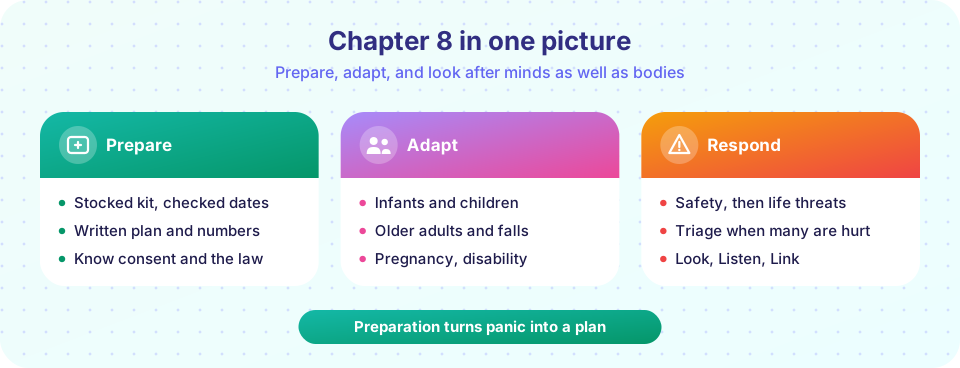
The chapter in three words
- Prepare. A kit, a plan, the numbers and a certified course turn a stressful moment into a routine.
- Adapt. The same principles apply to everyone, but infants, children, pregnant people and older adults need adjusted techniques and extra attention.
- Respond. In large events, safety, simple triage and humane support matter as much as any bandage.
Try it
A quick match: pair each situation with the technique. It keeps score so you can repeat until it feels easy.
Check your understanding
Quick check · 10 questions
of 10 answered You scored / 10 · perfect!
-
1. How often should you check a household first-aid kit?
Regular checks catch expired and used items. -
2. When is consent implied?
For an unresponsive person the law assumes they would want help. -
3. How do you help a choking infant?
Abdominal thrusts are not used for babies. -
4. Why do breaths matter more in children's CPR?
Drowning, choking and breathing problems are common causes. -
5. Which position is used for an unresponsive pregnant person?
Left tilt keeps the womb off the large vein returning blood to the heart. -
6. What is the main aim of triage?
Triage sorts by urgency and is repeated. -
7. In START, what is the category for a casualty who can walk?
Walking casualties are green (minor). -
8. What do the three actions in psychological first aid stand for?
Look, Listen, Link from the WHO guide. -
9. How should you respond to a person who may be suicidal and in immediate danger?
Do not leave them alone; get professional help. -
10. A sudden change in thinking in an older adult is called:
Delirium is often caused by illness and needs urgent assessment.
Summary
- Prepare: kit, plan, numbers, certified training and knowledge of local law.
- Adapt: infants, children, pregnancy, older age and disability each need adjusted techniques.
- Respond: in disasters use safety, START triage and psychological first aid; in a crisis ask, listen and connect.
- Practice and refresh your skills regularly.
Track your progress
Create a free account to tick off lessons and pick up where you left off on any device.
of First Aid and Emergency Care lessons completed