


















Lesson 11 of 47 · Assessment and CPR
Chapter 3 Overview: Assessment and CPR
Overview of chapter 3: the chain of survival, how to check a person quickly, and the life-saving skills of CPR, AED use and clearing a blocked airway.
Every second counts in a cardiac arrest, yet the person who will decide the outcome is often a family member, a coworker or a passer-by. In the next six lessons you will learn the skills that matter most in first aid: checking whether someone is responsive and breathing, giving chest compressions, using a defibrillator and helping a person who is choking. These are the skills for which a certified, hands-on course is most valuable, so treat this chapter as a thorough preparation and then practice on a manikin.
Educational information only. This chapter describes widely taught resuscitation principles. It is not a substitute for a certified, hands-on first-aid or CPR course, and guidelines differ between countries and are updated regularly. In a real emergency, call your local emergency number and follow the dispatcher and your local training.
What you will learn
- What cardiac arrest is and why the chain of survival matters.
- What each lesson in this chapter covers.
- How guidelines differ and why you should follow your local one.
Key terms
Cardiac arrest: the heart stops pumping effectively; the person is unresponsive and not breathing normally.
Heart attack: a blockage of an artery that supplies the heart muscle. The person is usually awake. Heart attacks can lead to cardiac arrest, but they are different conditions.
CPR: cardiopulmonary resuscitation, chest compressions with or without rescue breaths.
AED: automated external defibrillator, a device that analyses the heart rhythm and can deliver a shock.
Return of spontaneous circulation (ROSC): the heart starts again on its own.
Cardiac arrest and the chain of survival
In cardiac arrest the heart's electrical system fails, most often in a chaotic rhythm called ventricular fibrillation (VF) in which the muscle quivers instead of pumping. Blood stops flowing. The brain starts to lose function within seconds, and after a few minutes injury becomes permanent. The person looks as though they have suddenly fallen asleep, but they do not respond and are not breathing normally; some have occasional noisy gasps known as agonal breathing, which are not normal breathing.
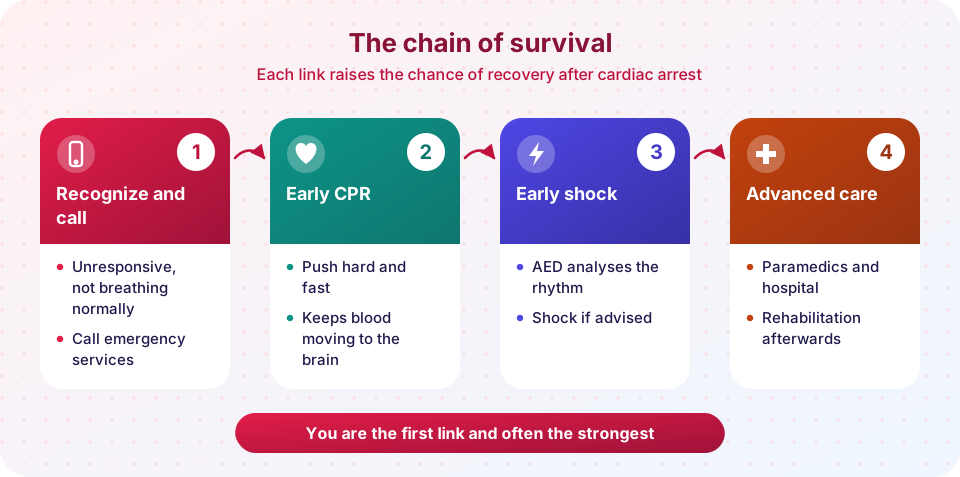
Survival from out-of-hospital cardiac arrest is far from guaranteed: in many regions only a small minority, under one in ten in some reports, leave hospital alive, while places that invest in each link of the chain report much higher figures. Resuscitation scientists describe the care as a chain of survival, in which every link must hold:
- Recognize and call. Spot the arrest and call emergency services early.
- Early CPR. Chest compressions keep a small flow of oxygenated blood going to the brain and heart.
- Early defibrillation. An AED can stop VF so the heart can restart. Each minute of delay lowers the chance of success.
- Advanced care. Paramedics and hospital teams provide drugs, airway management and treatment of the cause, followed by recovery and rehabilitation.
The first three links can be done by a bystander. That is why a short course can have more effect on survival than almost any other health skill.
Before CPR: the quick check
Normal breathing? Recovery position. Not normal? CPR.
CPR and the AED
Children, infants and choking
Lessons in this chapter
- The Primary Survey and the Recovery Position: how to check danger, response, airway and breathing, how to tell normal from abnormal breathing and how to place a breathing, unresponsive person on their side.
- CPR for Adults: hand position, depth, rate, 30:2 and hands-only CPR, with the evidence behind them.
- Using an AED: what a defibrillator does, where the pads go, safety around shocks and special cases.
- CPR for Children and Infants: how to adapt technique and why breaths matter more.
- Choking: mild and severe choking in adults, children and infants.
- Chapter 3 Review: a recap, a cheat-sheet picture and a ten-question quiz.
Guidelines differ, and that is fine
Resuscitation guidelines are updated every five years or so by the International Liaison Committee on Resuscitation and by regional bodies such as the American Heart Association and the European Resuscitation Council. They agree on the big points (call early, push hard and fast, use an AED) and differ in details such as whether to start with breaths in children, how to treat choking or when exactly to call. In this chapter you will see the points where bodies differ. Follow what your own course teaches; any good, consistent CPR is better than perfect CPR that is never started.
Try it
A tiny timeline of what happens in the first minutes, with and without early action. It shows the order of events and is not a prediction.
Press Run (or Ctrl + Enter) to see the console output here.
No output.
Check your understanding
Quick check · 4 questions
of 4 answered You scored / 4 · perfect!
-
1. What is cardiac arrest?
In cardiac arrest circulation stops. A heart attack is a different condition, though it can lead to arrest. -
2. Which is NOT one of the four links of the chain of survival described here?
The links are recognize and call, early CPR, early defibrillation and advanced care. -
3. Agonal breathing is...
Agonal gasps happen in some cardiac arrests; treat them as 'not breathing normally'. -
4. Why should you follow your own local guidelines?
Bodies agree on the main principles but differ in specifics.
Summary
- Cardiac arrest means the heart is not pumping blood; the chain of survival links calling, CPR, defibrillation and advanced care.
- Bystanders can perform the first three links.
- The chapter covers assessment, adult and child CPR, AED use and choking.
- Guidelines differ in details; follow your local training and the dispatcher.
Track your progress
Create a free account to tick off lessons and pick up where you left off on any device.
of First Aid and Emergency Care lessons completed