


















Lesson 12 of 47 · Assessment and CPR
The Primary Survey and the Recovery Position
Learn the DRABC check for an unresponsive person: response, opening the airway, telling normal from agonal breathing, and the recovery position step by step.
When you reach a person who has collapsed, you need an answer to one question within about thirty seconds: is this person's life in immediate danger? The primary survey is a short, fixed series of checks that answers it. It works the same way for a stranger on a pavement or a relative at the kitchen table, and it tells you whether to put the person in the recovery position or start CPR. Fixed steps are valuable under stress: you do not need to think about what comes next, you only need to do it.
Educational information only. This lesson is not a substitute for a certified first-aid course or for emergency services. Follow your local training and the dispatcher. Call your local emergency number early.
What you will learn
- The DRABC steps and the reason for each.
- How to check for a response and open the airway safely.
- How to tell normal breathing from absent or agonal breathing.
- How to place a breathing, unresponsive person in the recovery position, and when not to.
- What to do for a person who is responsive but unwell.
Key terms
Primary survey: the initial rapid check for immediate threats to life.
Airway: the passage from the mouth and nose to the lungs. In an unconscious person, relaxed muscles can let the tongue fall back and block it.
Head tilt, chin lift: the standard method for opening the airway of an unresponsive adult or child.
Agonal breathing: slow, irregular gasps, sometimes snoring-like, that may occur in the first minutes after the heart stops; it is not effective breathing.
Recovery position: lying on the side with the head tilted back and angled downwards so fluid drains out and the tongue cannot block the airway.
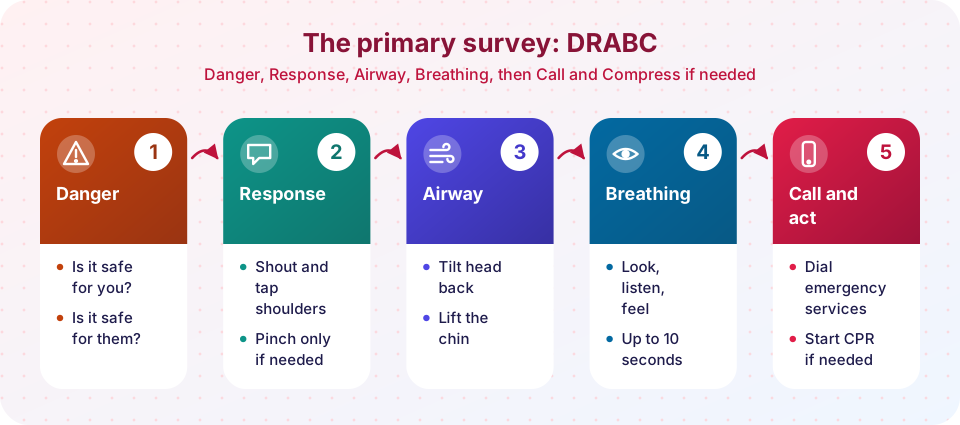
D is for Danger
Before you touch the person, spend a few seconds applying the previous chapter: look around for traffic, fire, electricity, violent people or other threats. If it is safe, put on gloves if you have them and go on. If it is not safe, do not approach. Say aloud "Danger: all clear" so the check becomes automatic.
R is for Response
Kneel beside the person. Speak loudly and clearly, "Can you hear me? Open your eyes!", and give them a chance to answer. If there is no answer, gently shake both shoulders with your hands, or squeeze a shoulder firmly. Do not shake the head or neck; if you suspect a neck injury, speak but do not move them.
- Responds (opens eyes, speaks, moves): leave them as you find them unless they are in danger, find out what happened, ask where it hurts, look for injuries and call for help if needed. Reassess them regularly, because a person who is awake now can fade.
- No response: shout for help (bystanders may bring an AED), and move on to the airway.
A is for Airway
An unconscious person lies limp, and the tongue and soft tissue at the back of the throat can slump backward and close the airway. Opening it is the single most important action for a person who is not conscious.
- Place one hand on the forehead and gently tilt the head back.
- Place the fingertips of your other hand under the point of the chin and lift. Avoid pressing on the soft tissue under the chin.
- If you can see something in the mouth, such as vomit or a loose object, turn the head to the side and scoop it out with your fingers. Never do a blind finger sweep.
For an infant (under one year), keep the head in a neutral position, so the nose points straight up, because the airway is narrow and bends easily if the neck is tilted too far. For a child, tilt only a little. If you suspect a neck injury, still open the airway: an open airway matters more than the small risk of moving the neck, but use the gentlest movement, such as a jaw thrust if you have been taught it.
B is for Breathing
With the airway open, look, listen and feel for normal breathing for up to 10 seconds: look for chest movement, listen at the mouth for breath sounds and feel for breath on your cheek. Do not spend longer than 10 seconds, and do not check for a pulse; trained professionals find pulse checks unreliable in an emergency and lay people are even less accurate.
What counts as normal breathing? In an adult at rest, roughly 12 to 20 breaths a minute, regular and quiet, which means two to three breaths in 10 seconds. Anything else is not normal:
- No chest movement at all.
- Agonal gasps: a gasp, a long pause, another gasp. These can last for minutes after the heart has stopped and fool onlookers into thinking the person is breathing.
- Very slow, noisy or labored breathing that you cannot count with confidence.
If you are in doubt, treat it as not normal. Dispatchers are trained to help you decide.
Press Run (or Ctrl + Enter) to see the result here.
Program input · what you'd type while the program runs
Type the answers before you press Run, one per line. Each time the program reads a line (with input()), it gets the next line from this box.
Decide: recovery position or CPR
%%{init: {"theme": "base", "themeVariables": {"primaryColor": "#fff1f2", "primaryBorderColor": "#e11d48", "primaryTextColor": "#1e1b4b", "lineColor": "#be123c", "fontFamily": "system-ui"}}}%%
flowchart TD
    A("Safe to approach?") -->|yes| B("Responds to voice and shoulders?")
    B -->|no| C("Shout for help and open the airway")
    B -->|yes| H("Ask what happened, check injuries, call if needed")
    C --> D("Look, listen, feel for up to 10 seconds")
    D -->|"normal breathing"| E("Call emergency services, recovery position, keep checking")
    D -->|"not normal or unsure"| F("Call on speaker and start CPR")
Caption: after the breathing check, the decision is between the recovery position and CPR.
If the person is breathing normally: the recovery position
The recovery position keeps the airway open and lets fluids drain, which reduces the risk of choking on vomit. It is used for a person who is unresponsive but breathing normally and who must be left briefly, or who needs to wait for the ambulance. Call emergency services first.
- Kneel beside the person. Remove glasses and bulky objects from pockets.
- Place the arm nearest to you at a right angle to the body, palm up.
- Bring the far arm across the chest and hold the back of that hand against the person's near cheek.
- With your other hand, grip the far knee and pull it up, keeping the foot on the ground.
- Keeping the hand pressed to the cheek, pull the knee toward you to roll the person onto their side.
- Tilt the head back to keep the airway open, and adjust the upper leg so that the hip and knee are bent at right angles and the person is stable.
- Keep checking breathing. If it stops or becomes abnormal, roll them onto their back and start CPR.
- If the person must stay on their side for a long time, turn them to the other side about every 30 minutes to avoid pressure damage, unless guidance in your course says otherwise.
The evidence for the exact recovery position is limited, since good trials are hard to run, but there is reasonable physiological reasoning and expert consensus that a side-lying position helps keep the airway clear in people who are unresponsive and breathing.
Do not use the recovery position for someone who is not breathing normally. They need CPR.
If the person is not breathing normally: call and start CPR
Call emergency services (put your phone on speaker), send someone for an AED if available and begin chest compressions straight away. The next lesson explains how.
What if the person is awake?
A person who responds but looks unwell needs a secondary survey, a head-to-toe check for injuries and a conversation. Ask: what happened, where does it hurt, any medical conditions or medicines, any allergies. Watch their breathing, color and alertness. A well-known memory aid for questions is SAMPLE: Signs and symptoms, Allergies, Medications, Past history, Last meal or drink, Events leading up to it. Hand these facts to the paramedics.
Common misconceptions
"Check for a pulse first." Lay rescuers are not taught to do this; it is unreliable and delays CPR. Check for response and breathing.
"Gasping means they are breathing." Occasional gasps in an unresponsive person can be agonal breathing. Treat it as not breathing normally and start CPR.
"The recovery position fixes everything." It is for a person who is unresponsive but breathing normally. It does not treat the cause, so call emergency services.
"Never move someone with a possible neck injury." If the person is not breathing, or you cannot keep the airway open, airway and breathing come first.
Try it
A small decision engine can help you rehearse the branches. It is a simplified teaching model.
Press Run (or Ctrl + Enter) to see the console output here.
No output.
Check your understanding
Quick check · 6 questions
of 6 answered You scored / 6 · perfect!
-
1. What does the D in DRABC stand for?
Always check for danger to yourself and the person first. -
2. How long should you look, listen and feel for normal breathing?
Up to 10 seconds is enough; longer delays CPR. -
3. A person gasps once every 20 seconds and does not respond. What is this?
Occasional gasps can occur after the heart stops and must be treated as not normal breathing. -
4. How do you open the airway of an adult?
Tilt the forehead back and lift the chin with the fingertips of the other hand. -
5. For which person is the recovery position appropriate?
If breathing is not normal, CPR is needed; if the person is awake, they can choose a comfortable position. -
6. Why is the head kept neutral for an infant?
A neutral position keeps the narrow infant airway open.
Summary
- DRABC: check danger, response, open the airway, look, listen and feel for up to 10 seconds, then call and act.
- Occasional gasps, noisy or absent breathing are not normal: call and start CPR.
- Unresponsive and breathing normally: call, recovery position, keep checking.
- Do not check for a pulse; do not delay CPR.
Next: CPR for Adults
Track your progress
Create a free account to tick off lessons and pick up where you left off on any device.
of First Aid and Emergency Care lessons completed