


















Lesson 4 of 47 · Getting Started
Consent, Law and Ethics for First Aiders
Understand how consent works in first aid, what Good Samaritan and duty-to-rescue laws mean, how to handle refusal, privacy and children, and the four ethical principles.
Helping someone also means treating them as a person with rights. A first aider touches strangers, sometimes in private moments, and acts under stress with incomplete information. Three questions come up again and again: May I help? What if they say no? What if something goes wrong and I am blamed? This lesson gives you the thinking tools for each, with the caution that the law differs from country to country and that this is general education, not legal advice.
Educational information only. Laws on first aid and consent vary by country and region. This lesson is not legal advice and not a substitute for a certified first-aid course. Ask your course provider about the rules where you live.
What you will learn
- The difference between expressed and implied consent, and how to ask.
- What to do when the patient is a child, confused or refuses help.
- What Good Samaritan laws and duty-to-rescue laws are, and why they differ.
- How to protect privacy and dignity while you help.
- Four ethical principles that guide decisions in health care and first aid.
Key terms
Consent: permission to be touched or treated, given freely by a person who understands what is proposed.
Mental capacity: the ability to understand information, weigh it, decide and communicate the decision.
Good Samaritan law: a law protecting people who give emergency help in good faith from liability, within limits.
Duty to rescue: a legal duty, in some countries, to give or summon help to a person in serious danger when you can do so safely.
Advance directive: a written statement of a person's wishes about future medical treatment, for example a "do not attempt resuscitation" order.
Why consent matters
In medical ethics, a person's body belongs to them. Touching someone without permission can be assault in law, and it is disrespectful even when well meant. Consent lets you help while honoring that principle, and it also gives you valuable information: a person who answers you can tell you where it hurts, what happened and what medicines they take.
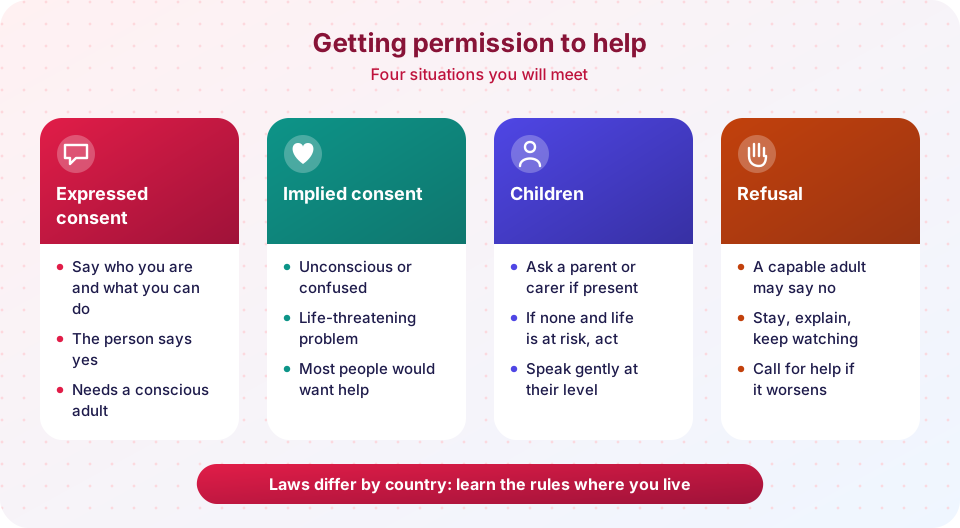
Expressed consent
When the person is awake and can understand you, introduce yourself and ask. A good opening has four parts: who you are ("My name is Mara"), what training you have ("I have first-aid training"), what you propose ("Can I look at your arm and help you?") and a pause for the answer. A nod, "yes" or an outstretched arm counts. Keep asking as you go: "I'm going to press on the cut now. Is that okay?"
Implied consent
If a person is unconscious, confused by injury or illness, or otherwise unable to answer, the law in most places allows you to assume that they would want help, as long as the problem is serious. This is implied consent. You can act to save life and prevent serious harm, but only with the least intrusive help that works. Implied consent is not a licence to do anything you like; it covers the kind of care a reasonable person would accept.
Children
For a child, consent normally comes from a parent or legal guardian. If a parent is present, ask them. If no adult is available and the child is seriously hurt or ill, implied consent applies: act to save life and call emergency services. Speak at the child's level, explain simply and truthfully ("I'm going to put a cover on your knee. It might sting for a moment"), and keep the parent informed. For older teenagers, local law differs on when a young person can consent to treatment, so follow your course guidance.
Refusal
An adult with capacity has the right to refuse help, even if you think they are wrong. In that case:
- Explain calmly what you are concerned about and what could happen.
- Respect the answer; do not touch or treat against their wish.
- Stay nearby if it is safe, because people sometimes change their minds or get worse.
- Call emergency services if they become unresponsive, since implied consent then applies.
- Note what was said, and who heard it.
Capacity can be reduced by shock, head injury, low blood sugar, alcohol, drugs, severe pain or mental illness. If you suspect the person cannot understand or weigh the situation, treat them as lacking capacity for now and call emergency services. If you are unsure, err on the side of calling for help.
What does the law expect?
Legal systems fall into two broad styles, and the difference surprises many people.
Good Samaritan laws (common in the United States, Canada, Australia and many other countries) protect you from being sued or prosecuted for acts done in good faith to help someone in an emergency. They usually exclude gross negligence, payment for help and cases where you have a duty to act. They do not require you to help.
Duty-to-rescue laws (found in many European countries, such as France and Germany, and in some US states in limited forms) make it an offence to fail to help a person in serious danger when you can do so without risking yourself. At minimum, that duty is met by calling emergency services.
Either way, courts generally ask whether you acted as a reasonable person with your level of training would. Practical consequences:
- Stay within your training.
- Act in good faith and in the person's interest.
- Do the simple things well and call for help.
- If you are a workplace first aider or lifeguard, you may have a stronger legal duty, so learn your employer's rules.
Privacy, dignity and safeguarding
Patients are vulnerable. Treat what you see and hear as confidential: share it with the ambulance crew and, if needed, the police, and not with onlookers or social media. Do not photograph or film the person. Ask bystanders who are not helping to give them space, and use a coat or blanket to shield the person from view when you must expose the body to treat them.
Respect cultural and religious preferences about touch, clothing and gender of the helper wherever life is not at immediate risk. Explain what you are doing, particularly if you must remove clothing or touch sensitive areas.
Be alert for signs that a child or vulnerable adult has been harmed by others. First aiders are not investigators, but a report to the police, emergency services or a child-protection line, made in line with local procedure, may be the most important thing you do.
Advance directives
Some people carry a card, bracelet or document saying they do not want resuscitation. A valid, clear and applicable order must be respected, but in a sudden emergency you will rarely have time to check legal validity. Most guidelines say: if you are unsure, begin CPR and call emergency services, and let professionals confirm the situation when they arrive. If the order is immediately visible, official and unambiguous, tell the dispatcher.
Four ethical principles
Biomedical ethics, as set out by Tom Beauchamp and James Childress in 1979, uses four principles that also work as a checklist for first aid:
| Principle | In first aid |
|---|---|
| Autonomy | Respect the person's choices; ask consent |
| Beneficence | Act to help; do good |
| Non-maleficence | Avoid harm; stay within training |
| Justice | Give the same care to everyone, regardless of background |
These sometimes pull in different directions. Respecting a refusal (autonomy) may feel like failing to help (beneficence). Good practice is to explain, stay, and call for help if the situation changes.
Try it
A decision helper shows how consent usually works in practice. It is a teaching simplification and not legal advice.
Press Run (or Ctrl + Enter) to see the console output here.
No output.
The second demonstration is a script generator for asking consent. Saying the same four things every time makes it automatic.
Press Run (or Ctrl + Enter) to see the console output here.
No output.
Common misconceptions
"I will be sued if I help." In places with Good Samaritan laws, acting in good faith within your training offers strong protection, and lawsuits against helpers are rare. Where duty-to-rescue laws exist, the larger legal risk is failing to call for help.
"A refusal means I must leave." Respect it, but you may stay nearby and call if the person worsens. You should not leave a person who is deteriorating alone.
"Consent is only a legal formality." It also tells you the person can speak, understand and cooperate, which is useful clinical information.
Check your understanding
Quick check · 5 questions
of 5 answered You scored / 5 · perfect!
-
1. A person lies unconscious and cannot give permission. Which consent applies?
Implied consent lets you give urgent, life-saving help to someone unable to answer. -
2. An adult with capacity says they do not want your help. What is the best response?
Adults with capacity may refuse; you respect it but remain available and call for help if they deteriorate. -
3. What do Good Samaritan laws usually do?
They protect good-faith helpers; they typically do not create a duty to help. -
4. Which is NOT one of the four classic ethical principles?
The four are autonomy, beneficence, non-maleficence and justice. -
5. A young child is seriously injured and no parent is present. What applies?
When life or limb is at risk, implied consent covers essential help and calling for professionals.
Summary
- Ask permission when the person can answer; assume permission when they cannot and the problem is serious.
- Children usually need a parent's consent, except in a life-threatening emergency with no parent available.
- Adults with capacity may refuse help; stay nearby and call if they get worse.
- Good Samaritan laws protect good-faith helpers; some countries also require you to call for help.
- Protect privacy and dignity, and use the four ethical principles when in doubt.
Next: Chapter 1 Review
Track your progress
Create a free account to tick off lessons and pick up where you left off on any device.
of First Aid and Emergency Care lessons completed