


















Lesson 33 of 49 · Instrumental Variables and Endogeneity
Chapter 6 review: instruments and endogeneity
Review chapter 6 with a one-picture summary, a recap table, a reusable 2SLS function and a ten-question quiz on endogeneity, 2SLS and instrument tests.
Chapter 6 started from a hard fact: when a regressor is correlated with the error term, no amount of data rescues OLS. It then offered a way out, instrumental variables, and a set of checks to keep you honest. This review gathers the pieces and gives you a compact function you can reuse for any just-identified or overidentified 2SLS problem in later chapters.
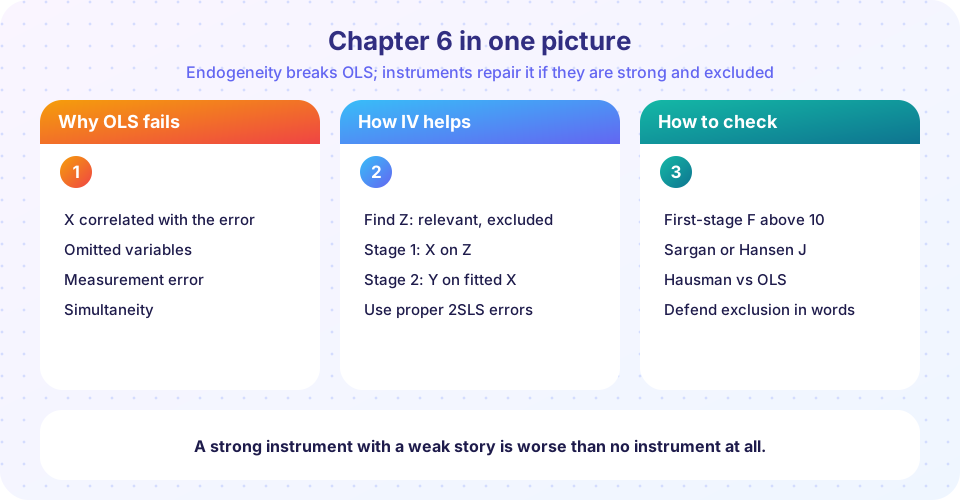
What you will learn
- A one-page recap of endogeneity, 2SLS and instrument checks.
- A reusable 2SLS function with robust standard errors, a first-stage F and a J statistic.
- Ten mixed questions to test the chapter.
Key terms
Endogeneity: Cov(x, u) ≠ 0. Instrument: relevant, exogenous and excluded. 2SLS: b = (X'P_Z X)⁻¹ X'P_Z y. Weak instrument: a small first-stage F, causing bias toward OLS. J test: a test of overidentifying restrictions. LATE: the effect for compliers.
Recap table
| Question | Answer | Where |
|---|---|---|
| What is the problem? | x correlated with u: OLS biased and inconsistent |
Overview |
| Where does it come from? | Omitted variables (β2 δ1), classical measurement error (attenuation λ), simultaneity |
Three roads |
| What is the fix? | Instrument z: relevant, exogenous, excluded |
2SLS |
| Simple estimator? | Cov(z, y) / Cov(z, x) = reduced form / first stage |
2SLS |
| How is it computed? | Stage 1: x on z and controls. Stage 2: y on x̂ and controls (use proper SEs) |
2SLS |
| What does it estimate? | LATE for compliers under heterogeneity | 2SLS |
| Is it strong? | First-stage F well above 10 | Tests |
| Is it valid? | Sargan or Hansen J if overidentified; otherwise argue | Tests |
| Is it needed? | Hausman or the control-function t test | Tests |
Three connections to remember:
- Bias versus precision. IV removes bias only by throwing away part of the variation in
x. The cost shows up as larger standard errors, and the smaller the first-stage R², the bigger the cost. - Argument beats statistics. Of the three instrument conditions, only relevance is testable. A good IV paper spends most of its pages on why the exclusion restriction is plausible.
- The direction of the OLS bias is informative. If you can sign the bias from theory (ability is positively related to both schooling and wages), you know whether IV should move the estimate down or up. A surprising movement is a clue to a problem.
A reusable function
The function below returns the 2SLS estimates with heteroskedasticity-robust standard errors, the first-stage F for the excluded instruments and Hansen's J (robust) when the model is overidentified. We test it on an invented market where the true demand slope is −2.
Press Run (or Ctrl + Enter) to see the result here.
Program input · what you'd type while the program runs
Type the answers before you press Run, one per line. Each time the program reads a line (with input()), it gets the next line from this box.
The estimate should be close to −2, the first-stage F large, and the J statistic unremarkable because both shifters are valid by construction. Try changing one shifter so that it also enters the demand equation (add 0.5 * w2 to Q) and watch J react.
A picture of the whole chapter
Press Run (or Ctrl + Enter) to see the result here.
Program input · what you'd type while the program runs
Type the answers before you press Run, one per line. Each time the program reads a line (with input()), it gets the next line from this box.
The boxes show three estimators repeated across many samples: OLS (biased), IV with a valid instrument (centred on the truth, wider) and IV with an invalid instrument (biased by the correlation between the instrument and ability). A strong first stage does not save an invalid instrument.
Common misconceptions
"If OLS and IV agree, OLS must have been fine." Agreement is consistent with exogeneity, but with a weak or invalid instrument the comparison tells you little.
"IV is always better than OLS when endogeneity is suspected." A poor instrument can give a worse estimate than OLS. Strength and credibility come first.
Check your understanding
Quick check · 10 questions
of 10 answered You scored / 10 · perfect!
-
1. A regressor is correlated with the error term. Which is true of the OLS slope?
Cov(x, u) different from zero means OLS converges to the wrong value. -
2. Omitted ability is positively related to schooling and positively related to wages. OLS on schooling is...
Both beta2 and delta1 are positive, so the bias beta2 times delta1 is positive. -
3. A noisy regressor has a reliability ratio of 0.8 and a true slope of 2. OLS converges to...
plim b = lambda times beta = 0.8 x 2 = 1.6. -
4. Which condition for an instrument can be tested with a single instrument?
Relevance shows up in the first stage; the other two need arguments or extra instruments. -
5. The reduced-form slope is 0.30 and the first-stage slope is 0.60. The IV estimate is...
IV = reduced form / first stage = 0.30 / 0.60 = 0.5. -
6. Why are the standard errors from a hand-made second-stage regression incorrect?
The structural residual is y - X b with the actual x. -
7. A first-stage F of 3 indicates...
F below about 10 is the classic warning of weakness. -
8. With 4 excluded instruments and 2 endogenous regressors, the J test has how many degrees of freedom?
4 - 2 = 2 overidentifying restrictions. -
9. A significant coefficient on the first-stage residual in the control-function regression suggests...
This is the Durbin-Wu-Hausman test: the part of x unexplained by z matters for y. -
10. With heterogeneous effects and a binary instrument, 2SLS estimates...
Under monotonicity, IV identifies the local average treatment effect for compliers.
Summary
- Endogeneity arises from omitted variables, measurement error and simultaneity; it biases OLS regardless of sample size.
- 2SLS uses only the variation in
xdriven by instruments; the simple IV estimate is reduced form over first stage. - Check strength (first-stage F), validity (J when overidentified, argument otherwise) and need (Hausman); report OLS next to IV.
- IV estimates describe compliers; weak or invalid instruments can be worse than OLS.
Track your progress
Create a free account to tick off lessons and pick up where you left off on any device.
of Econometrics lessons completed