


















Lesson 2 of 48 · Getting Started
What Is an Electric Circuit?
Learn what makes a circuit: a source, a closed conducting path and a load. See open and closed circuits, series and parallel layouts, and short circuits.
Press a light switch and a room fills with light. Nothing visible travels along the wall, yet energy moves from a power station to the bulb in an instant. The idea behind that everyday miracle is the electric circuit: a complete loop through which charge can circulate while carrying energy.
In this lesson you will meet the three ingredients of every circuit, see why the loop must be closed, and learn the vocabulary (node, branch, loop) that the rest of the course uses.
What you will learn
- The three ingredients of a working circuit.
- Why an open circuit carries no current and a short circuit is dangerous.
- The meaning of node, branch and loop.
- How series and parallel connections differ in a picture.
Key terms
Source: a part that supplies energy to the charge, such as a battery.
Load: a part that converts electrical energy into something useful (light, heat, motion).
Node: a point where two or more components connect.
Branch: one component (or a chain of them) between two nodes.
Loop: any closed path through the circuit that visits no node twice.
The three ingredients
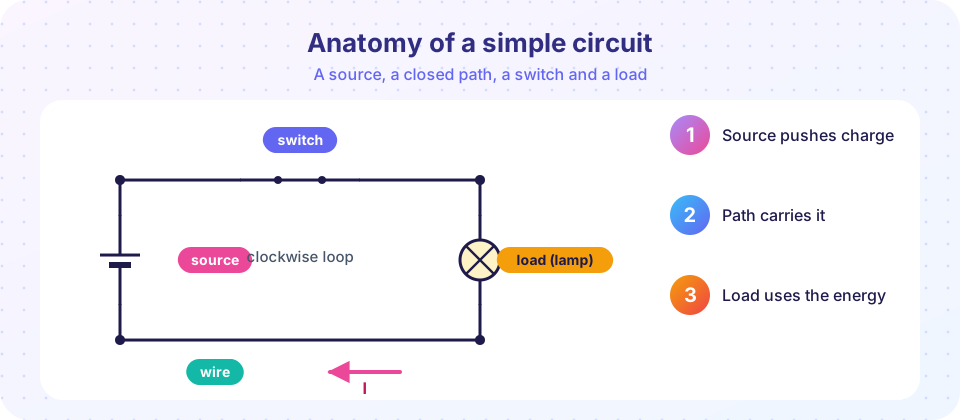
Every circuit that does something has:
- A source that does work on charge. A battery uses chemical reactions; a solar cell uses light; a wall outlet is fed by a generator far away. The source raises the energy per unit charge of the charge it pushes. That energy per charge is the voltage, which Lesson 2.3 develops.
- A conducting path that lets charge move. Usually this is copper wire, which has very low resistance, so very little energy is lost along it. In circuit diagrams we treat wires as ideal: zero resistance, zero voltage drop.
- A load where the energy leaves the charge. In a lamp the energy becomes light and heat; in a motor it becomes motion; in a resistor, heat.
The path must form a closed loop from one terminal of the source, through the load, and back to the other terminal. Charge does not pile up in the lamp; it flows through and returns to the battery for another dose of energy. That is why an electric current is sometimes compared to water in a closed pipe loop with a pump.
Open, closed and short circuits
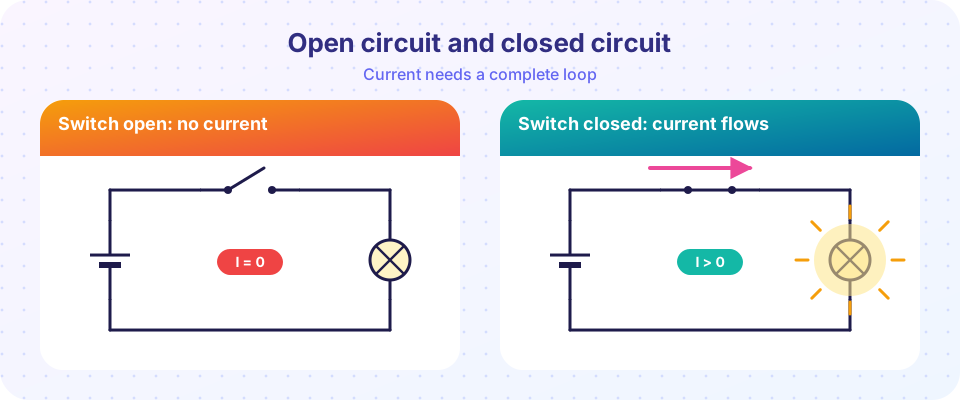
An open circuit has a break in the loop (an open switch, a snapped wire, a blown fuse). No current can flow anywhere in that loop, so the lamp stays dark. Notice that a break anywhere has the same effect: a single series loop is only as strong as its weakest link.
A closed circuit is a complete loop. Current flows, and energy is delivered.
A short circuit is an unintended low-resistance path across a source. With almost no resistance in the way, the current becomes enormous, since I = V / R grows as R shrinks. A battery or wall socket shorted by a wire can overheat the wire or the battery in seconds. That is why homes have fuses and circuit breakers: they open the loop deliberately when the current is dangerously high.
An open circuit has current 0 and can have any voltage across the gap. A short circuit has voltage 0 across it and can have any current. Remember this pair: it comes back in Chapter 5.
Nodes, branches and loops
Engineers describe a circuit's structure in a small vocabulary:
- A node is a connection point. A wire joining three parts is a single node, however long the wire; ideal wires are all one electrical point.
- A branch is a single element between two nodes.
- A loop is a closed path.
A circuit with one battery and one lamp has two nodes, two branches and one loop. Add a second lamp beside the first (both connected to the same two nodes) and you get two loops sharing the battery. We call these two lamps in parallel. Put the second lamp in line with the first, so that the same current has to pass through both, and the lamps are in series.
| Connection | What is shared | Picture | Everyday example |
|---|---|---|---|
| Series | the same current | parts in a single chain | old-style string lights: one bulb out, all out |
| Parallel | the same voltage | parts across the same two nodes | household outlets: each device works alone |
Chapter 3 makes these ideas quantitative. For now, just learn to see them in a drawing.
Common misconceptions
"The battery is a store of current." A battery stores chemical energy. Current only exists while a complete circuit lets charge move.
"Current is used up by the lamp, so less current returns." The same current that enters a series load leaves it. What shrinks is the energy per charge (the voltage).
"Electrons travel from the switch to the lamp at the speed of light." The signal (the electric field that pushes the charge) spreads at a large fraction of the speed of light; the electrons themselves drift slowly (Lesson 2.2).
Try it
Click the switch and watch the lamp. The code models a series loop: current flows only when every element in the chain is closed.
Now try a series chain in Python. The loop carries current only if every switch is closed. Change a True to False and rerun.
Press Run (or Ctrl + Enter) to see the result here.
Program input · what you'd type while the program runs
Type the answers before you press Run, one per line. Each time the program reads a line (with input()), it gets the next line from this box.
Check your understanding
Quick check · 5 questions
of 5 answered You scored / 5 · perfect!
-
1. Which set lists the three ingredients of a working circuit?
A source provides energy, a closed conducting path carries the charge, and a load uses the energy. -
2. A series string of lights has one dead bulb that has become an open circuit. What happens?
In series the same current must pass through every bulb. A break anywhere stops the current everywhere. -
3. Why is a short circuit dangerous?
I = V / R. With R near zero the current becomes very large, and heating grows with the square of the current. -
4. Three components all connect between the same two nodes. They are in
Parts that share the same two nodes have the same voltage across them, which is the definition of parallel. -
5. In a drawing, a long ideal wire connecting three components is
An ideal wire has zero resistance, so every point on it is at the same voltage and counts as a single node.
Summary
- A circuit needs a source, a conducting path and a load, joined in a closed loop.
- Open circuit: I = 0. Short circuit: V = 0 across it, very large current.
- Nodes are connection points, branches are elements between nodes, loops are closed paths.
- Series parts share current; parallel parts share voltage.
Track your progress
Create a free account to tick off lessons and pick up where you left off on any device.
of Circuit Analysis lessons completed