


















Lesson 3 of 48 · Getting Started
Units and Metric Prefixes in Electronics
Master the SI units of electronics (volt, ampere, ohm, watt) and the metric prefixes from pico to giga, with engineering notation and unit checking.
Electronics spans an astonishing range of sizes. A phone charger delivers about 2 A; a nerve signal in your body involves picoamps. A power line carries hundreds of kilovolts; a radio antenna picks up microvolts. To write these numbers without a mess of zeros, engineers use the metric system and its prefixes, and they treat units as part of the number. This lesson gives you that fluency.
What you will learn
- The SI base and derived units used in circuit analysis.
- The prefixes from pico (p) to giga (G) and how to convert between them.
- How to write numbers in engineering notation.
- How to use units as an error check ("dimensional analysis").
Key terms
SI: the International System of Units, used worldwide in science and engineering.
Prefix: a letter placed before a unit that multiplies it by a power of ten (kilo = 1,000).
Engineering notation: scientific notation with exponents that are multiples of 3 (4.7 × 10³ Ω).
Dimensional analysis: checking an equation by confirming that the units on both sides agree.
The units of electricity
Only one electrical unit is a base unit in the SI: the ampere (A). Since 2019 the ampere is defined by fixing the value of the elementary charge to exactly 1.602176634 × 10⁻¹⁹ coulombs. Every other electrical unit is derived from it together with the metre, kilogram and second.
| Quantity | Symbol | Unit | Abbreviation | Meaning |
|---|---|---|---|---|
| Charge | Q | coulomb | C | amount of charge |
| Current | I | ampere | A | coulombs per second |
| Voltage | V | volt | V | joules per coulomb |
| Resistance | R | ohm | Ω | volts per ampere |
| Power | P | watt | W | joules per second |
| Energy | W or E | joule | J | capacity to do work |
| Capacitance | C | farad | F | coulombs per volt |
| Inductance | L | henry | H | volt-seconds per ampere |
| Frequency | f | hertz | Hz | cycles per second |
Notice the naming rule: units named after people (ampere, volt, ohm, watt, joule, farad, henry, hertz, coulomb) are written with a lowercase first letter in full ("5 volts") but an uppercase abbreviation ("5 V"). The quantity symbols (V, I, R) are italic in print, the unit symbols are upright.
Metric prefixes
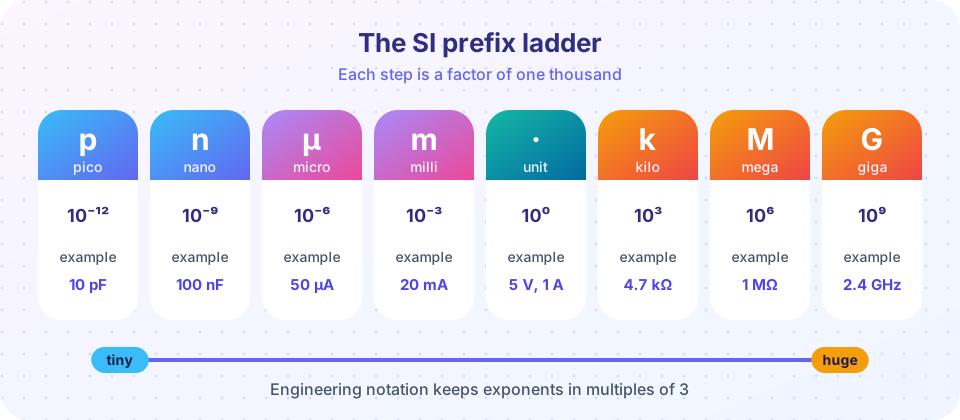
A prefix scales a unit by a power of ten. In electronics you will use these constantly:
| Prefix | Symbol | Factor | Example |
|---|---|---|---|
| pico | p | 10⁻¹² | 10 pF capacitor |
| nano | n | 10⁻⁹ | 100 nF capacitor |
| micro | µ | 10⁻⁶ | 50 µA current |
| milli | m | 10⁻³ | 20 mA LED current |
| (none) | 1 | 5 V, 1 A | |
| kilo | k | 10³ | 4.7 kΩ resistor |
| mega | M | 10⁶ | 1 MΩ resistor |
| giga | G | 10⁹ | 2.4 GHz Wi-Fi |
Careful with capital letters: m (milli, one thousandth) and M (mega, one million) differ by a factor of a billion. "5 mW" is five thousandths of a watt, "5 MW" is five million watts. Resistors are the usual trap: a resistor marked "1 M" is a megohm (1,000,000 Ω), never a milliohm.
Converting
To convert, move the decimal point three places per prefix step:
- 4,700 Ω = 4.7 kΩ (divide by 1,000 to go up one step).
- 0.0032 A = 3.2 mA (multiply by 1,000 to go down one step).
- 2.2 µF = 2,200 nF (µ to n is one step down, so multiply by 1,000).
- 0.5 MΩ = 500 kΩ.
Worked example. A sensor outputs 35 mV and drives a circuit with a 7 kΩ input resistance. The current is I = V / R = 0.035 V / 7,000 Ω = 0.000005 A = 5 µA. A shortcut: with V in millivolts and R in kilo-ohms, the current comes out in microamps (35 / 7 = 5 µA). Remember it: mV / kΩ = µA and V / kΩ = mA.
Engineering notation
Scientific notation (4.7 × 10³) allows any exponent. Engineering notation restricts exponents to multiples of three so each number lines up with a prefix: 0.0047 A = 4.7 × 10⁻³ A = 4.7 mA. When the result of a calculation is 0.000 047 3 V, rewrite as 47.3 × 10⁻⁶ V = 47.3 µV. The goal is a number between 1 and 999 with a prefix.
Checking with units
Units turn algebra into a safety net. Take V = I · R: amperes times ohms must give volts, and since 1 Ω = 1 V/A, it does. Now suppose you compute power as P = V · R by mistake. Volts times ohms is V²/A, which is not a watt, so you know something is wrong before you have even looked at the number. Carry units through every line of a calculation and check at the end.
Useful derived relations you will meet again:
- 1 V = 1 J/C and 1 A = 1 C/s, so V · A = J/s = W.
- 1 Ω = 1 V/A.
- 1 kWh (the unit on your electricity bill) = 1,000 W × 3,600 s = 3.6 MJ.
Common misconceptions
"k and K are the same." The SI prefix is a lowercase k (kilo). A capital K is the kelvin, a temperature unit.
"µ, u and m are interchangeable." µ (or the plain-text u) is micro, 10⁻⁶. m is milli, 10⁻³. They differ by 1,000.
"A battery rated 2,000 mAh holds 2,000 mA." That rating is charge: 2,000 mA × 1 h = 2 A·h = 7,200 C. Current is a rate; mAh is an amount.
Try it
This tool formats any number with the best prefix. Try your own values, including tiny and enormous ones.
Press Run (or Ctrl + Enter) to see the result here.
Program input · what you'd type while the program runs
Type the answers before you press Run, one per line. Each time the program reads a line (with input()), it gets the next line from this box.
Now a unit-aware calculation with a bill: a 1,500 W kettle runs for 4 minutes. Everything is converted to SI first.
Press Run (or Ctrl + Enter) to see the result here.
Program input · what you'd type while the program runs
Type the answers before you press Run, one per line. Each time the program reads a line (with input()), it gets the next line from this box.
Check your understanding
Quick check · 5 questions
of 5 answered You scored / 5 · perfect!
-
1. 4,700 Ω is written in engineering notation as
4,700 = 4.7 × 10³, and 10³ is the prefix kilo. -
2. 35 mV is applied across 7 kΩ. The current is
0.035 V / 7,000 Ω = 5 × 10⁻⁶ A = 5 µA. Remember mV / kΩ = µA. -
3. How many nanofarads are in 2.2 µF?
One step down from micro to nano multiplies the number by 1,000. -
4. Which pair differs by a factor of one billion?
m is 10⁻³ and M is 10⁶, a ratio of 10⁹. -
5. Which unit combination equals a watt?
V × A = (J/C) × (C/s) = J/s = W.
Summary
- The ampere is the base electrical unit; volt, ohm, watt, coulomb and others are derived.
- Prefixes p, n, µ, m, k, M, G differ by factors of 1,000; m and M are very different.
- Use engineering notation so every number pairs with a prefix.
- Carry units through every step and check that both sides of an equation agree.
Next: Reading Schematics
Track your progress
Create a free account to tick off lessons and pick up where you left off on any device.
of Circuit Analysis lessons completed