


















Lesson 23 of 48 · Network Theorems
Chapter 5 Overview: Network Theorems
A map of the four big shortcuts in circuit analysis: superposition, Thévenin, Norton and maximum power transfer, and why linearity makes them work.
So far you have solved circuits the direct way: write Kirchhoff's current and voltage equations, then solve them. That always works, but it can be slow. If you only care about one resistor in a big network, or if the load keeps changing while the rest of the circuit stays fixed, solving the whole system again and again is wasteful. This chapter gives you four shortcuts that engineers use every day.
What you will learn
- Why linear circuits allow shortcuts that other systems do not.
- What each of the four theorems does, in one sentence.
- How to decide which theorem to reach for.
- How the lessons in this chapter fit together.
Key terms
Linear circuit: a circuit whose elements obey straight-line laws (resistors, ideal sources, capacitors, inductors), so doubling the sources doubles every voltage and current.
Network theorem: a general statement about linear circuits that replaces a long calculation with a short one.
Equivalent circuit: a simpler circuit that behaves exactly the same as the original when seen from two chosen terminals.
Load: the part of the circuit you care about, often a single resistor, connected to the rest.
The big idea: linearity
A resistor obeys v = R i. Plot voltage against current and you get a straight line through the origin. The same is true of ideal sources (a fixed value) and, later in the course, of capacitors and inductors. A circuit built only from such parts is called linear.
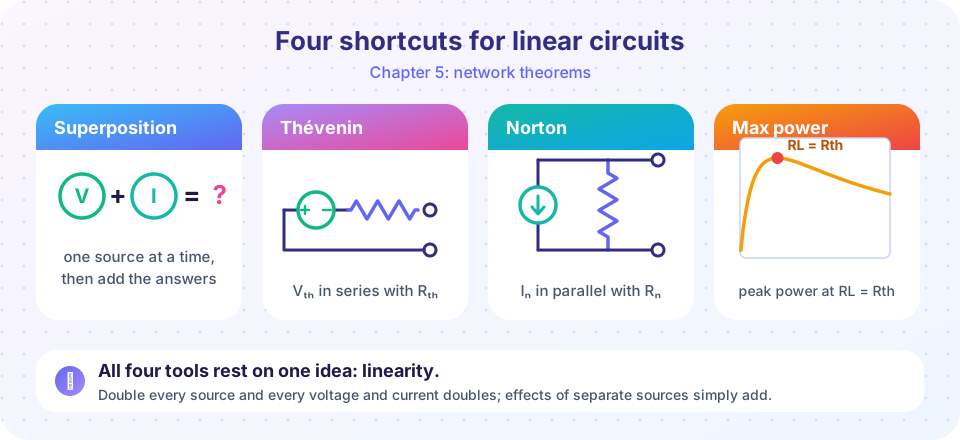
Linearity has two consequences. The first is homogeneity: scale every source by a factor k and every voltage and current scales by k. The second is additivity: if source A alone produces a response and source B alone produces another, both sources together produce the sum. Every theorem in this chapter is a clever use of one or both properties.
Here is the picture to keep in mind. A linear circuit is like a mixing desk where each knob (source) adds its own contribution to every output, independently of the other knobs.
Four shortcuts
All four need a linear circuit.
Superposition
Thévenin and Norton
Maximum power
Matching is for signals, not for power plants.
The four theorems in plain words
Superposition says: to find the effect of several sources, switch on one at a time, solve each easy circuit, and add the answers. It turns one hard problem into several easy ones, and it is the reason AC circuits with several frequencies are manageable.
Thévenin's theorem says: from any two terminals, a linear network looks like one voltage source in series with one resistor. Léon Charles Thévenin, a French telegraph engineer, published the idea in 1883. You find two numbers, the open-circuit voltage and the resistance seen looking in, and the whole network disappears.
Norton's theorem is the same idea with a current source in parallel with a resistor. It is named after Edward Lawry Norton of Bell Labs (1926), and a simple conversion links it to Thévenin's form.
Maximum power transfer answers a design question: for a source with internal resistance Rth, which load resistance receives the most power? The answer, RL = Rth, is surprisingly neat, and its cost, 50 % efficiency, is just as important.
What is in this chapter
| Lesson | What you will be able to do |
|---|---|
| Superposition | Solve multi-source circuits one source at a time |
| Thévenin's theorem | Replace a network with a voltage source and a resistor |
| Norton's theorem and source transformation | Convert between series and parallel forms |
| Maximum power transfer | Choose a load for peak power and judge the efficiency |
| Chapter review | Mix everything in one set of questions |
Common misconceptions
"Superposition works for everything." It works only for linear circuits, and only for voltages and currents. Power depends on the square of voltage or current, so you cannot add the powers from separate sources.
"A Thévenin equivalent is the same circuit inside." It is the same only as seen from the terminals. Heat dissipated inside the network differs completely.
Try it
The first demo shows linearity in numbers. A node is fed by a 12 V source through 4 Ω, a 6 Ω resistor to ground and a 3 A current source. Doubling both sources doubles the node voltage. Then a nonlinear element replaces the 6 Ω resistor, and the rule breaks.
Press Run (or Ctrl + Enter) to see the result here.
Program input · what you'd type while the program runs
Type the answers before you press Run, one per line. Each time the program reads a line (with input()), it gets the next line from this box.
The second demo is a small interactive board. Drag the sliders to scale the two sources and watch the node voltage: it is always the sum of the two separate contributions.
Check your understanding
Quick check · 5 questions
of 5 answered You scored / 5 · perfect!
-
1. What property of a linear circuit makes superposition possible?
Additivity (together with homogeneity) is what linearity means, and superposition applies it source by source. -
2. A Thévenin equivalent consists of
Thévenin gives a series pair, a voltage source and a resistance. The parallel pair is Norton's form. -
3. Which quantity can you NOT add by superposition?
Power depends on the square of voltage or current, so the power from two sources together is not the sum of the separate powers. -
4. Maximum power transfer from a source happens when
At RL = Rth the load receives the most power, Vth squared over four Rth. -
5. Why does the nonlinear element in the demo break superposition?
Kirchhoff's laws always hold, but a square-law element is not a straight-line device, so responses no longer add.
Summary
- Linear circuits scale and add: that is the basis of every theorem in this chapter.
- Superposition solves one source at a time; Thévenin and Norton hide a network behind two numbers; maximum power transfer picks the best load.
- Superposition applies to voltages and currents, never to power.
- Equivalent circuits match only at the chosen terminals.
Next: Superposition
Track your progress
Create a free account to tick off lessons and pick up where you left off on any device.
of Circuit Analysis lessons completed