


















Lesson 6 of 48 · Charge, Voltage, Current and Elements
Chapter 2 Overview: Charge, Voltage, Current and Elements
A big-picture tour of charge, current, voltage, power and ideal circuit elements, with a slide deck, a hero illustration and a map of the chapter's lessons.
Chapter 1 told you what a circuit is. Chapter 2 gives the four quantities you will use for the rest of your career: charge, current, voltage and power. Every circuit problem, from a torch to a power grid, is a question about one or more of them.
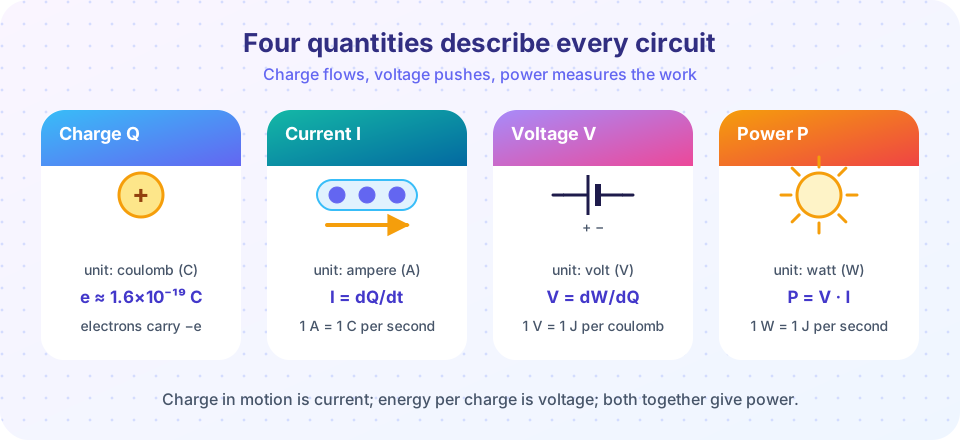
The ideas fit together beautifully. Charge is the "stuff" that moves. Current is how fast it moves. Voltage is how much energy each unit of charge carries. Power is the rate at which that energy is delivered. Once you see the chain, the formulas stop being separate facts to memorize.
What you will learn
- How the four main quantities relate to each other.
- What the next four lessons cover.
- The water-pipe analogy and where it helps and misleads.
Key terms
Charge (Q): a property of matter that feels electric force. Unit: coulomb (C).
Current (I): the rate of flow of charge, I = dQ/dt. Unit: ampere (A).
Voltage (V): energy per unit charge between two points. Unit: volt (V).
Power (P): energy transferred per second, P = V · I. Unit: watt (W).
The chain in one slide deck
Charge
Current
Voltage
Power
The water analogy, and its limits
Picture a closed loop of pipe filled with water and driven by a pump. The water volume that passes a point each second is like current. The pressure difference the pump creates is like voltage. A narrow section that resists flow is like a resistor. The analogy predicts a lot: if you narrow the pipe, less water flows (Ohm's law); if two pipes share the same pressure difference, their flows add (parallel circuits); the water entering a junction equals the water leaving (Kirchhoff's current law).
But it can mislead. Real electric current needs no "full tank" of water: the wires are already full of charge carriers. Voltage is a difference between two points; it does not belong to a single point. And electrical energy travels in the fields around the wires rather than in the moving charge itself. Use the analogy for intuition, then trust the equations.
What each lesson covers
- Charge and Current: coulombs, electrons, the direction of current, how current relates to charge, drift speed, and the area under an i(t) graph.
- Voltage, Energy and Power: potential difference, node voltages, P = V · I, and energy in joules and kilowatt-hours.
- Sources and Passive Elements: ideal voltage, current and dependent sources, the passive sign convention, and conservation of power.
- Chapter 2 Review: a cheat sheet and a ten-question quiz.
Common misconceptions
"Voltage flows through a wire." Current flows; voltage appears across two points. Saying "the voltage through a resistor" is a sign that the idea is blurred.
"A bigger current means a bigger voltage." They are independent quantities until a component links them (for a resistor, the link is V = I·R).
Try it
The first example integrates a current that changes in steps to find the total charge delivered. This is the single most important idea of the chapter: charge is the accumulation of current over time.
Press Run (or Ctrl + Enter) to see the result here.
Program input · what you'd type while the program runs
Type the answers before you press Run, one per line. Each time the program reads a line (with input()), it gets the next line from this box.
And a short console chain that links every quantity in the chapter: current gives charge, voltage gives energy, and the two give power.
Press Run (or Ctrl + Enter) to see the console output here.
No output.
Check your understanding
Quick check · 4 questions
of 4 answered You scored / 4 · perfect!
-
1. Which quantity measures energy per unit charge?
One volt is one joule per coulomb. -
2. Current is the rate of flow of
I = dQ/dt, the charge passing a point per second. -
3. In the water analogy, voltage corresponds to
Pressure difference pushes the water, like voltage pushes the charge. -
4. Power equals
P = V · I, energy per charge times charge per second.
Summary
- Charge Q (coulombs), current I = dQ/dt (amperes), voltage V = dW/dQ (volts), power P = V·I (watts).
- Charge is the accumulation of current over time.
- The water analogy is a good guide for intuition, but voltage is always between two points.
- This chapter's lessons cover charge and current, voltage and power, and ideal elements.
Next: Charge and Current
Track your progress
Create a free account to tick off lessons and pick up where you left off on any device.
of Circuit Analysis lessons completed