


















Lesson 22 of 48 · Kirchhoff's Laws and Nodal Analysis
Chapter 4 Review: Kirchhoff's Laws, Nodal and Mesh Analysis
Review KCL, KVL, nodal analysis and mesh analysis with a side-by-side cheat sheet, a worked comparison of both methods and a ten-question chapter quiz.
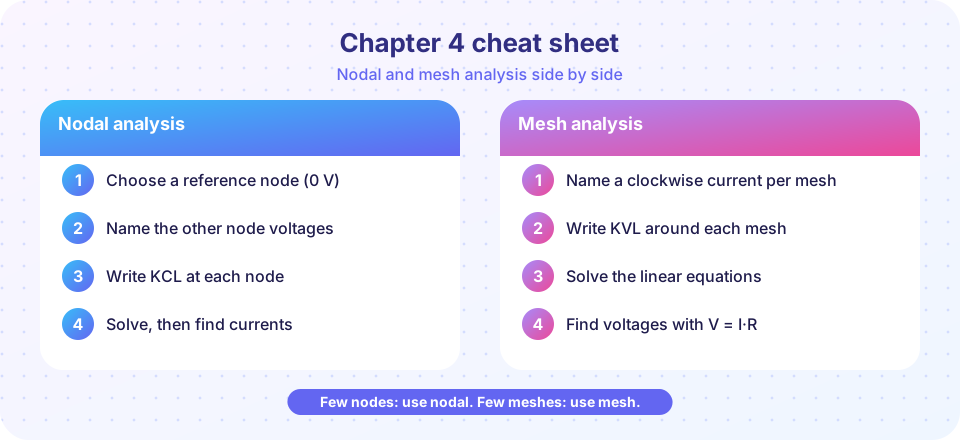
You now own the general tools of circuit analysis. Kirchhoff's laws give the equations; nodal and mesh analysis organize them; and the power balance checks the answers. This review puts the two methods side by side, solves one circuit both ways, and tests the whole chapter.
What you will learn
- A side-by-side comparison of the two methods.
- How the same circuit gives the same answer by either route.
- How to choose the method with fewer equations.
Recap table
| Nodal analysis | Mesh analysis | |
|---|---|---|
| Unknowns | node voltages | mesh currents |
| Law used | KCL | KVL |
| Matrix | G·v = i (conductances) | R·i = v (resistances) |
| Number of equations | nodes − 1 | branches − nodes + 1 |
| Easy with | current sources | voltage sources |
| Special case | supernode (floating voltage source) | supermesh (shared current source) |
| Needs planar circuit? | no | yes |
KCL: Σ i_in = Σ i_out at a node. KVL: Σ v = 0 around a loop. Both hold for any lumped element.
One circuit, two methods
Take the lesson 4.5 circuit: a 12 V source and R1 = 2 kΩ on the left, a shared R2 = 4 kΩ in the middle, R3 = 2 kΩ and a 6 V source on the right (the 6 V source's + terminal is at the top, connected to R3).
Mesh: two equations, 6I1 − 4I2 = 12 and −4I1 + 6I2 = −6. Result: I1 = 2.4 mA, I2 = 0.6 mA.
Nodal: only one non-reference node N (the junction of the three resistors), so one equation. KCL with all currents leaving N (units kΩ, mA, V):
(V_N − 12)/2 + V_N/4 + (V_N − 6)/2 = 0
Multiply by 4: 2V_N − 24 + V_N + 2V_N − 12 = 0, so 5V_N = 36 and V_N = 7.2 V. The branch currents: from the 12 V source (12 − 7.2)/2 = 2.4 mA = I1; through R3 (7.2 − 6)/2 = 0.6 mA = I2; through R2 7.2/4 = 1.8 mA = I1 − I2. Same answers, half the algebra.
Before writing any equation, count: unknown nodes (nodes − 1) versus meshes. Choose the smaller number. A few seconds of counting can save many minutes of algebra.
Common misconceptions
"The two methods give different answers if the circuit is complex." They are the same physics; any difference is an arithmetic or sign error.
"I must use the same method for the whole problem." Use whichever is easiest; you can even switch methods to check your answer.
"A negative current or voltage is an error." It simply means the real direction or polarity is opposite to your reference.
Try it
Solve the circuit both ways in code and compare. The two answers must agree to rounding.
Press Run (or Ctrl + Enter) to see the result here.
Program input · what you'd type while the program runs
Type the answers before you press Run, one per line. Each time the program reads a line (with input()), it gets the next line from this box.
Then a quick console drill on method choice: for each circuit description, which method needs fewer equations?
Press Run (or Ctrl + Enter) to see the console output here.
No output.
Check your understanding
Quick check · 10 questions
of 10 answered You scored / 10 · perfect!
-
1. KCL at a node says that
KCL is conservation of charge: current in = current out. -
2. A planar circuit has 7 nodes and 10 branches. How many mesh equations?
branches − nodes + 1 = 10 − 7 + 1 = 4. -
3. The same circuit has 7 nodes. How many nodal equations (no voltage sources to ground)?
nodes − 1 = 6. -
4. In mesh analysis with all mesh currents clockwise, the off-diagonal entries of the resistance matrix are
A shared resistor sees the neighbor's current in the opposite direction, so it enters with a minus sign. -
5. A voltage source connects two non-reference nodes. In nodal analysis you use
The source current is unknown, so combine the two nodes and add the voltage constraint. -
6. In the chapter's worked example the node voltage V_N is
5V_N = 36 gives V_N = 7.2 V. -
7. KVL around a loop with a 10 V source and two resistors with drops 3 V and x gives x =
+10 − 3 − x = 0, so x = 7 V. -
8. Which circuit most favors nodal analysis?
Current sources inject known currents directly into the node equations. -
9. A current source in a branch that belongs to one mesh only
That mesh current is known, which removes an unknown. -
10. A negative value for a computed branch current means
Signs compare the real direction with your reference arrows.
Summary
- KCL (charge) and KVL (energy) are the two laws behind all linear circuit analysis.
- Nodal: unknown node voltages, KCL, G·v = i. Mesh: unknown loop currents, KVL, R·i = v.
- Special cases: supernode (floating voltage source) and supermesh (shared current source).
- Choose the method with fewer equations, and verify with a power balance or the other method.
Track your progress
Create a free account to tick off lessons and pick up where you left off on any device.
of Circuit Analysis lessons completed