


















Lesson 46 of 48 · Projects and Practice
Glossary of Circuit Analysis
A plain-language glossary of more than sixty circuit analysis terms from admittance to watt, with units and formulas, plus a searchable widget and a vocabulary quiz.
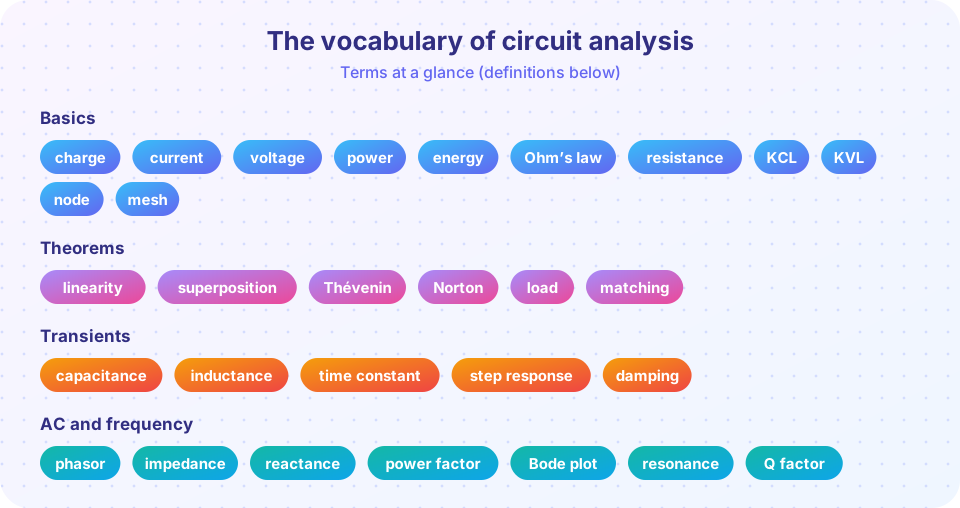
Circuit analysis has its own vocabulary, and a fuzzy word leads to fuzzy thinking. This glossary collects more than sixty terms you will meet most often in the course, with a one-line definition, the symbol or unit where it helps, and a pointer to the formula. Use it as a quick reference when a word in a problem is unclear, or as a self-test: cover the definition and see if you can state it.
What you will learn
- Precise definitions of the course's key terms.
- Which unit and symbol belongs to each quantity.
- How terms from different chapters connect.
Key terms
Quantity: something you can measure, like voltage, with a symbol and a unit.
Element: a component with a defined law, such as a resistor.
Theorem: a general result about circuits, such as superposition.
Equivalent: a simpler circuit with the same terminal behavior.
Basic quantities and elements
- Ampere (A): the unit of current; one coulomb of charge per second.
- Charge
Q: the property of matter that creates electric force; unit coulomb (C). - Conductance
G:1/R; unit siemens (S). - Coulomb (C): the unit of charge; about 6.24 × 10¹⁸ elementary charges.
- Current
I: the rate of flow of charge,I = dq/dt. - Energy
E: the capacity to do work; unit joule (J). - Farad (F): the unit of capacitance; one coulomb per volt.
- Ground: the reference node, defined as 0 V.
- Henry (H): the unit of inductance; one volt-second per ampere.
- Hertz (Hz): the unit of frequency; one cycle per second.
- Ohm (Ω): the unit of resistance; one volt per ampere.
- Ohm's law:
V = I Rfor a resistor. - Power
P: the rate of energy transfer,P = V I; unit watt (W). - Resistance
R: opposition to current in a resistor,R = V/I. - Siemens (S): the unit of conductance and admittance.
- Volt (V): the unit of voltage; one joule per coulomb.
- Voltage
V: the energy per unit charge between two points; also called potential difference. - Watt (W): the unit of power; one joule per second.
Circuit structure and laws
- Branch: a single element or path between two nodes.
- Current divider: a parallel circuit that splits current in proportion to conductance.
- Dependent source: a source whose value depends on another voltage or current in the circuit.
- Independent source: a source whose value is fixed by itself.
- Kirchhoff's current law (KCL): the currents entering a node sum to zero.
- Kirchhoff's voltage law (KVL): the voltages around any closed loop sum to zero.
- Linear circuit: one whose elements obey straight-line laws, so responses scale and add.
- Load: the element or circuit that consumes power from a source.
- Mesh: a loop that contains no other loop.
- Nodal analysis: solving a circuit by writing KCL at each node in terms of node voltages.
- Node: a point where two or more elements connect.
- Open circuit: a break; zero current for any voltage (infinite resistance).
- Short circuit: a wire; zero voltage for any current (zero resistance).
- Voltage divider: a series circuit that splits voltage in proportion to resistance.
Network theorems
- Maximum power transfer: a load receives the most power when
RL = Rth. - Norton equivalent: a current source
In = Iscin parallel withRn = Rth. - Source transformation: swapping a voltage source with series resistance for a current source with the same parallel resistance.
- Superposition: the response of a linear circuit to several sources is the sum of the responses to each alone.
- Test source: a trial source used to find a Thévenin resistance when dependent sources are present.
- Thévenin equivalent: a voltage source
Vth = Vocin series withRth.
Capacitors, inductors and transients
- Capacitance
C: charge stored per volt,Q = C v. - Capacitor: an element with
i = C dv/dt, storing energy½ C v². - Critical damping: the case
α = ω₀: the fastest response without overshoot. - Damping ratio
ζ:α/ω₀; below 1 the response rings. - Inductance
L: flux linkage per ampere,λ = L i. - Inductor: an element with
v = L di/dt, storing energy½ L i². - Steady state: the long-term behavior after transients have died.
- Time constant
τ:RCorL/R; the time to cover 63.2 % of a first-order change. - Transient: the temporary response between two steady states.
AC and frequency response
- Admittance
Y:1/Z; unit siemens. - Apparent power
S:Vrms Irms, in volt-amperes (VA). - Bandwidth: the width of the frequency range between the half-power points.
- Bode plot: gain in decibels and phase against log frequency.
- Cutoff frequency: the −3 dB edge of a filter's pass band.
- Decade: a factor of ten in frequency.
- Decibel (dB):
20 log₁₀of a voltage ratio. - Filter: a circuit that passes some frequencies and blocks others.
- Impedance
Z:V/Ias a complex number,Z = R + jX. - Phase: the angle shifting a sinusoid in time.
- Phasor: amplitude and phase of a sinusoid as a complex number.
- Power factor:
P/S = cos φ. - Quality factor
Q:ω₀L/Rfor series RLC; alsof₀/bandwidth. - Reactance
X: the imaginary part of impedance. - Reactive power
Q:V I sin φ, in var. - Real power
P: the average powerV I cos φ, in watts. - Resonance: the state where inductive and capacitive reactance cancel.
- RMS: root mean square;
Vm/√2for a sinusoid. - Transfer function
H(jω):Vout/Vinas a function of frequency.
Common misconceptions
"Voltage flows through a circuit." Voltage is a difference between two points; current flows.
"Reactance and resistance are the same thing." Both are measured in ohms, but resistance dissipates energy while reactance stores and returns it.
"Q means the same in every chapter." The letter Q is used for charge, reactive power and quality factor; the context tells you which.
Try it
The first tool is a searchable glossary. Type part of a term or a word from a definition and the list narrows.
The second tool is a small units helper. Engineering notation uses the prefixes p n µ m k M G; this function formats any number the way a datasheet would.
Press Run (or Ctrl + Enter) to see the result here.
Program input · what you'd type while the program runs
Type the answers before you press Run, one per line. Each time the program reads a line (with input()), it gets the next line from this box.
Check your understanding
Quick check · 6 questions
of 6 answered You scored / 6 · perfect!
-
1. The unit of capacitance is the
One farad is one coulomb per volt. -
2. Admittance is the reciprocal of
Y = 1/Z, measured in siemens. -
3. Which term describes the average power in an AC circuit?
Real power P = V I cos φ is the average power, in watts. -
4. The time constant of an RL circuit is
τ = L/R. -
5. A decade is
A decade is a tenfold change in frequency; a factor of two is an octave. -
6. In the Thévenin equivalent, Vth is equal to the
Vth = Voc, measured with the load removed.
Summary
- Quantities come with symbols and SI units: V, A, Ω, S, F, H, W, Hz.
- Source and element names (independent, dependent, ideal) tell you how a part behaves in analysis.
- Theorems (superposition, Thévenin, Norton, maximum power) are named by what they replace or optimize.
- AC and frequency terms (phasor, impedance, power factor, Q, Bode plot) build on the phasor idea.
Next: Cheat sheet
Track your progress
Create a free account to tick off lessons and pick up where you left off on any device.
of Circuit Analysis lessons completed