


















Lesson 21 of 48 · Kirchhoff's Laws and Nodal Analysis
Mesh Analysis
Solve circuits with mesh analysis: assign clockwise loop currents, write KVL for each mesh, handle shared resistors, supermeshes and a three-mesh ladder.
Nodal analysis chooses voltages as its unknowns. Mesh analysis is its mirror image: it chooses currents. Imagine a circuit drawn on paper with several "windows". Give each window a circulating loop current, write Kirchhoff's voltage law around each window, and solve. A resistor shared by two windows simply sees the difference of the two loop currents.
Mesh analysis shines when a circuit has many voltage sources and few windows. Like nodal analysis, it always works for planar circuits (those that can be drawn without crossing wires).
What you will learn
- The steps of mesh analysis and why the clockwise convention is useful.
- How to write the mesh equations quickly in matrix form R·i = v.
- How to handle current sources with a supermesh.
- How to solve a three-mesh ladder and check the answer.
Key terms
Mesh: a loop with no other loop inside it (a "window" of a planar circuit).
Mesh current: an imagined current circulating around one mesh.
Shared branch: an element on the border of two meshes; its real current is the difference of the mesh currents.
Supermesh: two meshes sharing a current source, analyzed together.
The method
- Identify the meshes and assign each a clockwise current I1, I2, … Always use the same direction (clockwise) so that shared-element signs are predictable.
- Write KVL around each mesh, walking in the direction of the mesh current. A resistor in mesh k contributes a drop I_k·R from its own mesh current; if it is shared with mesh j, it also contributes −I_j·R (the neighbor's current flows through it in the opposite direction in your walk).
- Collect into equations in the unknowns.
- Solve the linear system.
- Recover the branch currents (for shared elements, the difference) and voltages; check the power balance.
Worked example
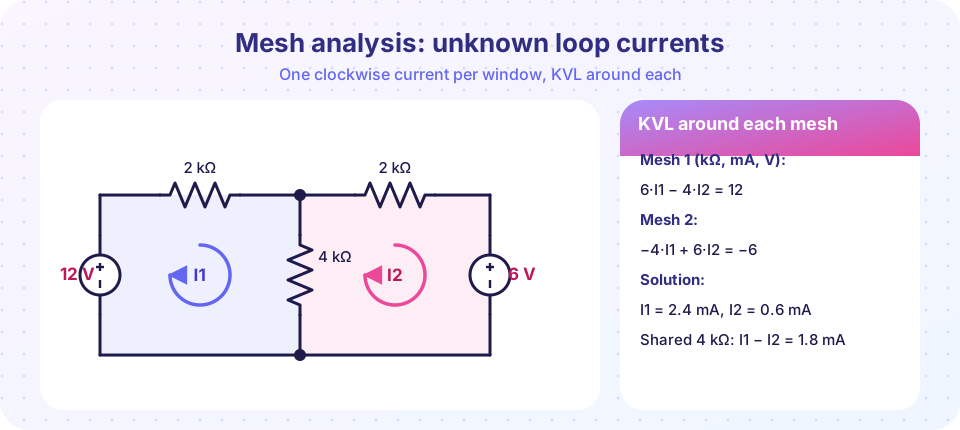
The picture shows two meshes. Left mesh: 12 V source, R1 = 2 kΩ, and the shared R2 = 4 kΩ. Right mesh: the shared R2, R3 = 2 kΩ, and a 6 V source that opposes the clockwise current of mesh 2. Units: kΩ, mA, V.
Mesh 1 (clockwise): sources raise +12; drops: 2·I1 in R1, and 4·(I1 − I2) in R2.
12 − 2I1 − 4(I1 − I2) = 0, so 6I1 − 4I2 = 12.
Mesh 2: drops: 4·(I2 − I1) in R2 and 2·I2 in R3, and the 6 V source also drops 6 V in the direction of I2 (its + terminal is entered first).
−4(I2 − I1) − 2I2 − 6 = 0, which rearranges to −4I1 + 6I2 = −6.
Solve: from the first equation I1 = (12 + 4I2)/6. Substituting: −4(12 + 4I2)/6 + 6I2 = −6, so −8 − (8/3)I2 + 6I2 = −6, giving (10/3)I2 = 2 and I2 = 0.6 mA, I1 = 2.4 mA.
Recover and check. The shared resistor carries I1 − I2 = 1.8 mA, with 7.2 V across it. Power absorbed: R1 = 2 × 2.4² = 11.52 mW, R2 = 4 × 1.8² = 12.96 mW, R3 = 2 × 0.6² = 0.72 mW, and the 6 V source absorbs 6 × 0.6 = 3.6 mW (current enters its + terminal), a total of 28.8 mW. The 12 V source supplies 12 × 2.4 = 28.8 mW ✓.
Writing the equations by inspection
For circuits with only resistors and independent voltage sources, the system is
R · i = v
- Diagonal entry R_kk: the sum of all resistances in mesh k.
- Off-diagonal entry −R_kj: minus the sum of resistances shared by meshes k and j (with all meshes clockwise).
- Right-hand side v_k: the sum of source voltage rises in mesh k in the direction of its current.
Check the worked example: R11 = 2 + 4 = 6, R22 = 4 + 2 = 6, R12 = R21 = −4, v = (12, −6). Exactly what we derived, and the matrix is symmetric (a good error check). This is the dual of nodal analysis: resistance matrix and voltage sources here, conductance matrix and current sources there.
Current sources: the supermesh
A current source in a branch that belongs to only one mesh simply sets that mesh current (to ± the source value), removing one unknown. If the source is shared between two meshes, its voltage is unknown, so:
- Draw a supermesh around both meshes, leaving out the branch with the source, and write one KVL equation around the outer loop.
- Add the constraint: the difference of the two mesh currents equals the source current (I1 − I2 = Is, with the sign set by the arrow).
Count again: two unknowns, two equations. The same idea that gave the supernode in nodal analysis.
A three-mesh ladder
For a ladder with a 10 V source, series R1 = 1 kΩ, shunt R2 = 2 kΩ, series R3 = 3 kΩ, shunt R4 = 4 kΩ and end resistor R5 = 5 kΩ in three meshes, the equations by inspection are
( 3  -2   0 ) (I1)   (10)
(-2   9  -4 ) (I2) = ( 0)
( 0  -4   9 ) (I3)   ( 0)
You would not want to solve that by hand every day, which is exactly what the program below does. Reduction gives a check: R4 ‖ R5 = 2.222 kΩ, plus R3 gives 5.222 kΩ, in parallel with R2 gives 1.446 kΩ, plus R1 gives Req = 2.446 kΩ, so I1 = 10 / 2.446 = 4.09 mA.
Nodal or mesh?
For the two-window circuit of this lesson there are two mesh equations but only one non-reference node unknown (the node between the three resistors): nodal needs one equation, 5V_N = 36, so V_N = 7.2 V, matching the shared-resistor voltage. Count unknowns before you choose.
Common misconceptions
"A mesh current is a real current in every element." It is a mathematical loop current. Only elements in a single mesh carry exactly that current; shared elements carry the difference.
"I can choose any direction for each mesh current." You can, but using clockwise for all keeps every off-diagonal term negative and the matrix symmetric.
"Mesh analysis works on any circuit." It requires a planar circuit; a circuit with crossing wires that cannot be redrawn flat needs nodal analysis.
"A current source in a mesh just adds a voltage term." Its voltage is unknown, so it fixes a current (or needs a supermesh) instead.
Try it
This program solves the two-mesh example, recovers every branch current, and checks that the supplied power equals the absorbed power.
Press Run (or Ctrl + Enter) to see the result here.
Program input · what you'd type while the program runs
Type the answers before you press Run, one per line. Each time the program reads a line (with input()), it gets the next line from this box.
Now the three-mesh ladder, checked against series-parallel reduction. Change any resistor and both answers should move together.
Press Run (or Ctrl + Enter) to see the result here.
Program input · what you'd type while the program runs
Type the answers before you press Run, one per line. Each time the program reads a line (with input()), it gets the next line from this box.
Check your understanding
Quick check · 5 questions
of 5 answered You scored / 5 · perfect!
-
1. Two meshes share a 4 kΩ resistor. Mesh currents (both clockwise) are I1 = 2.4 mA and I2 = 0.6 mA. The current in the shared resistor is
The shared resistor carries I1 − I2 = 1.8 mA. -
2. In the matrix R·i = v for clockwise mesh currents, the diagonal entry for mesh k is
R_kk is the total resistance around mesh k; the off-diagonals hold the shared resistances with a minus sign. -
3. A current source is shared by two meshes. You should
Its voltage is unknown, so write KVL around the supermesh and use I1 − I2 = Is. -
4. Mesh analysis requires the circuit to be
Meshes are the windows of a planar circuit. -
5. For the worked example the 6 V source absorbs
6 V × 0.6 mA = 3.6 mW; current enters its + terminal, so it absorbs.
Summary
- Mesh analysis assigns a clockwise current to each window and writes KVL around each.
- Matrix form R·i = v: diagonal = total resistance in the mesh; off-diagonal = −shared resistance; v = source rises.
- Shared elements carry the difference of the mesh currents.
- A current source shared by two meshes needs a supermesh plus a constraint; a current source in one mesh fixes that current.
- Compare unknown counts: choose mesh or nodal, whichever gives fewer equations.
Next: Chapter 4 Review
Track your progress
Create a free account to tick off lessons and pick up where you left off on any device.
of Circuit Analysis lessons completed