


















Lesson 10 of 48 · Charge, Voltage, Current and Elements
Chapter 2 Review: Charge, Voltage, Current and Elements
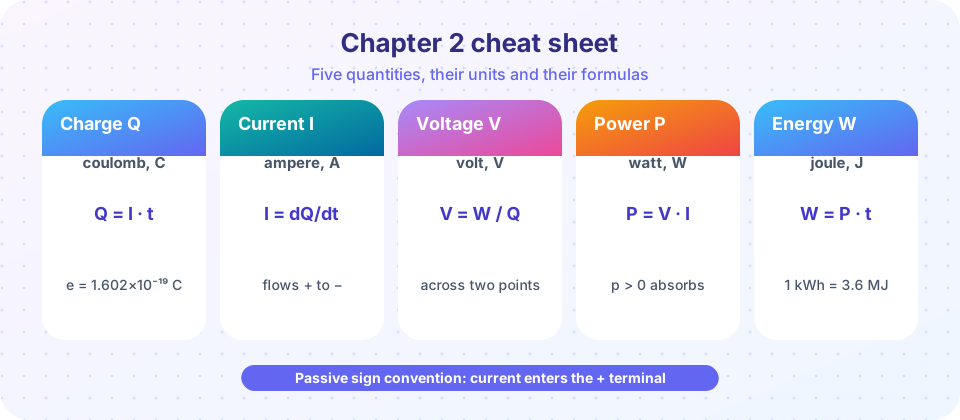
Chapter 2 cheat sheet and ten-question quiz: charge, current, voltage, power, energy, ideal sources, the passive sign convention and conservation of power.
You now know the four central quantities of circuit analysis and the ideal elements that create them. This review collects the formulas on one page, walks through a mixed example, and tests you with ten questions before you start solving real resistor circuits in Chapter 3.
What you will learn
- A one-page summary of every formula from the chapter.
- How to combine charge, voltage, power and energy in one problem.
- Which topics need another look.
Recap table
| Idea | Formula | Unit | Note |
|---|---|---|---|
| Charge from current | Q = ∫ i dt | C | area under i(t) |
| Current | i = dQ/dt | A | 1 A = 1 C/s |
| Voltage | v = dW/dQ | V | 1 V = 1 J/C, between two points |
| Power | p = v·i | W | resistor: P = I²R = V²/R |
| Energy | W = ∫ p dt | J, kWh | 1 kWh = 3.6 MJ |
| Sign convention | i enters + terminal | p > 0 absorbs, p < 0 supplies | |
| Conservation | Σ p = 0 | supplied = absorbed |
Mixed example
A 12 V battery supplies a constant 0.5 A to a motor for 10 minutes.
- Charge moved: Q = I · t = 0.5 A × 600 s = 300 C.
- Energy supplied: W = V · Q = 12 V × 300 C = 3,600 J.
- Power: P = V · I = 12 V × 0.5 A = 6 W; check: 3,600 J / 600 s = 6 W ✓.
- In kWh: 3,600 J / 3.6 × 10⁶ = 0.001 kWh.
- Sign convention: the battery supplies, so p_battery = −6 W; the motor absorbs +6 W (assuming ideal wires). Sum = 0 ✓.
When a problem seems confusing, write down the chain I → Q → W → P and ask which link is missing.
Common misconceptions
"Power is the same as energy." Power is the rate; energy is power multiplied by time. A 3 kW kettle uses 3 kW of power, but 3 kWh of energy only after an hour.
"The sign of power depends on which way I measure." It depends on the convention. Always put the current into the + terminal first, then trust the sign.
Try it
Verify a power balance for a circuit with two sources. The program applies the passive sign convention automatically and shows that the powers sum to zero. Change the numbers to test other loops.
Press Run (or Ctrl + Enter) to see the result here.
Program input · what you'd type while the program runs
Type the answers before you press Run, one per line. Each time the program reads a line (with input()), it gets the next line from this box.
Finish with a console bill calculator. Compute the cost of several appliances for a month.
Press Run (or Ctrl + Enter) to see the console output here.
No output.
Check your understanding
Quick check · 10 questions
of 10 answered You scored / 10 · perfect!
-
1. A current of 5 mA flows for 2 minutes. The charge is
Q = 0.005 A × 120 s = 0.6 C. -
2. How much energy does a 9 V battery give to 3 C of charge?
W = V·Q = 9 × 3 = 27 J. -
3. A 40 W lamp is on for 5 hours. The energy is
0.040 kW × 5 h = 0.2 kWh. -
4. Under the passive sign convention an element has p = −8 W. It is
Negative power means the element supplies power. -
5. An ideal voltage source of 5 V is placed across a 10 Ω resistor. The source current is
I = V / R = 5/10 = 0.5 A. The source supplies whatever current is demanded. -
6. Which is the unit of charge?
The coulomb (C) measures charge; the ampere measures current. -
7. A 2 kΩ resistor carries 3 mA. Its power is
P = I²R = (0.003)² × 2000 = 0.018 W = 18 mW. -
8. A dependent source of the CCCS type has i = 50·i_x with i_x = 40 µA. i is
50 × 40 µA = 2,000 µA = 2 mA. -
9. In a circuit, the powers of all elements (passive convention) add up to
Conservation of energy: supplied equals absorbed. -
10. The drift speed of electrons in copper at 1 A in a 1 mm² wire is about
v = I / (n e A) ≈ 7 × 10⁻⁵ m/s, about 0.07 mm/s.
Summary
- The chain: current gives charge (Q = ∫ i dt), voltage gives energy (W = V·Q), and v·i gives power.
- Use the passive sign convention; the sign of p tells you whether an element absorbs or supplies.
- Ideal voltage sources fix v, current sources fix i, dependent sources follow another variable.
- Always check solutions with a power balance (Σ p = 0).
Track your progress
Create a free account to tick off lessons and pick up where you left off on any device.
of Circuit Analysis lessons completed