


















Lesson 32 of 48 · Capacitors, Inductors and Transients
Series RLC Circuits: Second-Order Transients
Understand second-order circuits: the damping ratio, natural frequency, and the three step responses of a series RLC circuit with worked numbers and plots.
Put a capacitor and an inductor in the same loop and something new happens: energy can slosh back and forth between the electric field of the capacitor and the magnetic field of the inductor, like a weight bouncing on a spring. The resistor drains energy from this motion. Whether the circuit rings, overshoots or creeps depends on how strong that resistor is. This lesson analyzes the series RLC circuit driven by a voltage step.
What you will learn
- How to derive the second-order equation of a series RLC circuit.
- The natural frequency
ω₀, damping coefficientαand damping ratioζ. - The three cases (under-, critically and overdamped) and their formulas.
- How overshoot and ringing frequency are calculated.
Key terms
Natural frequency ω₀: the frequency at which the circuit would oscillate with no resistance, ω₀ = 1/√(LC).
Damping coefficient α: how fast oscillations die away; for series RLC α = R / (2L).
Damping ratio ζ: α / ω₀; below 1 the circuit rings, above 1 it does not.
Damped frequency ω_d: the actual ringing frequency, √(ω₀² − α²).
The equation
Close a switch that applies a step Vs to a series loop of R, L and C. Kirchhoff's voltage law gives
L di/dt + R i + v_C = Vs
The capacitor law i = C dv_C/dt turns this into an equation for the capacitor voltage alone:
LC v_C″ + RC v_C′ + v_C = Vs
Divide by LC and introduce α = R/(2L) and ω₀² = 1/(LC):
v_C″ + 2α v_C′ + ω₀² v_C = ω₀² Vs
This is the standard second-order equation. It is the same equation that describes a mass on a spring with friction, a pendulum with air resistance and a car's suspension, so the intuition carries over.
Three cases
The behavior depends on the roots of s² + 2αs + ω₀² = 0, namely s = −α ± √(α² − ω₀²).
| Case | Condition | Roots | Step response (zero initial energy) |
|---|---|---|---|
| Underdamped | α < ω₀ (ζ < 1) |
complex, −α ± jω_d |
Vs [1 − e^(−αt)(cos ω_d t + (α/ω_d) sin ω_d t)] |
| Critically damped | α = ω₀ (ζ = 1) |
double, −α |
Vs [1 − (1 + αt) e^(−αt)] |
| Overdamped | α > ω₀ (ζ > 1) |
two real, s₁, s₂ |
Vs [1 − (s₂ e^(s₁t) − s₁ e^(s₂t)) / (s₂ − s₁)] |
Worked numbers
Let L = 10 mH and C = 1 µF. Then ω₀ = 1/√(0.01 × 10⁻⁶) = 1/√(10⁻⁸) = 10 000 rad/s, which is f₀ = 1.59 kHz. The critical resistance satisfies α = ω₀, so R/(2L) = 10 000, giving R = 200 Ω.
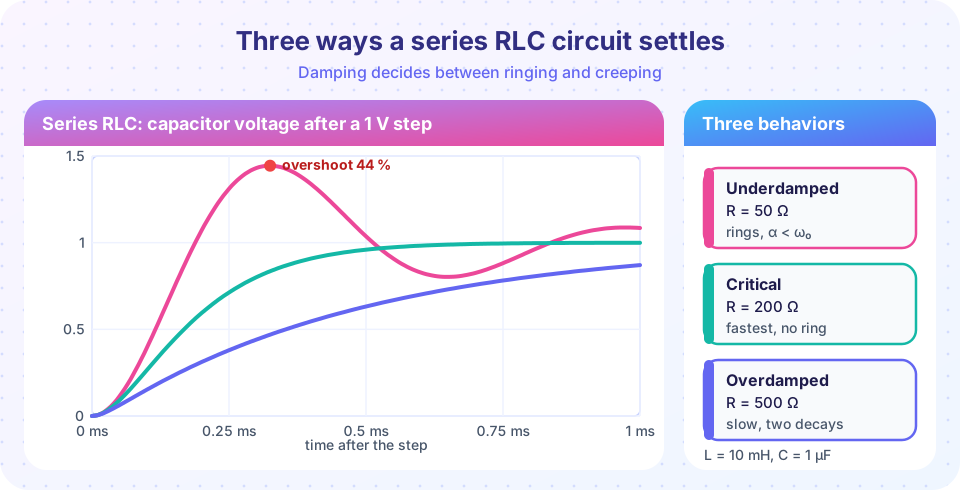
R = 50 Ω (underdamped). α = 2500 s⁻¹, ζ = 0.25. The ringing frequency is ω_d = √(10 000² − 2500²) = 9682 rad/s (1.54 kHz). The first peak occurs at t = π/ω_d = 0.324 ms and overshoots the final value by e^(−απ/ω_d) = e^(−0.811) = 44 %. The oscillation envelope decays with time constant 1/α = 0.4 ms.
R = 200 Ω (critical). α = 10 000. The response reaches the final value as fast as possible without overshoot. This is the design target for many control and measurement circuits.
R = 500 Ω (overdamped). α = 25 000, the roots are s = −25 000 ± √(25 000² − 10 000²) = −25 000 ± 22 913, so s₁ = −2087 and s₂ = −47 913. The slow root s₁ dominates: the response creeps up with a time constant of about 1/2087 = 0.48 ms, slower than the critically damped case.
The picture at the top shows these three curves. Notice that the overdamped circuit has no overshoot, yet is slower than the critical one, and the underdamped circuit reaches the final value first but then rings.
Why ringing matters
- In a digital circuit, ringing on a signal line can create false edges. Designers add series resistors to raise the damping.
- In a radio, ringing is the desired behavior: an LC circuit "rings" at its natural frequency, which is how tuned circuits select a station. The ratio
ω₀ / (2α)is called the quality factorQ; you will meet it again in resonance. - In a power supply, a poorly damped output filter causes voltage overshoot when the load changes.
Initial conditions for the step response
Continuity applies as before: at t = 0⁺, v_C = v_C(0⁻) and i = i_L(0⁻). In the cases above both were zero, so v_C(0) = 0 and v_C′(0) = i(0)/C = 0. For other starting energy you add the "natural response" to the final value and fix two constants from the two initial conditions.
Common misconceptions
"More resistance always means a faster response." Beyond critical damping, more resistance makes the response slower (overdamped).
"The ringing frequency is the natural frequency." It is slightly lower: ω_d = √(ω₀² − α²).
"Critical damping is the only stable case." All three are stable for positive R; they differ in speed and overshoot.
Try it
The first program solves the differential equation numerically for three resistor values and compares the overshoot with the formula.
Press Run (or Ctrl + Enter) to see the result here.
Program input · what you'd type while the program runs
Type the answers before you press Run, one per line. Each time the program reads a line (with input()), it gets the next line from this box.
The second demo lets you drag the resistor and see the response change shape. Find the value where the overshoot just disappears.
Check your understanding
Quick check · 5 questions
of 5 answered You scored / 5 · perfect!
-
1. For a series RLC circuit, the damping coefficient is
α = R/(2L) comes from dividing the circuit equation by LC and matching the standard form. -
2. With L = 4 mH and C = 10 µF, the natural frequency is
ω₀ = 1/√(0.004 × 10⁻⁵) = 1/√(4×10⁻⁸) = 1/(2×10⁻⁴) = 5000 rad/s. -
3. The circuit is critically damped when
Critical damping is the borderline where the two roots coincide: α = ω₀, ζ = 1. -
4. L = 10 mH and C = 1 µF. What is the critical resistance?
R = 2√(L/C) = 2 × √(10⁴) = 200 Ω. -
5. Compared with critical damping, an overdamped circuit
The slow real root dominates, so the response creeps toward the final value without overshooting.
Summary
- Series RLC step response obeys
v_C″ + 2α v_C′ + ω₀² v_C = ω₀² Vswithα = R/2L,ω₀ = 1/√(LC). ζ < 1rings atω_d = √(ω₀² − α²);ζ = 1is the fastest without overshoot;ζ > 1creeps.- Overshoot for the underdamped case is
e^(−απ/ω_d). - Ringing is a nuisance in digital lines and the working principle of tuned circuits.
Next: Chapter 6 review
Track your progress
Create a free account to tick off lessons and pick up where you left off on any device.
of Circuit Analysis lessons completed