


















Lesson 29 of 48 · Capacitors, Inductors and Transients
Chapter 6 Overview: Capacitors, Inductors and Transients
Meet the two circuit elements with memory, learn why voltage or current cannot jump, and get a map of first-order and second-order transient analysis.
Resistive circuits have no past. Change a source and every voltage and current adjusts at once. Add a capacitor or an inductor and that changes: the circuit now remembers, and after a switch flips it takes time to settle into its new state. That settling period is called a transient. This chapter explains why transients happen, how long they last, and what shapes they take.
What you will learn
- What capacitors and inductors store, and the rule that limits how fast they can change.
- What a time constant is and why five of them mean "settled".
- When a circuit responds smoothly (first order) and when it rings (second order).
- Where each topic sits in this chapter.
Key terms
Transient: the temporary behavior of a circuit between one steady state and another.
Steady state: the long-term behavior once all transients have died away.
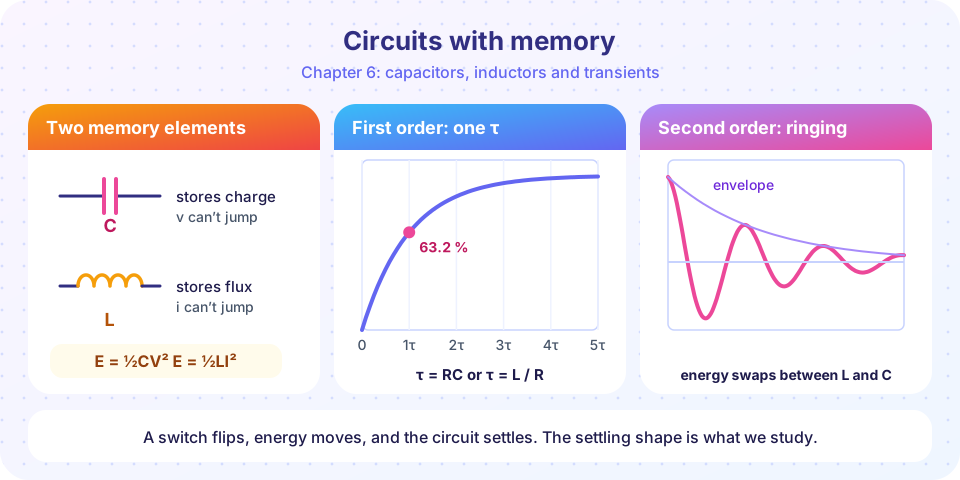
Time constant τ: the characteristic time of a first-order circuit; after one τ the response has covered 63.2 % of its journey.
Order: the number of independent energy-storing elements, which is also the order of the differential equation.
Memory in a circuit
A capacitor stores energy in an electric field between two plates. Its law is i = C dv/dt: the current depends on how fast the voltage changes. An inductor stores energy in a magnetic field around a coil. Its law is v = L di/dt: the voltage depends on how fast the current changes.
Both laws contain a rate of change. If the voltage across a capacitor could jump instantly, dv/dt would be infinite and so would the current, which needs infinite power. In the real world that does not happen, so the capacitor voltage cannot change instantly. By the same argument, an inductor's current cannot change instantly. These two facts are the starting points for every transient calculation.
Two elements with memory
Both store energy and release it later.
Rules that never break
First order
Second order
Energy and the DC steady state
Capacitors store E = ½ C v² and inductors store E = ½ L i². After a long time in a DC circuit all currents and voltages stop changing. Then dv/dt = 0 for a capacitor, so its current is zero and it acts as an open circuit. For an inductor di/dt = 0, so its voltage is zero and it acts as a short circuit. This simple rule lets you find the final state of a circuit without solving any differential equation.
The transient connects the old steady state to the new one. First-order circuits move between them along a single exponential. Second-order circuits can overshoot and oscillate.
Chapter map
| Lesson | What it covers |
|---|---|
| Capacitors and inductors | The two element laws, energy, series and parallel rules |
| RC and RL transients | Time constants, the general first-order formula, worked switching problems |
| Series RLC circuits | Underdamped, critical and overdamped responses |
| Chapter review | Everything mixed together |
Common misconceptions
"A capacitor blocks current." It blocks steady current only. A changing voltage drives current through it.
"The inductor current drops to zero when the switch opens." It tries to stay constant, which is why opening a switch in an inductive circuit can create a large voltage spike.
Try it
This program shows the principle behind all first-order circuits: a capacitor charging through a resistor, solved numerically step by step and compared with the exact exponential. The step size is small, so both curves agree.
Press Run (or Ctrl + Enter) to see the result here.
Program input · what you'd type while the program runs
Type the answers before you press Run, one per line. Each time the program reads a line (with input()), it gets the next line from this box.
The second demo is a tiny charging animation. Press the button to close a switch and watch the capacitor fill along its exponential curve.
Check your understanding
Quick check · 5 questions
of 5 answered You scored / 5 · perfect!
-
1. Which quantity cannot change instantly in a real circuit?
An instant jump in capacitor voltage would need infinite current, so capacitor voltage is continuous. -
2. In DC steady state an inductor acts like
Constant current means di/dt = 0, so the voltage across an ideal inductor is zero: a wire. -
3. In DC steady state a capacitor acts like
Constant voltage means dv/dt = 0, so no current flows. -
4. After how many time constants is a first-order circuit usually considered settled?
After 5τ the remaining error is about 0.7 %, which is negligible in most work. -
5. A circuit with one capacitor, one inductor and a resistor has order
Two energy-storing elements give a second-order differential equation.
Summary
- Capacitors and inductors store energy; capacitor voltage and inductor current cannot jump.
- DC steady state: capacitor = open circuit, inductor = short circuit.
- First-order circuits settle with one time constant; second-order circuits may ring.
- Transients connect the initial state to the final state.
Next: Capacitors and inductors
Track your progress
Create a free account to tick off lessons and pick up where you left off on any device.
of Circuit Analysis lessons completed