


















Lesson 27 of 48 · Network Theorems
Maximum Power Transfer
Find the load that draws the most power from a source. Derive RL = Rth with calculus, compute efficiency, and learn when matching is the wrong goal.
A battery with some internal resistance powers a lamp. If the lamp's resistance is tiny, the current is large, but the lamp drops almost no voltage, so it receives little power. If the lamp's resistance is huge, it takes the whole voltage, but almost no current flows. Somewhere in between, the lamp receives the most power it ever can. The maximum power transfer theorem tells you exactly where.
What you will learn
- The statement: maximum load power occurs when
RL = Rth. - A short calculus derivation you can reproduce.
- How to compute
Pmaxand the efficiency of the transfer. - When matching is a good idea (signals) and when it is a bad one (power delivery).
Key terms
Matched load: a load whose resistance equals the source's Thévenin resistance.
Load power PL: the power dissipated in the load resistor, PL = IL² RL.
Efficiency η: load power divided by the total power the source delivers.
Source resistance: another name for Rth when the source is a real battery, amplifier or sensor.
Setting up
Replace the rest of the circuit by its Thévenin equivalent, Vth in series with Rth, and connect a load RL. The current is
I = Vth / (Rth + RL)
and the power in the load is
PL = I² RL = Vth² RL / (Rth + RL)²
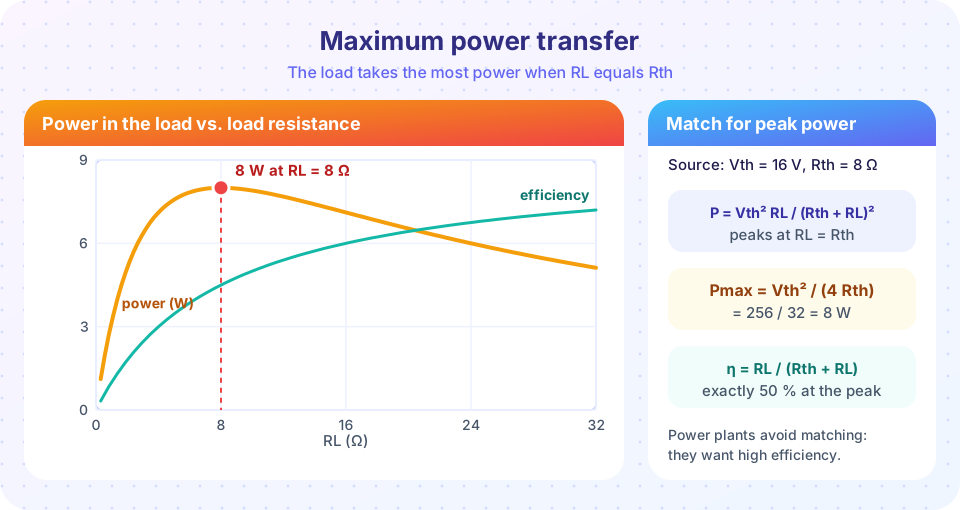
Take Vth = 16 V and Rth = 8 Ω (the equivalent from the Thévenin lesson). Try a few loads:
| RL (Ω) | I (A) | PL (W) | Efficiency |
|---|---|---|---|
| 2 | 1.600 | 5.12 | 20 % |
| 4 | 1.333 | 7.11 | 33 % |
| 8 | 1.000 | 8.00 | 50 % |
| 16 | 0.667 | 7.11 | 67 % |
| 32 | 0.400 | 5.12 | 80 % |
The power climbs, peaks at 8 Ω, then falls. Notice the symmetry: 4 Ω and 16 Ω give the same power, as do 2 Ω and 32 Ω. Their product is Rth² = 64.
Derivation
Differentiate PL with respect to RL and set the result to zero. With Rth and Vth constant:
dPL/dRL = Vth² [ (Rth + RL)² − 2 RL (Rth + RL) ] / (Rth + RL)⁴
The numerator simplifies to (Rth + RL)(Rth + RL − 2 RL) = (Rth + RL)(Rth − RL). It is zero when RL = Rth. For RL < Rth the derivative is positive (power rising), and for RL > Rth it is negative (power falling), so this point is a maximum.
At the maximum:
Pmax = Vth² Rth / (2 Rth)² = Vth² / (4 Rth)
With our numbers: 256 / 32 = 8 W. In Norton terms, Pmax = In² Rn / 4.
Efficiency: the catch
The source delivers Vth × I, of which the load takes I² RL. So
η = RL / (Rth + RL)
At RL = Rth exactly half the power is wasted inside the source resistance. That is fine for a radio antenna, because the signal power is tiny and every bit of it matters. It is terrible for a power station: matching the load to the line would burn half the generated energy in the wires and generators. Power systems are designed for a load much larger than the source resistance, giving efficiencies of 95 % and more.
| Situation | Goal | Choice |
|---|---|---|
| Antenna, microphone, RF stage | Get the most signal power | Match: RL = Rth |
| Audio amplifier driving speakers | High damping and efficiency | Load much larger than the output resistance |
| Battery powering a device | Make the battery last | Avoid matching; keep losses small |
| Power transmission | Minimize loss | Very small Rth, high voltage |
If the load is fixed and the source resistance can change
The theorem assumes Rth is fixed and RL is adjustable. Flip it: if the load is fixed and you can change the source resistance, then PL = Vth² RL / (Rth + RL)² is largest when Rth = 0. Matching is not magic; it only applies to the variable you actually control.
Common misconceptions
"Matching gives the best efficiency." It gives the best power in the load but only 50 % efficiency.
"The theorem says the source delivers the most power at RL = Rth." The source's own delivered power keeps rising as RL falls (until a short circuit). Only the load power peaks at the match.
"Rth is the load's resistance." It is the resistance of the source network seen from the terminals, found with sources off.
Try it
The first program sweeps the load and finds the maximum numerically. Try changing Vth and Rth and check that the peak always lands on RL = Rth.
Press Run (or Ctrl + Enter) to see the result here.
Program input · what you'd type while the program runs
Type the answers before you press Run, one per line. Each time the program reads a line (with input()), it gets the next line from this box.
The second program draws the power and the efficiency curves on one chart, with the peak highlighted.
Press Run (or Ctrl + Enter) to see the result here.
Program input · what you'd type while the program runs
Type the answers before you press Run, one per line. Each time the program reads a line (with input()), it gets the next line from this box.
Check your understanding
Quick check · 5 questions
of 5 answered You scored / 5 · perfect!
-
1. A source has Vth = 12 V and Rth = 3 Ω. What load gets the most power?
Maximum load power occurs at RL = Rth = 3 Ω. -
2. What is the maximum power for Vth = 12 V and Rth = 3 Ω?
Pmax = Vth² / (4 Rth) = 144 / 12 = 12 W. Check: the current is 12/6 = 2 A and 2² × 3 = 12 W. -
3. What is the efficiency when the load is matched to the source?
η = RL / (Rth + RL) = 1/2 when RL = Rth. -
4. Why do power stations avoid matched loads?
Matching gives maximum load power but only 50 % efficiency, which is unacceptable for large power systems. -
5. The load is fixed at 8 Ω and you may adjust the source resistance. To get the most load power you should choose Rth
With Rth in the denominator of the load power, the smallest Rth gives the largest power. Matching only applies when the load is the adjustable part.
Summary
- Load power is
Vth² RL / (Rth + RL)²and peaks atRL = Rth. Pmax = Vth² / (4 Rth), and the efficiency there is exactly 50 %.- Match for weak signals; avoid matching where energy efficiency matters.
- The theorem concerns an adjustable load with a fixed source.
Next: Chapter 5 review
Track your progress
Create a free account to tick off lessons and pick up where you left off on any device.
of Circuit Analysis lessons completed