


















Lesson 14 of 48 · Resistive Circuits and Ohm's Law
Parallel Resistors and the Current Divider
Combine resistors in parallel with conductances, use product over sum for two resistors, split a current with the divider rule, and see why house wiring is parallel.
Plug a kettle into a wall socket and the lights in the room do not dim. That works because the socket is wired in parallel with everything else in the house: each device sits directly across the same supply voltage and takes whatever current it needs. Parallel connections are everywhere, and their mathematics is just as simple as series, once you switch to conductance.
What you will learn
- Why parallel elements share one voltage and how currents add.
- The parallel formula in resistance and conductance forms, and the shortcuts for two or N equal resistors.
- The current divider rule.
- Why household circuits are parallel, and what a circuit breaker does.
Key terms
Parallel connection: elements connected between the same two nodes.
Branch current: the current through one of the parallel paths.
Conductance (G): 1/R, in siemens (S); conductances in parallel add.
Current divider: a parallel pair that splits an incoming current between two branches.
The parallel rule
If elements share the same two nodes, they have the same voltage V across them. Each branch current follows from Ohm's law: I_k = V / R_k. The source supplies the sum of all the branch currents (charge arriving at the top node must go somewhere: Kirchhoff's current law, Chapter 4):
I = V/R1 + V/R2 + … + V/Rn = V · (1/R1 + 1/R2 + … + 1/Rn)
So the combination behaves like a single resistor with
1/Req = 1/R1 + 1/R2 + … + 1/Rn or Geq = G1 + G2 + … + Gn
In terms of conductance, parallel is exactly as simple as series is in terms of resistance: conductances add.
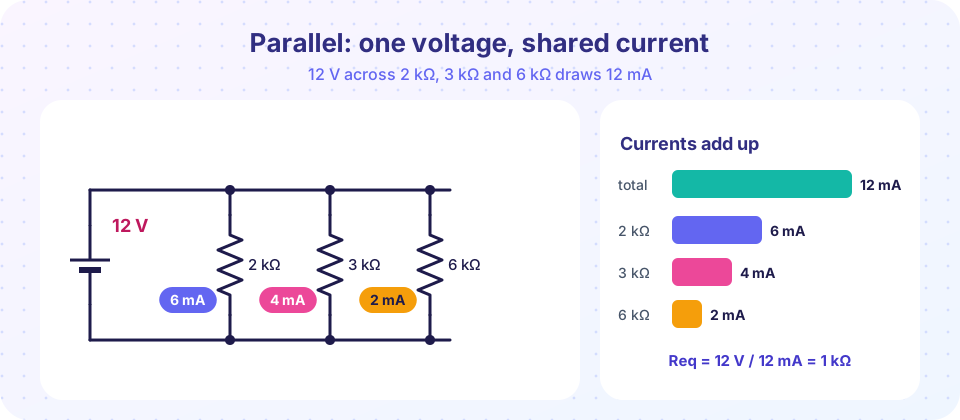
Worked example. 12 V across 2 kΩ, 3 kΩ and 6 kΩ in parallel (the figure). The conductances are 0.5 mS, 0.333 mS and 0.1667 mS, total 1 mS. So Req = 1 kΩ. The source current is 12 V / 1 kΩ = 12 mA. The branch currents are 6 mA, 4 mA and 2 mA, which add to 12 mA ✓. Powers: 72 mW, 48 mW, 24 mW = 144 mW = 12 V × 12 mA ✓.
Useful shortcuts
| Case | Formula | Example |
|---|---|---|
| Two resistors | Req = R1·R2 / (R1 + R2) ("product over sum") | 6 kΩ ‖ 12 kΩ = 72/18 = 4 kΩ |
| N equal resistors R | Req = R / N | five 10 kΩ → 2 kΩ |
| One much smaller | Req ≈ the smaller one | 100 Ω ‖ 1 MΩ ≈ 100 Ω |
| Any resistor ‖ a short | Req = 0 | the short wins |
Three facts to remember:
- Req is always smaller than the smallest branch. Adding a branch can only make it easier for current to flow.
- Product-over-sum works for exactly two resistors. For three, use conductances, or combine two first.
- The smallest resistor carries the largest current.
The symbol ‖ means "in parallel with".
The current divider rule
Two resistors R1 and R2 in parallel share a total current I. The common voltage is V = I · (R1 ‖ R2) = I · R1·R2 / (R1 + R2). Then
I1 = V / R1 = I · R2 / (R1 + R2) and I2 = I · R1 / (R1 + R2)
Notice the cross-over: the current in R1 depends on the other resistor's value in the numerator, because the current favors the easier path. In conductance form it is symmetrical and works for any number of branches:
I_k = I · G_k / (G1 + G2 + … + Gn)
Worked example. A 9 mA current enters a 1 kΩ ‖ 2 kΩ pair. I1 = 9 × 2 / 3 = 6 mA; I2 = 9 × 1 / 3 = 3 mA. The lower resistance carries twice the current.
Compare the two dividers:
| Voltage divider | Current divider | |
|---|---|---|
| Elements | in series | in parallel |
| Shared quantity | current | voltage |
| Rule | Vk = Vin · Rk / Rtotal | Ik = I · Gk / Gtotal |
| Bigger resistor gets | bigger voltage | smaller current |
Why homes are wired in parallel
Mains outlets are parallel branches across a fixed supply (about 120 V in North America, 230 V in most of the world). Each added appliance adds a branch and increases the total current. A kettle rated 1,500 W at 120 V draws 1,500 / 120 = 12.5 A. Two such kettles on one circuit would need 25 A.
Wires heat up as the current grows (P = I²R), so each circuit has a circuit breaker or fuse that opens the circuit above a safe current, such as 15 A. A fuse is deliberately the weakest link in a series path: when the total current is too large, it melts (a fuse) or a bimetal strip trips (a breaker), which breaks the loop and protects the wiring.
Common misconceptions
"Adding a parallel resistor increases the resistance." It decreases it, because it provides an extra path.
"Current takes only the path of least resistance." Current takes all paths, in proportion to their conductance; the lowest-resistance path just gets the largest share.
"Parallel branches share the current equally." They share the voltage. Currents are equal only if the resistances are equal.
"A blown bulb in a parallel string kills the rest." In parallel, one open branch leaves the others untouched, unlike series.
Try it
This solver takes any list of parallel resistors and prints the equivalent resistance, branch currents and powers, then draws the branch currents as bars. Change the values to explore.
Press Run (or Ctrl + Enter) to see the result here.
Program input · what you'd type while the program runs
Type the answers before you press Run, one per line. Each time the program reads a line (with input()), it gets the next line from this box.
Now try overloading a household circuit. Turn appliances on and watch the total current approach the breaker limit.
Finally, check the current divider rule numerically with two and three branches.
Press Run (or Ctrl + Enter) to see the result here.
Program input · what you'd type while the program runs
Type the answers before you press Run, one per line. Each time the program reads a line (with input()), it gets the next line from this box.
Check your understanding
Quick check · 5 questions
of 5 answered You scored / 5 · perfect!
-
1. Four 8 kΩ resistors are in parallel. The equivalent resistance is
R/N = 8 kΩ / 4 = 2 kΩ. -
2. 6 kΩ in parallel with 12 kΩ equals
Product over sum: 72 / 18 = 4 kΩ. -
3. A 12 mA current splits between 1 kΩ and 3 kΩ in parallel. The current in the 3 kΩ resistor is
I = 12 × R_other / (R1 + R2) = 12 × 1 / 4 = 3 mA. -
4. Parallel branches always share
They connect across the same two nodes, so the voltage is common. -
5. A 1,200 W hair dryer and a 1,500 W kettle run on a 120 V, 15 A circuit. Does the breaker trip?
2,700 W / 120 V = 22.5 A, greater than 15 A, so the breaker trips.
Summary
- Parallel elements share the same voltage; branch currents add to the source current.
- Conductances add: Geq = G1 + G2 + …; for two resistors Req = R1R2/(R1 + R2); for N equal ones, R/N.
- Req is always less than the smallest branch.
- Current divider: I_k = I · G_k / G_total; for two branches I1 = I · R2/(R1 + R2).
- Household wiring is parallel, protected by fuses or breakers.
Track your progress
Create a free account to tick off lessons and pick up where you left off on any device.
of Circuit Analysis lessons completed