


















Lesson 17 of 48 · Kirchhoff's Laws and Nodal Analysis
Chapter 4 Overview: Kirchhoff's Laws and Nodal Analysis
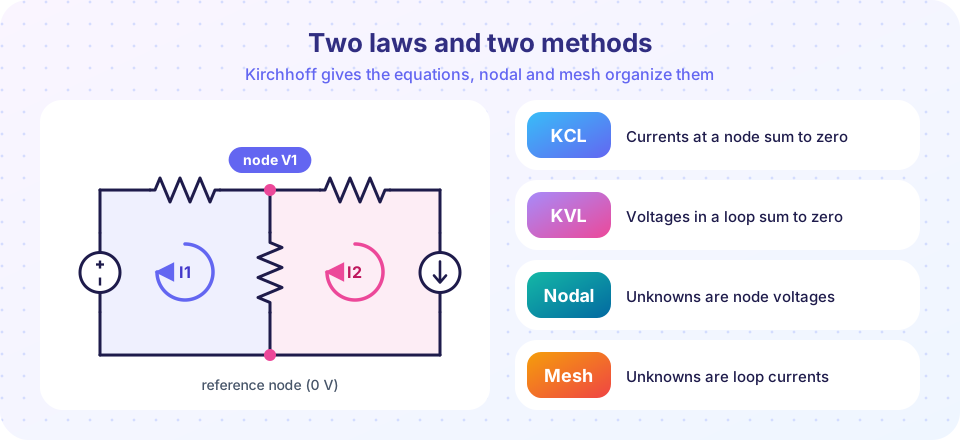
A map of Chapter 4: Kirchhoff's current and voltage laws and the two systematic methods, nodal and mesh analysis, that solve any linear resistive circuit.
Series and parallel reduction is elegant, but it has limits: the bridge circuit would not collapse, and circuits with several sources are awkward. The two laws of Gustav Kirchhoff, published in 1845 when he was a student, remove those limits. With them, you can write down enough equations to solve any circuit, however tangled. The price is a little algebra, and this chapter teaches you to organize it so it becomes routine.
What you will learn
- What the two Kirchhoff laws say and why they are true.
- How nodal analysis and mesh analysis turn a circuit into a few linear equations.
- When to use which method.
- The plan for the chapter's lessons.
Key terms
KCL (Kirchhoff's current law): the currents at a node sum to zero.
KVL (Kirchhoff's voltage law): the voltages around any closed loop sum to zero.
Nodal analysis: choose node voltages as the unknowns and write KCL at each node.
Mesh analysis: choose loop currents as the unknowns and write KVL around each mesh.
Why the laws are true
KCL is conservation of charge: charge cannot pile up at a node, so what flows in must flow out. KVL is conservation of energy: a charge that travels around a closed loop returns to its starting point with the same energy, so the rises and drops in potential must cancel. Both hold for any lumped circuit at any instant, resistive or not. (They fail only when the circuit is so large or so fast that wave effects matter, which is a topic for transmission lines.)
Two laws, two methods
KCL
KVL
Nodal analysis
Mesh analysis
What each lesson covers
- Kirchhoff's Current Law: sign conventions, unknown currents and a first one-node problem.
- Kirchhoff's Voltage Law: walking a loop, finding unknown voltages and path independence.
- Nodal Analysis: the step-by-step method, conductance matrix form, supernodes and dependent sources.
- Mesh Analysis: the dual method, shared resistors, supermeshes and a three-mesh ladder.
- Chapter 4 Review: comparing the methods with a cheat sheet and quiz.
Which method when?
Both methods always work for linear resistive circuits; the choice is about effort.
- Count the nodes (minus one for ground) and the meshes. Pick the method with fewer unknowns.
- Circuits with many current sources favor nodal analysis (a current source fixes a node current directly).
- Circuits with many voltage sources favor mesh analysis (a voltage source fixes a mesh voltage directly).
- Only planar circuits (drawable without crossing wires) have well-defined meshes; nodal works on any circuit.
Common misconceptions
"Kirchhoff's laws apply only to resistors." They hold for any lumped elements: capacitors, inductors, diodes, transistors.
"KVL means all the voltages in a loop are equal." It means they sum to zero when each is counted with its sign.
"A node is a single point in the drawing." A node includes every ideal wire connected to it, wherever it runs.
Try it
Preview what you will learn: the two methods solve circuits by turning them into a few linear equations, and NumPy solves those equations in one line. These are the equations of the two circuits in the pictures. (You will derive them yourself in Lessons 4.3 and 4.4.)
Press Run (or Ctrl + Enter) to see the result here.
Program input · what you'd type while the program runs
Type the answers before you press Run, one per line. Each time the program reads a line (with input()), it gets the next line from this box.
A tiny console helper: given nodes and elements, count the unknowns each method would need. Euler's formula for planar networks says meshes = branches − nodes + 1.
Press Run (or Ctrl + Enter) to see the console output here.
No output.
Check your understanding
Quick check · 4 questions
of 4 answered You scored / 4 · perfect!
-
1. Kirchhoff's current law is a statement of conservation of
Charge cannot accumulate at a node, so currents in equal currents out. -
2. Kirchhoff's voltage law says that around any closed loop the voltages
Rises and drops cancel because energy per charge returns to its starting value. -
3. In nodal analysis the unknowns are
Nodal analysis uses node voltages relative to a reference node. -
4. A circuit has 5 nodes and 8 branches (planar). How many nodal equations (reference chosen) and mesh equations are needed?
Nodal: nodes − 1 = 4. Mesh: branches − nodes + 1 = 8 − 5 + 1 = 4.
Summary
- KCL (charge conservation) and KVL (energy conservation) hold for every lumped circuit.
- Nodal analysis solves for node voltages using KCL; mesh analysis solves for loop currents using KVL.
- Choose the method with fewer unknowns; many current sources favor nodal, many voltage sources favor mesh.
- Both methods reduce to a small set of linear equations.
Next: Kirchhoff's Current Law
Track your progress
Create a free account to tick off lessons and pick up where you left off on any device.
of Circuit Analysis lessons completed