


















Lesson 24 of 48 · Network Theorems
Superposition
Learn the superposition theorem step by step: switch off sources correctly, add the partial answers, and see why power cannot be superposed.
Imagine two people pushing the same shopping cart. To find the cart's final speed you could model both pushes at once, or you could ask what each person would do alone and add the results. For a linear system the two methods agree. The superposition theorem applies exactly this idea to circuits: with several independent sources, find the response to each source acting alone, then add.
What you will learn
- The statement of the superposition theorem and when it applies.
- How to turn off a voltage source and a current source correctly.
- A step-by-step method with a complete worked example.
- Why power can never be found by adding partial powers.
Key terms
Independent source: a source whose value does not depend on any other voltage or current in the circuit.
Short circuit: a wire, zero ohms. A voltage source turned off becomes one, because zero volts across anything is just a wire.
Open circuit: a gap, infinite ohms. A current source turned off becomes one, because zero amps flows through a gap.
Partial response: the voltage or current produced by one source acting alone.
The theorem
In a linear circuit with several independent sources, any voltage or current equals the algebraic sum of the voltages or currents each source would produce acting alone, with all the other independent sources turned off.
"Turned off" has a precise meaning that students often get wrong:
| Source | Turned off means | Replace with |
|---|---|---|
| Independent voltage source | 0 V across its terminals | Short circuit (wire) |
| Independent current source | 0 A through it | Open circuit (gap) |
Think about why. A 0 V battery has the same voltage on both ends, which is what a wire does. A 0 A current source lets no current through, which is what a break in the wire does.
The method
- Pick one independent source; turn off all the others.
- Solve the simplified circuit for the quantity you want. Keep the reference directions fixed.
- Repeat for every source.
- Add the partial results, paying attention to sign.
Worked example
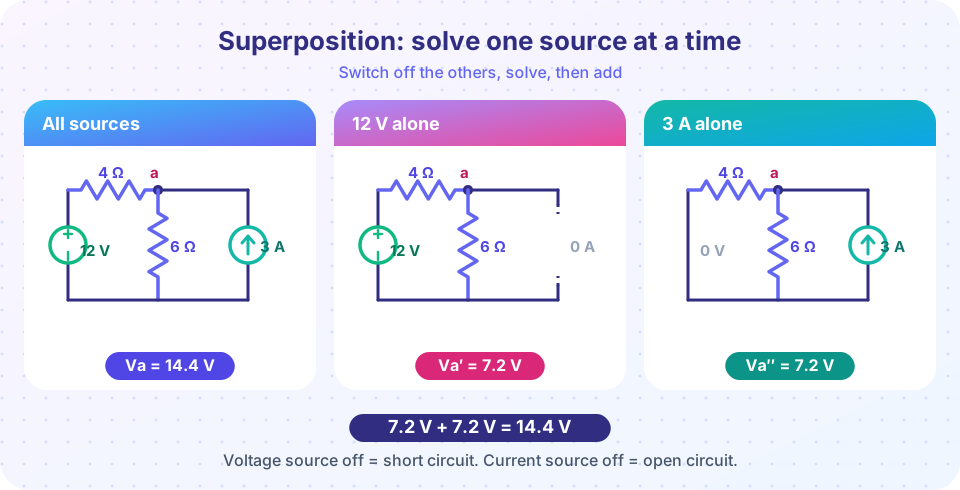
The circuit in the picture has a 12 V source in series with 4 Ω feeding a node a. A 6 Ω resistor connects a to ground, and a 3 A current source pushes current into a from ground. Find Va, the voltage at node a.
Step 1: the 12 V source alone. Replace the current source by an open circuit. Now 4 Ω and 6 Ω form a simple voltage divider:
Va′ = 12 × 6 / (4 + 6) = 7.2 V
Step 2: the 3 A source alone. Replace the voltage source by a wire. The 4 Ω and 6 Ω resistors now both connect node a to ground, so they are in parallel: 4 ∥ 6 = 24 / 10 = 2.4 Ω. The 3 A source drives current through this combination:
Va″ = 3 × 2.4 = 7.2 V
Step 3: add.
Va = 7.2 + 7.2 = 14.4 V
Check with KCL. The current from the 12 V source into the node through the 4 Ω is (12 − 14.4) / 4 = −0.6 A (negative: it actually flows toward the source). Add the 3 A: −0.6 + 3 = 2.4 A flows into the 6 Ω. And 14.4 / 6 = 2.4 A. The books balance.
You can also find the current in the 4 Ω this way: I′ = (12 − 7.2)/4 = 1.2 A toward the node from the voltage source, and I″ = 7.2/4 = 1.8 A away from the node (the current source pushes some of its current backward through the 4 Ω). Net: 1.2 − 1.8 = −0.6 A, the same answer.
Why bother?
For a circuit with two sources the saving is small, since nodal analysis would also take one equation. Superposition earns its place in three situations.
- Mixed signals. A circuit might have a DC bias and a small AC signal at the same time. You analyze the DC part with capacitors open and the AC part with the DC source shorted. This is the foundation of amplifier analysis.
- Understanding. It tells you how much each source contributes, which is exactly what you want when you ask, "which supply is causing this noise?"
- Different frequencies. Sources at different frequencies cannot share one phasor, so each frequency must be solved separately and the time functions added.
Power does not superpose
Look at the 6 Ω resistor in the example. The power with both sources is 14.4² / 6 = 34.56 W. The "partial" powers are 7.2² / 6 = 8.64 W each, and their sum is 17.28 W, only half the real value. The reason is the square: (a + b)² = a² + 2ab + b², and the cross-term 2ab is missing from the sum of separate powers. To get power, first add the voltages (or currents), then square.
Common misconceptions
"Turn a current source off by shorting it." No: a short would let current flow freely. A dead current source is an open circuit.
"Dependent sources get turned off too." Dependent (controlled) sources must stay in the circuit during every step; only independent sources are switched off.
"Add the powers." Never. Add voltages or currents, then compute power from the total.
Try it
The first program applies superposition to the example and checks it against the full nodal solution. Change the source values and see that the two methods always agree.
Press Run (or Ctrl + Enter) to see the result here.
Program input · what you'd type while the program runs
Type the answers before you press Run, one per line. Each time the program reads a line (with input()), it gets the next line from this box.
The second program draws how the node voltage grows as you sweep the voltage source from 0 to 24 V with the current source fixed at 3 A. The total is a straight line made of a rising part and a constant part.
Press Run (or Ctrl + Enter) to see the result here.
Program input · what you'd type while the program runs
Type the answers before you press Run, one per line. Each time the program reads a line (with input()), it gets the next line from this box.
Check your understanding
Quick check · 5 questions
of 5 answered You scored / 5 · perfect!
-
1. To switch off an independent current source for superposition you replace it with
A current source of 0 A passes no current, which is what a gap in the wire does. -
2. To switch off an independent voltage source you replace it with
A source of 0 V forces zero voltage between its terminals, exactly like a wire. -
3. In the worked example the 12 V source alone gives 7.2 V at node a. What does the 3 A source alone give?
With the voltage source shorted, 4 Ω and 6 Ω are in parallel (2.4 Ω), and 3 A through 2.4 Ω is 7.2 V. -
4. Why can you not add the powers from separate sources?
(a + b)² contains the cross-term 2ab, which is lost when you add a² and b² separately. -
5. A circuit contains a controlled (dependent) source. During superposition you should
Dependent sources are part of the circuit's structure and must remain; only independent sources are switched off.
Summary
- Superposition: response of a linear circuit = sum of responses to each independent source alone.
- Voltage source off = short circuit; current source off = open circuit; dependent sources stay.
- Works for voltages and currents; never for power.
- Most useful for mixed DC and AC signals and for seeing each source's contribution.
Next: Thévenin's theorem
Track your progress
Create a free account to tick off lessons and pick up where you left off on any device.
of Circuit Analysis lessons completed