


















Lesson 12 of 48 · Resistive Circuits and Ohm's Law
Ohm's Law and Resistors
Learn Ohm's law V = I·R, the V-I graph, power forms, conductance, wire resistance, resistor color codes and why some devices do not obey the law.
In 1827 the German teacher Georg Simon Ohm published the result of careful experiments with wires and a voltage source: for a metal conductor at constant temperature, the current is proportional to the applied voltage. The proportionality constant is the conductor's resistance. The relation that carries his name is the most used equation in electronics, and this lesson shows how to use it with confidence.
What you will learn
- Ohm's law in its three forms and how to read a V-I graph.
- Power in a resistor: P = V·I = I²R = V²/R.
- Conductance, resistivity and the resistance of a wire.
- How to read a resistor color code, and when Ohm's law does not apply.
Key terms
Ohm's law: V = I · R for an ohmic resistor.
Resistance (R): V/I, in ohms (Ω).
Conductance (G): 1/R, in siemens (S).
Resistivity (ρ): a material property; the resistance of a wire is R = ρ·L/A.
Tolerance: the allowed percentage error in a resistor's value.
The law
For a resistor with voltage v across it and current i through it (current entering the + terminal, the passive convention):
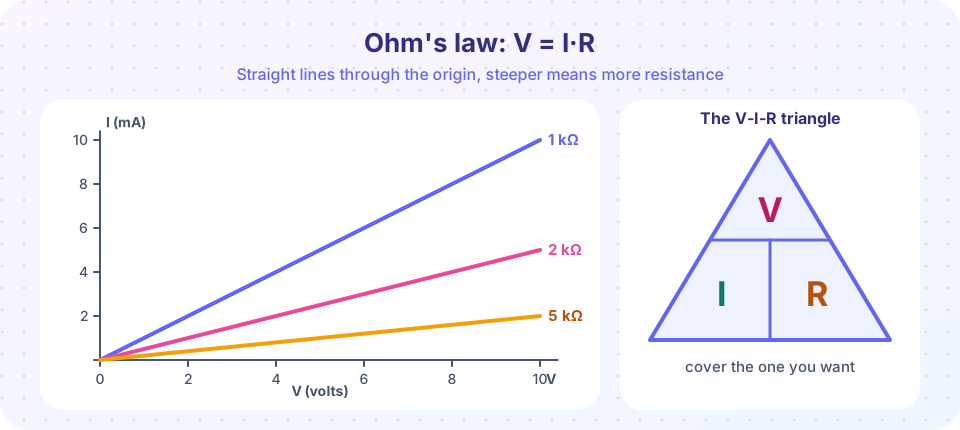
V = I · R I = V / R R = V / I
The V-I graph is a straight line through the origin, and the slope of I against V is 1/R. A larger resistance gives a flatter line (less current for the same voltage). One ohm is one volt per ampere.
Worked example 1. A 220 Ω resistor is connected to 5 V. I = 5 / 220 = 22.7 mA.
Worked example 2: LED resistor. An LED needs about 10 mA and drops about 2 V when lit. You have a 5 V supply. The resistor in series must drop the other 3 V, so R = 3 V / 0.010 A = 300 Ω. Its power is P = V·I = 3 × 0.010 = 30 mW, far below the ¼ W rating of a small resistor. (A standard value near 300 Ω is 330 Ω, which gives 9.1 mA.)
Worked example 3. A heater element has 24 Ω and carries 5 A. Voltage across it: V = 5 × 24 = 120 V. Power: P = I²R = 25 × 24 = 600 W.
Conductance
Sometimes it is easier to think about how well a part conducts. Conductance G = 1/R, measured in siemens (S). A 2 kΩ resistor has G = 0.5 mS. In terms of G, Ohm's law becomes I = G·V. Conductances will be the natural unit for parallel circuits (Lesson 3.3) and for nodal analysis (Lesson 4.4).
Power in a resistor
Combine p = v·i with Ohm's law:
P = V·I = I²·R = V²/R
All three are equal. Pick the one that uses the quantities you know. The power is always positive for a resistor: it absorbs energy and turns it into heat. Resistors are rated for a maximum power (commonly ⅛, ¼, ½, 1 W): exceed it and the part overheats.
Where resistance comes from
For a uniform wire of length L and cross-sectional area A made of a material with resistivity ρ (in Ω·m):
R = ρ · L / A
Longer wire resists more; thicker wire resists less. For copper at room temperature ρ ≈ 1.68 × 10⁻⁸ Ω·m. A 100 m run of 1 mm² copper wire (A = 10⁻⁶ m²) has R = 1.68 × 10⁻⁸ × 100 / 10⁻⁶ = 1.68 Ω. At 5 A that wire drops 8.4 V and wastes 42 W as heat, which is why long cables for heavy loads must be thick.
Resistivity depends on temperature: for metals it rises with temperature, which is why a bulb filament's resistance is much higher when hot than when cold.
Resistor color codes
Through-hole resistors carry colored bands. For the common four-band type, the first two bands are digits, the third a multiplier, the fourth the tolerance.
| Color | Digit | Multiplier | Tolerance |
|---|---|---|---|
| black | 0 | ×1 | |
| brown | 1 | ×10 | ±1% |
| red | 2 | ×100 | ±2% |
| orange | 3 | ×1 k | |
| yellow | 4 | ×10 k | |
| green | 5 | ×100 k | |
| blue | 6 | ×1 M | |
| violet | 7 | ×10 M | |
| grey | 8 | ||
| white | 9 | ||
| gold | ×0.1 | ±5% | |
| silver | ×0.01 | ±10% |
Example: yellow, violet, red, gold = 4, 7, ×100, ±5% = 4,700 Ω ± 5% = 4.7 kΩ. With 5% tolerance the true value lies between 4,465 Ω and 4,935 Ω. Resistors come in preferred series (E12: 10, 12, 15, 18, 22, 27, 33, 39, 47, 56, 68, 82 and their decades) so every value is within tolerance of a standard one.
When Ohm's law does not apply
Ohm's law is a model, not a law of nature. Components for which V and I are proportional are called ohmic; others are non-ohmic:
- A filament lamp: resistance rises as it heats, so the V-I curve bends.
- A diode or LED: almost no current until a threshold voltage (about 0.6-0.7 V for silicon, about 1.8-3 V for LEDs), then current rises very fast.
- A thermistor or LDR: resistance changes with temperature or light.
Even for those parts, the quantity V/I at one operating point can be called their resistance there; it is simply not constant.
Common misconceptions
"Resistance is determined by the voltage across it." For an ohmic part R is a property of the part; voltage and current adjust to it.
"R = V/I means doubling V doubles R." R stays fixed for an ohmic resistor; doubling V doubles I.
"Resistors reduce current in the wire before them." In a single series loop the current is the same everywhere; the resistor does not "use up" current.
"Higher tolerance number means better." A tolerance of ±1% is more accurate than ±10%.
Try it
Compare resistors on one chart and find the operating point. The plot shows three V-I lines and annotates the current each draws at 8 V.
Press Run (or Ctrl + Enter) to see the result here.
Program input · what you'd type while the program runs
Type the answers before you press Run, one per line. Each time the program reads a line (with input()), it gets the next line from this box.
Now a three-way solver. Enter any two of voltage, current and resistance (leave the third blank) and it fills in the missing one, plus the power.
Finally, a color-code decoder. Change the list of bands to decode your own resistor.
Press Run (or Ctrl + Enter) to see the result here.
Program input · what you'd type while the program runs
Type the answers before you press Run, one per line. Each time the program reads a line (with input()), it gets the next line from this box.
Check your understanding
Quick check · 6 questions
of 6 answered You scored / 6 · perfect!
-
1. A 470 Ω resistor has 9 V across it. The current is
I = 9 / 470 = 0.01915 A = 19.1 mA. -
2. An LED drops 2 V and needs 10 mA from a 5 V supply. What series resistor is required?
The resistor must drop 5 − 2 = 3 V at 10 mA: R = 3 / 0.01 = 300 Ω. -
3. Which resistor color code (4 bands) means 4.7 kΩ ±5%?
Yellow (4), violet (7), red (×100) = 4,700 Ω; gold = ±5%. -
4. A 100 Ω resistor dissipates 4 W. The current through it is
P = I²R, so I = √(P/R) = √(0.04) = 0.2 A. -
5. Doubling the length of a wire of the same material and thickness
R = ρL/A is proportional to length. -
6. Which device is non-ohmic?
A diode's V-I curve is strongly nonlinear.
Summary
- Ohm's law: V = I·R, I = V/R, R = V/I. Conductance G = 1/R in siemens.
- A resistor's power is P = VI = I²R = V²/R, always positive.
- Wire resistance R = ρL/A; copper has ρ ≈ 1.68 × 10⁻⁸ Ω·m.
- Color bands encode value and tolerance; many devices (diodes, lamps) are non-ohmic.
Track your progress
Create a free account to tick off lessons and pick up where you left off on any device.
of Circuit Analysis lessons completed